12 February, 2018

[Real] Rabbi Syme: Continued!

My previous post about [the Real] Rabbi Syme generated a wonderful internet "moment—" one of those lightning-in-a-bottle experiences where the internet proves to be truly connective. I wrote the post in response to questions I received through the course of my book tour, and online: is the Rabbi Syme (Perchik's teacher and advocate) of After Anatevka at all connected to a real person, particular a man named Rabbi Daniel Syme of Bloomfield Hills, Michigan?

The answer: yes. To briefly quote my previous post:

Fictional Rabbi Syme is based very loosely upon the real-life Rabbi Syme—loosely because my description in the novel is not so much a literal, but more of an evocative recollection and honoring of his influence. Real-life Rabbi Syme and I only spent a collection of minutes together in 2001, but they were crucial minutes. He gave me the gift of delivering the eulogy at my father's funeral service, as well as bearing witness to it when he lead the funeral service, and above all, he gave me an hour of his time months later, reminding me of what was eternal, and chartering a map toward the beauty, strength and individuality my faith. Irreplaceable gifts one can never forget. The influence of Rabbi Syme proves another true-to-life maxim: that we never know the depth of the influence we have upon one another

I then followed this by recounting a crucial memory of the real Rabbi Syme.
Keep in mind that I have not seen, heard from, been in touch with dear Rabbi Syme since 2001. Nearly 17 years.
I pressed "publish." 
I posted the blog's link to a few social media places.
The link was shared on Facebook.
Then again.
And before long?
An email in my inbox was sitting there from the real Rabbi Syme.
This was followed by a save-it-forever voicemail.
And finally, a phone call that, at long last, completed a circle I never even dreamed would reach its resolution.

Then today...

Today I gave a book talk at Temple Beth Israel in West Bloomfield, Michigan—only a few miles away from Birmingham, the suburb of Detroit in which I grew up, and in fact, from Bloomfield Hills, where Rabbi Syme and I first met.

My talk went on, and as usual, I concluded with a reading. Whenever one of my book events is located in a temple I like to read the following passage and tell the audience a little about the real Rabbi Syme. How the character came to be and how this was my form of honoring the man who was my father's advocate, and thus, artistically, Perchik's.  I read:
  
     “Free a man of the constraints that limit and inhibit his development, and you have a free human being. Freedom is the natural state of man.” He looked away from the boy for a moment and recalled his youth, his own search for self. “My boy,” he imparted with a ferocious passion that shook them both by the throat, “there is nothing negative about our human potential—do you understand me? God Himself created you the way you are. Do not let anyone in this world convince you otherwise. And you are capable of anything, my boy. There is and shall always be a disparity among the gifts God has granted men, but we all deserve equal consideration. All men, no matter how low, how basic, or how tormented, deserve compassion, dignified brotherhood, and respect.
     “But part of respecting all men is respecting ourselves. Recognizing that God has blessed you. By embracing these gifts, we live as God lives, with love for all He has created—with an open heart.
     “Thus our Sages have said: ‘In every generation, a person must see himself as if he has himself come out from Mitzrayim.’ You, of course, know what Mitzrayim, this Hebrew word used for ‘Egypt,’ means, do you not?”
     “Boundaries,” the boy said quietly.
     “It does indeed—and the effort to free ourselves is a perpetual one.”
     The rabbi removed his spectacles and looked deeply into the eyes of the boy. “I promise you, Perchik: you are a truly blessed child of our Lord. I promise you will find the strength to overcome the oppression of your circumstances. This fight is your purpose—the strength for it inherent within you. Like rocks of salt shaken in water, the turbulence soon asserts itself in perfect order. My boy, you are supported by the greatest parent of them all. As it is He who has endowed you with your gifts, you can be sure that He, therefore, believes in their power. And for the record, my boy, so do I.”

Reader?
The real Rabbi Syme... was there.
In the audience.

Coming up in line as I signed copies of the novel that honors him in character, and thanks him in the acknowledgments, came the real-life, breathing man who bears the name Rabbi Daniel Syme.

We reunited.
Embraced.
Cried.

What other proof do we need that miracles happen?
Because they do.
Happen.


11 February, 2018

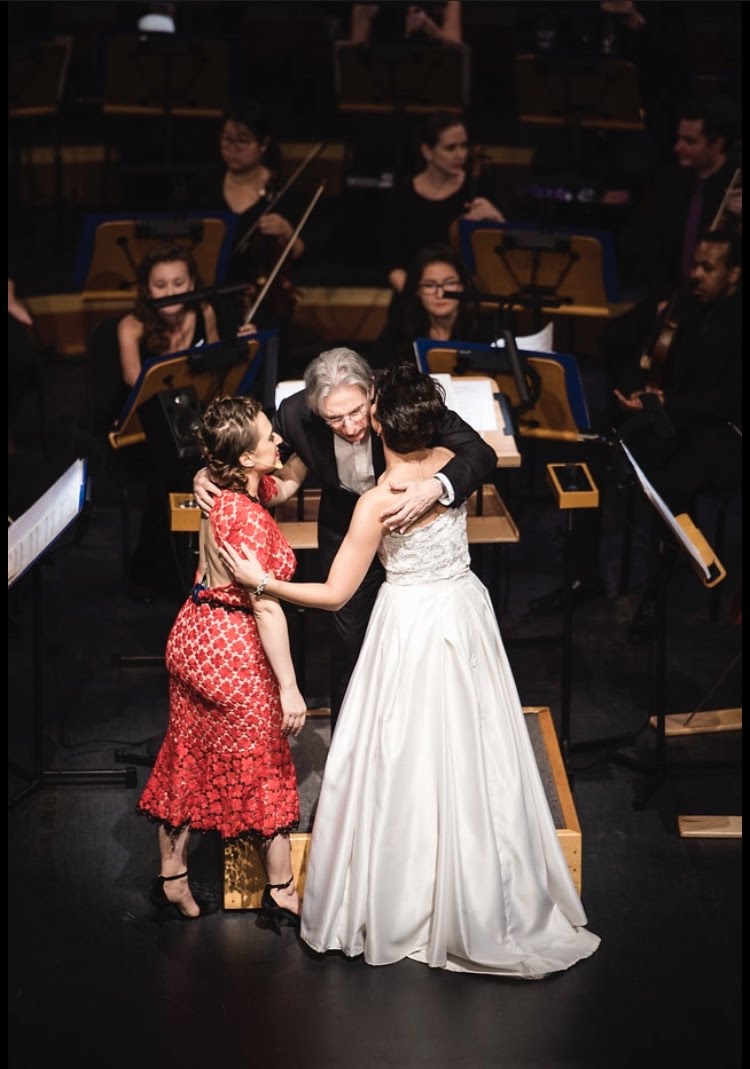
New World Symphony Gala

Tonight tonight...
Oh what a night. 

Happy 30th Birthday, New World Symphony.

The New World Symphony, America's Orchestral Academy (NWS), prepares graduates of music programs for leadership roles in professional orchestras and ensembles. In the 29 years since its co-founding by Artistic Director Michael Tilson Thomas and Lin and Ted Arison, NWS has helped launch the careers of more than 1000 alumni worldwide. A laboratory for the way music is taught, presented and experienced, the New World Symphony consists of 87 young musicians who are granted fellowships lasting up to three years.

The fellowship program offers in-depth exposure to traditional and modern repertoire, professional development training and personalized experiences working with leading guest conductors, soloists and visiting faculty. Relationships with these artists are extended through NWS's extensive distance learning via the internet. NWS Fellows take advantage of the innovative performance facilities and state-of-the art practice and ensemble rooms of the Frank Gehry-designed New World Center, the campus of the New World Symphony and home of the Knight New Media Center.

In the hopes of joining NWS, more than 1,500 recent music school and conservatory graduates compete for about 35 available fellowships each year. The Fellows are selected for this highly competitive, prestigious opportunity based on their musical achievement and promise, as well as their passion for the future of classical music.
What a joy and honor to reunite with Michael Tilson Thomas, and dear friends Jessica Vosk, and Tony Yazbeck.

The set list was as follows:

Overture to Candide
From On the Town: "Lucky to be Me" - Mr. Yazbeck
"I Get Carried Away" - Mr. Yazbeck and Ms. Silber
Coney Island Dream Sequence
"I Can Cook Too" - Ms. Vosk
From West Side Story: "Somewhere" - Ms. Silber
"A Boy Like That/I Have a Love" - Ms. Vosk and Ms. Silber
Symphonic Dances

We flew.
We ate.
We laughed.
We sang.
We danced the night away in Miami.
All with friends.And the universal language of music.


02 February, 2018

“Health-i-versary!”

Today is my 6-month “Health-i-versary.”

What does that mean..?

Hello. My name is Alexandra Silber and I have an auto-immune disease.

So what does that mean..?

The immune system normally guards against germs like bacteria and viruses. When it senses these foreign invaders, it sends out an army of fighter cells to attack them.

In an autoimmune disease, the immune system mistakes part of your body — like your joints, thyroid, pancreas, colon or skin — as foreign or contaminated. Thus, at its simplest, an autoimmune disease is when your body's immune system (usually there to protect you from disease and infection) over-reacts and instead of attacking diseased or unhealthy cells, attack the healthy ones (including tissue and organs) by mistake. This over-reactive response is like a broken switch: once the alarm system is turned on, it difficult (and sometimes impossible) to turn off. The body releases proteins called autoantibodies that attack healthy cells ad infinutum—the attack upon the healthy tissue continues on and on until the tissue wears away and the organs start to fail.

Doctors don’t yet know what causes the immune system misfire. (which is...not...awesome...). Factors that make an individual susceptible can be based on family history, gender, ethnicity, diet, and lifestyle; but also, due to the incidence of autoimmune diseases dramatically on the rise, researchers suspect cultural and environmental factors to possibly be involved.

Initial symptoms can be sneaky and vague at first, and in today's "power through" culture, they can be very easy to ignore until it is far too late. May I recommend, from experience, to... not do that. If you have any sudden changes in your overall health (however mild, and whatever it may be) track your symptoms, ask about family history, do an internet search (or three), and get thee to a doctor! Then? Get a second opinion. (For a basic guide to more efficiently diagnosing an auto-immune disorder try this link.)

Some autoimmune diseases target only one organ (Type 1 diabetes, for example, exclusively damages the pancreas) other diseases, like lupus, affect the whole body. There are over 80 known autoimmune diseases, many with similar symptoms, which can make them difficult to diagnose and treat until the symptoms are severe. It is often a challenging trial-and-error of medications, major lifestyle changes, side-effects and possible surgeries.

2013: the start of my health journey to MORDOR.
I won't go into detail about my specific disease and the nitty-gritty of its consequences, but I will tell you that over the last few years, my health journey has brought me to:
- 11 colonoscopies
- 3 surgeries
- 2 blood transfusions
- 2 iron infusions
- 1 near-death experience
- 9 medications (including chemotherapy and the life-saving but life-ruining drug prednisone)
- 4 hospitals (including a trip to the Mayo Clinic)
- countless side effects
- and over 16 different doctors—
and today, this health-i-versary means, that, I have been healthy for 6 months in a row—for the first time since 2013.

I’ve lost time, sleep, my beloved hair, my singing voice, my dignity, my personality, so much weight, foods I loved, many friendships, important relationships familial and romantic, and some very real innocence; but I’ve gained an appreciation for being alive in ways I lack language for.

Today we often only choose to share our joys on the internet and social media. Trust me when I tell you this has been a terrifying private journey, one filled with so much uncertainty. I have not had answers to so many of my health questions, thus did not feel confident sharing the truth in its entirety until I was more confidently on the other side. (I also did not want to court anyone's rogue advice—however well-meaning!)

Today, in this joy I also admit the very real struggle, but the exhilarating triumph of a fight well won. There is no cure for an autoimmune disease, but remission is possible! Today, I’ve achieved a 6-month version of that. Now it’s about maintaining it. 

This health triumph would not be possible without my main (SUPERHERO) physician, Dr. Steven Fochios, the Mayo Clinic, Mount Sinai Hospital, my incredibly brave mother, a sense of humor, and a very small circle of friends who knew (and bore witness to) what was actually going on. Some of these people held me while I wept, helped me change my diet, stayed awake with me all night, and once, even carried me up the four flights of stairs to my apartment when I was too weak to walk after a two-show day at Fiddler on the Roof on Broadway. 

Dad.
I also felt extraordinarily close to my father during the darkest days. What I endured is likely 1-1000th of what my father had to physically and mentally go through, and I do not even have a spouse and child to leave behind should I not survive. But the uncertainty, the physical pain, the endless tests and hospitals and unknowns... I experienced an empathy for what he went through in his last years, a full immersion of understanding I feel so grateful for. What my father fought for, fought against, what he physically did and endured to remain alive in the face of unnameable uncertainty is something I now understand in my marrow.

Whoever you are, no matter how low, know this: being fully alive is worth fighting for. I had no idea how much I wanted to live until the option of not being alive was truly presented to me. "Okay Al," said Life, "You wanna be here? Act like it." So I did everything in my power to do just that. (This is my gentle reminder to... stop "powering through" and maybe go to the doctor like a damn adult.)

Don't get me wrong. I lost many things—friendships, (not-cute amounts of) weight, my precious hair, a very important relationship, dignity, inclusion in social events, money, probably some people's patience, understanding, and respect.

But I also did some extraordinary things while ill—sang at Royal Albert Hall (twice!), and San Francisco Symphony (twice!), Carnegie Hall, Caramoor, Disney Hall, did a solo show for a week in London. I rehearsed and opened a 3 hour Broadway musical and consistently did 8 shows a week. I taught time (and overtime) at Pace University (and even continued to teach during the run of Fiddler...WTF...), staged two readings of my adaptation of Antigone, recorded the Arlington cast recording, sold two books—a novel and memoir, and published one (the other soon to come), and all the while managed, somehow, to stay awake, not to die and even keep a few friends and not kill my cat

Show up.
 I say this to merely share this simple truth: we are limited in life only by what we believe we are capable of. I know I know, I can already see you rolling your eyes over there! But reader trust me: I had days when it hurt to breathe. When I could not physically stay awake for more than 3 hours at a time (no amount of coffee or sugar would fix this level of medical fatigue). Days when I could not stop shaking from the intensity of the pain. When the weakness and starvation I experienced were so intense I lacked the capacity to even shed tears or cry out. 

But reader? I showed up. To work. To life.

I am not remarkable. No. I am a human being just like you—capable of everything from the most deplorable of errors to the vastest glories. As are we all.

But when we stare down the black infinity of not being on earth anymore, we experience the most considerable democracy of all: the democracy of mortality. We all—no matter how wealthy, beautiful, talented, kind, willful, adveturous—die. 
We all die. 
You will, someday, die. 
And in the end, we all must face the same questions: 
Was I brave? 
Did I use my gifts? 
What did I believe in? 
What did I stand for? 
What did I stand against?
Did I do what truly mattered?  
Did I say yes to life? 
And above all, did I love enough

As mentioned before, there is no cure for autoimmune diseases—only remission and maintenance. But know this: though there will be setbacks, I look forward to many more healthy, fully-lived, days to come. 

Onwards, with courage and integrity.

©Emma Mead

31 January, 2018

'Dust of Snow' by Robert Frost

The way a crow

Shook down on me

The dust of snow

From a hemlock tree
Has given my heart

A change of mood

And saved some part

Of a day I had rued.


25 January, 2018

Robert Burns Night

On 25 January every year, Scots and Scots-at-heart come together to celebrate the life and works of Scotland's national poet, Robert Burns.

The first Burns night was celebrated in 1801, when a group of Burns' friends came together at his childhood home to celebrate the life of their friend. In the more than 200 years since then, this tradition continues to grow as the influence of Burns' work has spread across the globe.

Today, people in countries all round the world who have been captivated by his haunting verses come together on his birthday, 25 January, to celebrate his life and works. Traditional Scottish food and drink is blended with some of Burns' best-known poems to create a truly memorable experience for everyone involved.

The end of the party: JOY.
Born in Ayrshire in 1759, Robert Burns is Scotland's national bard. Affectionately known as 'the Ploughman Poet', his verses stand as a fitting testament to Scotland's proud literary history. Here's a selection of his greatest works:


And, Robert Burns Night was the very first party of the "one party a month" plan for my 2018 goal. 

Josh playing.
What a way to begin the year! Good food, good whisky, good music, good cheer and good poetry; there's no experience quite like a Burns Night celebration. Whether you're addressing the haggis or the 'lassies', or you dont know your kilts from your ceilidhs, that is a-ok, because all are welcome at Chez AlSilbs.
 

The centrepiece of any good Burns Supper menu is the iconic haggis, or as the bard himself described it, the 'great chieftain o' the puddin'-race'.  And of course, whisky is the usual choice at Burns Suppers, either malts or blends. Contrary to popular belief, adding a little water to your malt may improve rather than dilute the flavour, although some whisky drinkers may not take kindly to watering down their drams! 
 

But the best (and certainly my favorite) part of Burns Night is the traditional poetry recitals. These include Burns classics (above) especially the 'Address to a Haggis' (recited by my dearst Tzeitl WHO FLEW OVER ESPECIALLY FROM SCOTLAND, Frances Thorburn). Other recitals on the evening include contemporary Scots poetry, and of course, traditional music (which filled my home thanks to all the signers, and friends playing the accordion, oboe and cello!)
all the signs of a good party

16 January, 2018

Questions from Book Tour, Part 3

1. What are the main differences between working in the two art forms: performance versus writing?

It’s fascinating. Two major observations.

The first is the difference between the social versus private nature of both art forms. (These are not exclusive observations and, of course, there are exceptions).

The theater is an innately social art form— created in collaboration with others, and enacted in the presence of others. Though I suppose you can technically recite speeches into thin air, that is not why theatre was created. In Ancient Greece, the theatre was born out of the need for communal catharsis— a shared cleansing of the mind and spirit, performed to and for the people. Aristotle defined it as “the purification of the spirit…by witnessing the playing out of such emotions or ideas on stage.” The result is personal, as well as sociological, positive change. Therefore it is an art form that cannot be created or experienced in solitude.

Literature is the opposite. Its nature is of solitude— both in its creation and in its consumption. It is an art that must occur within the confines of an author’s inner world. Though collaboration may occur in the later parts of the process, the majority of the writing experience takes place (necessarily) in utter solitude, quietly attempting to capture a universe before it escapes from your fingers. Further, literature (specifically) is experienced in solitude. The relationship between a writer and her reader is among the more intimate relationships that exist. The reader is being taken on a journey, often experiencing many emotions along the way, all taking place within the confines of the “theatre” of their imaginations. Writer and reader in a private, intimate space for a period of time. I have relationships with authors I will never know or meet, but have had more of an impact on my life than certain boyfriends or family members.

The second has to do with the form of creativity that is exercised.

Both art forms are, of course, creative. But being an actor in the theater is, at its essence, an interpretive creative art form— one is interpreting (and hopefully, elevating and breathing very real life into) characters that one did not write, dress, light, or direct. Your role in the creative process is to interpret. This is in no way to diminish this art form, it is merely to clarify it. Interpretive artists are among our highest contributors in society, shedding an illuminative light upon the intricacies of life.

Whereas writing, I contrast, is innately creative. A story, a character, a sentence, did not exist before the writer created it.

Something about these artist dichotomies deeply enriches me— it provides a satisfaction across the spectrum of creativity. I wouldn’t want to be without one now that I’ve tasted the gratifications of both.


2. What is the reaction of readers who attend your book signings and events? 

I’d say less than 5% of interactions are a little unpleasant and have included such gems as cornering me about politics, presenting me with pages of critical notes they have on my book (one woman even told me she’d “wait” so she could go through them with me in person, thought by thought), pearl-clutching about the darkness of the book, dozens of people trying to set me up with their grandson/the Rabbi’s son/literally anyone. Those were mostly sort of hilarious and happened quite rarely (okay, the setting-me-up part happens every time...). But pah! Worth it.

The best parts are always meeting people who have had an emotional experience with your book, who have spent hours in this world that prior to a year ago, only I lived in. Now these characters that I love as if they were real, are known and sometimes loved by others. These readers share their insights, stories, their vulnerabilities, and reflections, and sometimes illuminate my own work to me in a way I had never considered.

Further, though many of these people are incredibly cultured, not all of them would have the chance or funds to make it to a theatre, let alone a Broadway theatre, let alone to the stage door after the show. I am meeting so many people I would never otherwise cross paths with because literature is the ultimate democratic art form—thanks to libraries, the written word is accessible to all. There have been some people I met in Austin, St. Louis, Naples, Saratoga Springs, that I have formed lifelong connections with, and will be indebted to for the rest of my life. Connections I would not otherwise have.

Above all, I endeavor to share my story with as much authenticity as I can with both the organizers and the attendees of these events, and when they respond with the same generosity back, when they hold your personal story and honor the depth of love that went in to creating a project like a novel, there is no greater transaction— gratitude always begets gratitude.


3. Other than writing, have you got any hidden passions you’d like to pursue?

I love the accordion and have taken lessons! I passionately love travel of all kinds— Antarctica is at the top of my list.

I would also love to spend more time creating visual art of some kind— I once took a collage workshop with my idol Nick Bantock several years ago now, and I’d love to try my hand at engaging with the visual on a more consistent basis. But apartment living + curious cat = not conducive? Still worth a try! I just have visions of Tati-shaped paint paw prints all over the place…


4. Do/did you feel any extra responsibility or pressure playing and writing about Hodel/Tzeitl in London/Broadway— seeing as they are among very few overtly Jewish characters in musical theatre?

I believe that if you portray any character or story with honesty, authenticity, and vulnerability, the work will resonate. Our only responsibility as artists is, to tell the truth.


5. Your next book is White Hot Grief Parade, about the death of your father. How has After Anatevka impacted that book?

They say that all fiction is in some way non-fiction, thus, yes, these two works are very much companion pieces.

The writing of After Anatevka felt like a necessary personal exercise for me because of the extraordinary significance playing Hodel had in my personal life. That significance was directly related to my experience playing Hodel, and “saying goodbye” to him every day (whilst singing “Far From the Home I Love”)— an experience I felt robbed of in my actual life, approximately five years after the death of my father. White Hot Grief Parade is a direct account of the experience of that loss.

So you see, one could not truly have happened without the other. In fact, if I were to chart the writing in real-time: I wrote the first two-thirds of After Anatevka very quickly, got terrible writer’s block for over a year, marked the 10th anniversary of my father’s death, then, almost in a frenzied trance I wrote the first draft of WHGP in about three months. It came galloping out of me! Then, almost as if the writing of WHGP had shifted something essential within me, the finale of After Anatevka became clear to me and I felt ready to complete it.

There are definitely crossover characters as well—Hodel is in every way a combination of myself and my mother. Perchik is a version of my father (particularly his experience in childhood). Gershom is modeled after my paternal grandfather. And Rabbi Syme is a real man who oversaw my father’s funeral service and gave me the great gift of advocacy when I need it the most—I wanted to honor him in After Anatevka by making him Perchik’s advocate as well (thus Rabbi Syme is the only actual character in both books).

But to answer the question directly: I am a direct descendant of these people from the Pale of Settlement. Their legacy of suffering, endurance, oppression, and persecution trickled down and affected the generations that eventually touched my life directly. To write about their trials helps me feel compassion for the “characters” in my actual life. We all come from somewhere, and these two books, though wildly different in tone, genre, voice, and setting, have threads that reach across all barriers and interweave.


10 January, 2018

Coulda-been-ku 13

13.

Breadcrumbs are savage. 
I am nobodys just in case.
Hear this: Crumbs arent food.


02 January, 2018

The One-Party-Per-Month Plan

Welcome, 2018!

My goal for this calendar year (I don't really like the term "New Year's Resolution—it sounds like something is innately broken and requires resolving. Goals are go-get-em and all-positive) is to have one party or gathering in my home per month. I know I know. It sounds a little overwhelming but hear me out.

I have hinted on this blog about my health journey, and though I am nearly ready to share its depths, I can share a bit  that one of the overall woes was the sensation that my life was getting smaller and smaller. It was a necessity of sorts—my wonderful little haven of an apartment (along with Tatiana's healing cuddles) became a kind of cocoon for my daily restoration.

However, I sensed a need to break open once more.

That said, I still have my limitations (not to mention my introvert nature!)—and I realized that going from fetal position to CLUBBING ALL NIGHT was not really going to be trajectory when it came to "getting back out into the world." (Plus, let's be frank: I'm in my thirties, Y'all. I don't "club" as a verb. Ever. And I didn't at any age but that's not even the point.) Anyway! My goal was to open my life, my heart, re-introduce myself to the world again, on my own terms.

The solution?

Use my own wonderful home! The place that has served me so well as a place of healing and womb-like restoration, can now be a place to gather friends old and new. I vow to throw one gathering or party in my home per calendar month, for every month of 2018. This will allow me to socialize meaningfully, in my own space, at my own pace, filling this previously closed off space with loving energy and new energy, for the purpose of opening my life again.

Here's to open hearts and open homes.

from The Hanukkah Hoedown

31 December, 2017

from The Once and Future King by T.H. White

"The best thing for being sad," replied Merlin, beginning to puff and blow, "is to learn something. That's the only thing that never fails. You may grow old and trembling in your anatomies, you may lie awake at night listening to the disorder of your veins, you may miss your only love, you may see the world about you devastated by evil lunatics, or know your honour trampled in the sewers of baser minds. There is only one thing for it then — to learn. Learn why the world wags and what wags it. That is the only thing which the mind can never exhaust, never alienate, never be tortured by, never fear or distrust, and never dream of regretting. Learning is the only thing for you. Look what a lot of things there are to learn."
—T.H. White, The Once and Future King


19 December, 2017

"The Impossible Dream"

Last night I performed in a concert version of Man of La Mancha at Merkin Hall in Manhattan for The Transport Group. It was one of the most moving nights of theatre I have ever participated in and among my 'Top Five New York City memories.'

I was fortunate enough to be tasked with Aldonza's big emotional scenes at the finale of the piece but also partnered with longtime friend, the golden-throated Jason Danieley in the "Impossible Dream" scene at the finale of Act 1.

Quixote says:
"Love not what thou art, only what thou may become.
Do not pursue pleasure...
or thou mayest have the misfortune to overtake it.
Look always forward.
In last year's nests...
there are no birds this year.
Be just to all men, courteous to all women.
Live in the vision...
of the one for whom great deeds are done.."

As the scene progressed, it became abundantly clear that Don Quixote's idealism and vision of fighting for a better world was painfully relevant and poignant in a way none of us participants were prepared for. Jason and I came prepared to embody a scene, not knowing we would be embodying a philosophy for our age—lifting the audience to a higher, more hopeful place.

The scene began, and with it, the music.

To dream the impossible dream,
To fight the unbeatable foe,
To bear with unbearable sorrow
To run where the brave dare not go;
To right the un-rightable wrong.

To love, pure and chaste, from afar,
To try, when your arms are too weary,
To reach the unreachable star!

This is my Quest to follow that star,
No matter how hopeless, no matter how far,
To fight for the right
Without question or pause,
To be willing to march into hell
For a heavenly cause!

And I know, if I'll only be true
To this glorious Quest,
That my heart will lie peaceful and calm
When I'm laid to my rest.

And the world will be better for this,
That one man scorned and covered with scars,
Still strove, with his last ounce of courage,
To reach the unreachable stars.”

Jason singing with his glorious voice, that song, with those lyrics accompanied by a full orchestra, in this moment in history? All with the emotional aid of our friendship and connected “eyeballs”... it was one of the greatest artistic moments of my life thus far.
I will never, in all my life, forget it.

Thank you, dear dear Jason, and Jack Cummings III for giving it to us.


Highlights from the entire spine-chilling evening are captured here:

13 December, 2017

Coulda-been-ku 12

12.


We endured so much.
No one else could have done it.  
I loved you. Im sorry. 


04 December, 2017

Questions from Book Tour - Part 2

I wanted this to be the cover. I... didn't win that one.
1. The novel exposes much of the social change and violence in Russia that the characters experience. Did you feel that you wanted to create a different and perhaps more realistic story for the characters than the more sentimental one that existed in Fiddler On The Roof?

I did absolutely. The tone of the world changed dramatically in 1905 after the first Revolution—and Fiddler on the Roof nods to those changes directly with the program, the inter-marriage of Chava, the presence of Perchik and his ideals, and subsequent imprisonment.

But what Fiddler hints at, but does (and can) not directly display, are the true horrors experienced by individuals across the country during that post-1905 era. These are the brutalities endured particularly by women, children, the elderly, political activists and the religiously displaced. I wanted to add those very real adversities realistically to the plot, to throw light on a profoundly dark era, and in doing so, give our protagonists the dignity they deserve for they have the strength and capacity to endure such horrors.

I receive some strong "criticism" that the book is "dark" or "not like Fiddler—" both of which I don't interpret as criticism at all. Not only because those points are both accurate, but moreover, I am extremely proud of them!

Everything changed in 1905. The world became a harsher place. By hiding those truths, by brushing them under the rug, avoiding the horrors entirely and treating them like mere historical 'unpleasantness,' I rob Hodel, Perchik (and the millions of human beings they represent) of their strength and capacity to endure. Historical fiction is fiction, yes, but it is also historical. A history that was real, and thus must be accurate because the authors are choosing to set their tale truthfully in a time and place different from our own and it is important that we tell the truth. Details matter. Truth matters.


2. When did you start writing After Anatevka and did the writing process affect how you approached your role in the play?

I began writing the book about a year after I completed playing Hodel so it did not have an impact on her portrayal. However it did have a great impact on my portrayal of Tzeitel on Broadway, and subsequently, I utilized that knowledge and put it back into the manuscript before finally submitting it. It truly was stage to page, page to stage, and back again.


3. If you were writing/editing during the New York production, how did your role as Tzeitel affect your writing of hat is basically Hodel's story?

I realized that I had judged Tzeitel! Not unlike the way siblings judge one another growing up and come to understand the complexities more finely as they grow up.

One of the things so fascinating about being a human being is that we can all experience the exact same upbringing, parental guidance (or sadly, sometimes, lack thereof) the same birthday parties, high schools, teachers, elections, vacations… the list goes on. We can have identical experiences, and yet, interpret those experiences totally differently for a myriad of reasons. It’s one of the great joys of growing up— reconciling those differences and hopefully making sense as well as peace.

I suppose that is exactly what happened between Hodel and Tzeitel for me, the only difference was the experience occurred at the same geographical address. The result is a real dialogue between my older and younger “selves” and I believe one of the strongest parts of the narrative.


4. What is a fun fact people might not know about you?

I’m an introvert. In fact, according to the Myers Briggs personality test, I’m a super-introverted  INFJ (which is a very rare personality type, about 2% of the world’s population).

Many—if not most—people challenge me on this, based on their misimpressions of not only me but introverts in general. They meet me for 5 minutes and perceive me as "gregarious" or "friendly—" both of which I am the majority of the time. But those qualities are not antithetical to introversion. Introverts are not necessarily aloof, shy, people-hating trolls, we simply recharge our personal batteries in solitude.

Some unsolicited advice? If a person shares with you that they are an introvert, never say “But you’re so friendly” or “but you’re not shy” or, the worst of all: “No you’re not!” Comments like these are degrading to Introverts (who are not necessarily aloof, shy, socially anxious or rude). The final statement especially attacks the person’s sense of self, and knowledge of self. All of these comments are presumptuous and abrasive.

If you are surprised to learn that a person declares themselves to be an introvert, it is perfectly appropriate to respond with “Oh really? I find that very surprising, please tell me more,” but to deny what an Introvert is, or worse, that a person does not fully know themselves is rude at best, particularly if the individual prides themselves on their self-awareness. It is wise to assume that you are not the expert on anyone but your self. Ask questions before making any statements.

Despite my highly developed extrovert behavior, I still require (and enjoy!) lots of time alone to process life, abhor small talk, love to socialize in small groups, treasure my closest friends, and enjoy quiet, solo activities above all others. These all indicate that I am a powerfully introverted person— it does not mean that I don’t have highly developed extrovert behavior! But that behavior is energetically “expensive,” and I must always recharge from it.


5. It is highly unusual for someone to both act as a popular character (Hodel) and then to create a novel. Are you hoping to continue as a writer by creating more novels or do you prefer to continue more of your career in acting and singing?

I do not intend to stop professionally engaging in either! It has been my honor to enjoy such a varied and ongoing career on the stage, and writing has brought be extraordinary creative pleasure—We only get one life. Why limit oneself? I desire a rich and textured life full of a variety of experiences from the personal to the professional.

Is it at times challenging juggling doing multiple things? Certainly.
Rewarding? Inexplicably.

An example: Motherhood is an expansion of Womanhood, not the definition of it. So too is becoming a professional writer an expansion of my artistic identity. It is an expansion of my artistry, not the definition of it.

Society often associates “success” with a very vertical trajectory of accumulated rewards. “More." More things, more wealth, more possessions, more accomplishments, Broadway shows, fame, followers, etc. But I desire a wider trajectory of “more." More experiences, more connections, more skills, more cultures, knowledge, satisfied curiosities, and, I suppose, more careers. I’ve said it before, but success is not about what you do, it is about how you feel about what you do, and I feel my best when I am contributing to the world, and connected to a sense of attempting to fulfill my maximum possible potential for one lifetime.

When I am done with this life, I want to feel like I wrung every last drop out of life's washcloth.