Showing posts with label White Hot Grief Parade. Show all posts

09 October, 2021

20 Years

Today is the 20th anniversary of the death of my father, Michael Silber. I’ve been pretty overwhelmed with feelings about it. Sometimes this anniversary comes and goes, the world spins on. This year? I don’t know. Perhaps it is the milestone. Perhaps it is all that we have endured as a planet, society, and what my individual body has been through, but the event is having a profound effect.

Right now we live in an era of loss. It is also an era of agony, division, disconnection, anxiety, uncertainty, trauma, grief, and of course a confrontation with our own very real mortality.

I survived COVID, when so many have not.
I had three life-altering surgeries that permanently changed my body and saved my life.
These experiences have give me insight into my Dad’s final years and days in ways I never could have dreamed of or anticipated.
For these, I am grateful.

These days, I find myself thinking a lot about what it all means, or what it is all for, what the Purpose of Life is, and what MY purpose is here on earth, and whether or not I am adequately fulfilling it. I feel I have been spared. Saved. So… why? I have doubts. So many doubts.

And in the context of today, I think 20 years. My God. 20 years on and I wonder have I done enough?
Become enough?
Fulfilled his hopes and dreams for me as a human being?
Would I make him proud?
And of course, we that are left behind in death never receive these answers with any certainty. It is one of grief’s sharpest cuts and cruelest agonies.

And yet, I can say with certainty that I have had more conversations with him in death than I ever had in life. 20 years of silent dialogue that provides all the certainty I truly need, and ever will.

So on this milestone of a day, I take heart in the fact that after all we have endured, I will be spending this deeply personal 20 year anniversary right where my Dad would recognize me as happy and purposeful, and where I know I belong: in a theatre, doing a play. Contributing to the world in the very best way I can. And when I think about it, isn’t that all any of us can do? Make the world better by contributing as best we can. 


I’ll close with words I’ve found before, they are near the end of the book I offered about all of this (and honored my wonderful mom and all the friends who held me up 20 years ago today). I hope it contributes something to you today, to whomever might need it:


I have had the greatest adventures anyone could ever hope for.
I would trade it all for Only. One. Thing. 

But that is not how it works. 

And that is what still smarts. And probably always will. 

Whoever you are, no matter how despairing or isolated, know this: being fully alive and fully present in all of your experiences—joyful and harrowing—is a human right worth fighting for. We are limited in life only by what we believe we are capable of. I am not remarkable. No. I am a human being just like you—capable of everything from the most deplorable of errors to the vastest glories. As are we all. But I endeavor to show up: to work, to love, to grow, to life. No matter what any of it chooses to serve. 

When we stare deep into the black infinity, when we truly take part in the democracy of loss and mortality, we recognize that all of us—no matter how wealthy, beautiful, talented, kind, willful, adventurous— die. We all die. You will, someday, die. And in the end, we all must face the same questions: 

Was I brave?


Did I use my gifts?


What did I believe in?
What did I stand for?
 What did I stand against?
Did I do what truly mattered?
Did I love enough?

It has been said that wisdom is a guide upon which to chart the journey of the spirit.
Wisdom is precious.
 And wisdom is earned.


18 January, 2020

In dialogue with "Hey, Alma" regarding my Bat Mitzvah!

Hello, darling blog readers!  Below is an interview I did with Emily Burack for the glorious Jewish website Hey Alma.

Enjoy a little peek inside my journey to becoming a Bat Mitzvah at 36, and all the illuminating points along the way.

The article below was published on Hey Alma, January 17, 2020.

*

Alexandra Silber is a Broadway star, writer, Jewish educator — and now a newly bat mitzvah’ed woman.

Let’s back up a second. Silber is Jewish; she was raised outside Detroit, Michigan, the daughter of a Jewish dad and a Catholic mom. Her dad passed away when she was 18 years old.

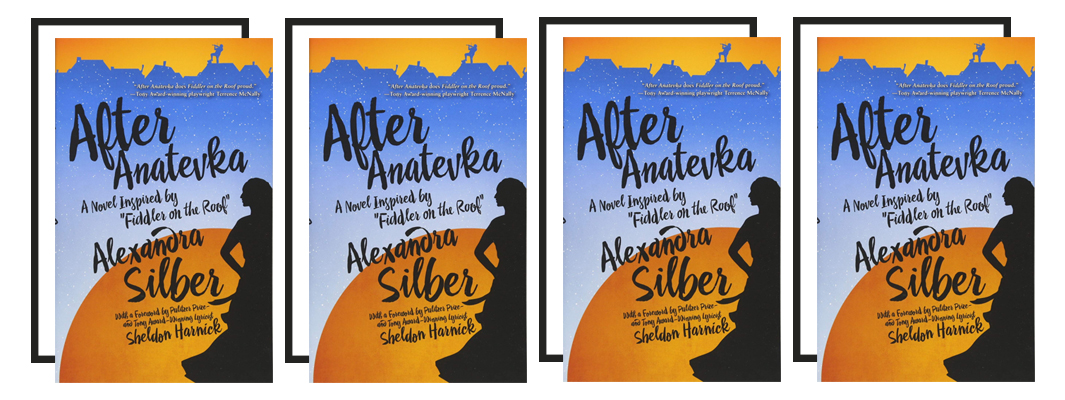
Silber has a long history with Fiddler on the Roof. In 2007 and 2008, she portrayed Hodel (the middle daughter) on London’s West End, and in 2015 and 2016, she was part of the Broadway revival of Fiddler as Tzeitel, the eldest sister. After the Broadway run of Fiddler ended, she went on to write After Anatevka, a novel that imagines what happened to Hodel after the story of Fiddler ends, and White Hot Grief Parade, a memoir about what happened when her father died of cancer.

“After two huge productions of Fiddler and the publication and book tours around each of my books, I met so many people in Jewish communities that sparked, fed, and fueled my interest in knowing more, and finding a peaceful, curious, voracious, and joyful certainty of God,” Silber explained over e-mail to Alma. Becoming a bat mitzvah “was the best decision I’ve made in my adult life.”


We talked with Silber about her bat mitzvah, why she wore her mom’s wedding dress and her deep relationship with Fiddler on the Roof.

Mazel tov on your bat mitzvah! What made you decide to become a bat mitzvah?
I come from a mixed family — my father’s family being Jewish and both sides of my mother’s family, Catholic. Life in my home was deeply spiritual, religiously informed, but entirely secular. I would say I am definitely a product of a few generations of highly motivated American assimilation — my mother’s cultural background is Irish and Latinx, and her maiden name is Noriega. When and where she grew up in California in the 1950s and ’60s, there was cultural incentives for assimilation that her parents and grandparents gave their lives for.


The same was true for the Silber family. My grandparents came into the prime of their adulthoods during the Holocaust, and though they were far from the European atrocities, their families and friends were not unaffected by the horrors. I will never fully understand their experience, but I can wrap my mind around the cultural pressures to assimilate.

I lost my father to cancer when I was just 18, and the experience charged me with many spiritual life-and-death questions at that tender age. As I’ve grown, those thoughts and concepts have swirled around me, informing so much of my life and work. And of course, professionally, Judaism has been a huge part of my life and immersing in the culture via the theatre (and subsequently through my books) has been a game-changer.

I saw on Instagram that you wore your mom’s wedding dress to your bat mitzvah — why did you decide to do this? What did it mean?
I’m so glad you asked this question. I wanted my mother to feel that she was literally embracing me, standing alongside me and offering a meaningful contribution to the ceremony that might otherwise feel slightly alienating to her culture and faith of origin. My mom Catherine could not be more supportive of all that I do, but I wanted her to feel significantly represented in the ceremony.
My parents were married in 1980 by a generous and beautifully spirited rabbi in Detroit, Rabbi Richard Hertz. The wedding photos of this outdoor Jewish ceremony are integral to my vision of my parents’ origins and peerless love story. It was a simple way for both of my parents to be “present” on the day, almost 40 years later.

What was the process like?
The month after the Broadway run of Fiddler on the Roof ended, Rabbi Larry Hoffman of Hebrew Union College invited me to teach at a retreat for his fourth year rabbinical and cantorial students. It was a three-day experience I will never forget. I used lessons commonly taught in theatrical environments and applied them to the scope of Judaism, and got some of the most memorable feedback and lessons were thrown back at me from the group of 16 or so students (that were largely my own age!).

A few students in particular really stood out to me as people I’d love to remain friends with — two being (now Rabbi) Samantha Frank and (soon to be Rabbi) Rena Singer. They had gone about starting what can only be described as a Reform, feminist, totally inclusive, profoundly informative, and an all-around glorious Instagram account called @modern_ritual. I devoured the content. I identified with it. And before long, I realized that if I was going to engage with this bat mitzvah experience, I wanted to do it with them — with peers I looked up to immensely leading me, in just the way I had led them just a few years earlier.

Rabbi Frank and I made an initial date to meet and discuss the details — my prior knowledge, my goals, and what I truly wanted from the experience, and together we crafted a plan that was personal to me, where I am in my life now as an adult woman. We met once a week (sometimes in person and sometimes over the internet), and not only learned Hebrew and trope (from scratch!) but we discussed all things spiritual, Israel, Torah, history, and culture.

What was the hardest part?
Aside from learning Hebrew (medium-hard — I’m quite adept at languages in general) and trope (almost unbearably hard as a musician and music-reader), the hardest part was the bittersweet moment of saying goodbye to Rabbi Frank after the process was over. She became the only person in my life (other than my partner and my mother) whom I spoke with every day. I miss her!

Totally on a different note from your bat mitzvah, why did you write After Anatevka?
I played Hodel in the ’07-’08 West End production at the Savoy Theatre. Hodel took on a deeper significance for me than any other character I’d ever portrayed, mostly because when I began rehearsing here in London I was coming to terms with the death of my father five years earlier at the age of 18. Hodel’s final scene is not only an assertion of her adult autonomy, but it’s her chance to say goodbye to her father, a chance I was personally lacking in my real life. When Hodel said, “Papa, God alone knows when we shall see each other again,” it was more than a piece of dialogue for me. It felt mythological, primal even.
after anatevka

I suppose I only now see the direct connection between the an 18-year-old girl who boards a train to Siberia, and an 18-year-old girl who boarded a plane to Scotland. By exploring and assuring Hodel’s future, and her capacity to endure, I was in some deeper way doing the same for myself.

Did playing Hodel in Fiddler impact your Jewish identity?
Of course. On several levels. The first being that I was playing Hodel in London and the UK has a much less prominent experience of Jewish culture woven into the mainstream than we do here in the US. That said, in a large cast of 30, I was only one of three (even remotely) Jewish actors, and throughout that experience I learned many things alongside the Judaism novices, as well as feeling charged to be the best ambassador of Jewish culture I could be. I did endless research not only to benefit myself but to be a more dependable guide for my castmates. That naturally trickled into my off-stage life.

Second, and perhaps deepening that experience, studying Jewish culture, history, and the faith itself gave me an aperture into my personal genetic legacy — a connection to my father, grandparents, and beyond — all of whom I could no longer connect with on earth in the present tense. It was a way for me to feel the ancient links that connected me straight back to Hodel herself. A way to feel close to my father.

fiddler al silber
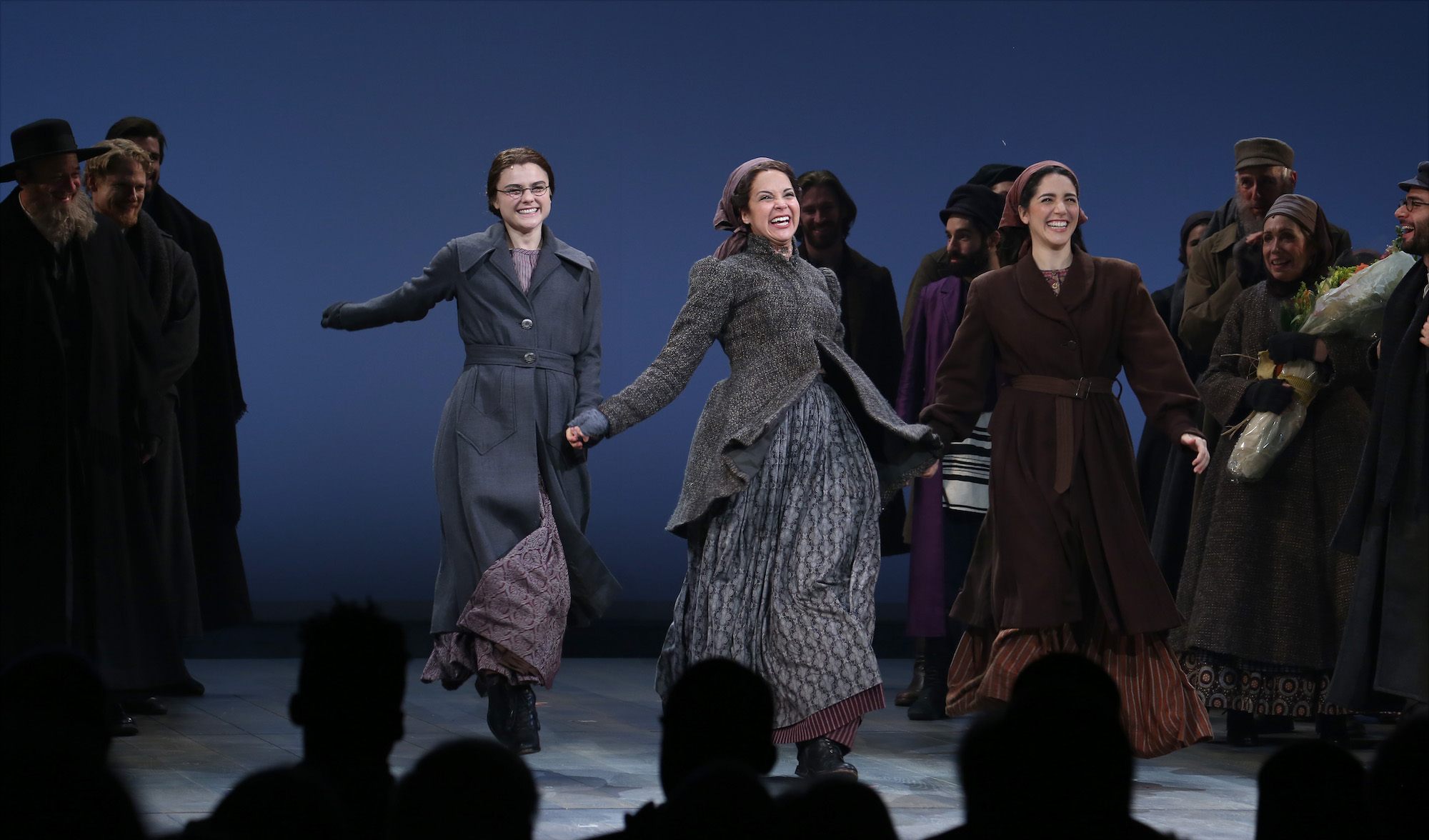
Melanie Moore, Alexandra Silber and Samantha Massell during the Broadway Opening Nigh,t Performance Curtain Call bows for ‘Fiddler On The Roof’ at the Broadway Theatre on December 20, 2015 in New York City.
By the time I arrived to live permanently in America in 2010, the process was well underway even if it wasn’t in the forefront of my consciousness. And by the time I was cast as Tzeitel in the 2016 Broadway revival, if the deal wasn’t sealed already, it was sealed doubly so by Rabbi Larry Hoffman of Hebrew Union College. He served as the Broadway production’s Jewish consultant, and we forged a very special connection that remains alive to this day.


What was the reaction like to your novel?
Largely positive. So many people shared my curiosity about what happens to this family! Of course, there will always be dissenters and people who wished I’d crafted the date of their beloved characters in a different way, but I had to remain true to history and to the woman I grew to know Hodel to become.

Jews have such a long history in the theater — why do you think that is?
All of the arts have powerful Jewish cultural parallels: ways of uniting a community, telling stories that make people think, feel, laugh, and change, and providing a way to bear the adversities of life.

What’s your favorite Jewish show?
Aside from Fiddler, I’m a huge fan of Paula Vogel’s gorgeous play Indecent — which chronicles the history of another pivotal Jewish/Yiddish play “The God of Vengeance” by Shalom Ashe.

02 April, 2019

Questions from Book Tour - Part 7

Book tour!
1. In addition to grieving and overcoming pain, the book really seems to explore keeping up appearances in a lot of ways. What did this tragedy instill within you about that and how society so often avoids talking about death, in general?

     Death is the Great Unknown, and most human being love nothing more than snuggling up and getting all cozy with certainty. The trouble is— certainty hardly ever truly exists in our lives.

     The greatest fears all living things hold within them is the loss of someone they love and the loss of their own lives. Avoiding death and survival instinct is built into the tiniest amoebas, and they don’t even have intricate death mythology or structure of beliefs about an afterlife. Humanity has been mythologizing death since we had cognizance, one to make peace with it for our own demise, but also to ease the profound suffering of being left behind in death by anyone we love.


     Around Christmas, my mom and I were going through some of her life treasures in the basement.
    “Oh I like those shoes,” I said salivating slightly.
    “Patience, Al, you can borrow them now but you keep them when I’m dead.”
    “Roger that, Mom.”
    “Cheer up. You’ll get it all when I’m dead! Who am I gonna leave it to— the cat?”

     This level of banter is pretty standard for us.

     But the other day I experienced a very special career highlight, and my wonderful, witty mother was there to bear witness. We have an unspoken tradition where after every major life event of mine (such as an opening night, a book launch, a concert), she takes me aside and we pause a few minutes to revel in what has just transpired. After we did that, I paused as said:
    “Mom. Just so you know, this tradition means everything to me.”
    “Me too,” she replied.
    “And,” I continued after reflecting a moment, “I don’t know about the details of the afterlife and all that, but I’m just letting you know now, that if you do get to come back and haunt or visit or say hi, this ‘after the show’ moment would be when I’d really like to know you’re popping in.”
    “Okay,” she said, then smirking added “Good talk.”

     We laughed. Life and death and real-talk chat is no big deal to the Silber ladies anymore. As you can see, the ability to so blithely operate in that kind of dialogue does not put a damper on the joyous occasion, it made it even more memorable, without being a huge downer.


Ta-DA!!! Real Talk!
     Taking death and grief out and looking at them directly seems unpleasant, unnecessary and downright “grim,” but it removes the stigma from a human experience every single one of us is going to have sooner or later, and avoiding the subject is not going to prevent it, and certainly not the solution for making any kind of peace with it.

     My suggestion is to very simply: think and talk about it. Recognize that you might be avoiding the subject out of discomfort or fear. The more you accept the reality of death and grief, the more you can get on with the business of truly investing in and fully living your life.


the real Rabbi Daniel Syme
2. Why did you make the choice to fictionalize Rabbi Syme [in After Anatevka]?

     What a wonderful question. Ah, beautiful beautiful Rabbi Daniel Syme...

     I went about fictionalizing the real Rabbi Syme (who is chronicled literally in WHGP) into the fictional version that captured his spirit, in Rabbi Syme.

     The real Rabbi Daniel Syme was a crucial advocate to and for not only me, but to and for my father’s human legacy.

    Fictional Rabbi Syme (in After Anatevka) is based very loosely upon the real-life Rabbi Syme (chronicled literally in WHGP)—loosely because my description in the novel is not so much a literal, but more of an evocative recollection and honoring of his influence. Real-life Rabbi Syme and I only spent a collection of minutes together in 2001, but they were crucial minutes. He gave me the gift of delivering the eulogy at my father's funeral service, as well as bearing witness to it when he lead the funeral service, and above all, he gave me an hour of his time months later, reminding me of what was eternal, and chartering a map toward the beauty, strength, and individuality my faith. Irreplaceable gifts one can never forget.

     The fictional version of the character was my way of honoring the man who was my father's advocate, and thus, Perchik's (who is modeled in many ways after my father). He was also my first spiritual teacher of any kind.

    The influence of Rabbi Syme proves another true-to-life maxim: that we never know the depth of the influence we have upon one another. A fleeting moment to one, might bear a lifetime of profundity to another, for better and for worse. So it is in these tiny actions that we must recognize that our influence on earth is vast, has meaning, and should never be taken for granted.

To read more about Rabbi Syme click here:
The Real Rabbi Syme
The Real Rabbi Syme continued


3. What questions do you still have for G-d?

Why so many Fast and the Furious movies, Big Guy?


4. Later, with the chapter "Where Memories," you state that you "have always clutched fiercely onto ordinary moments." As I was reading the book, I had a pad of sticky notes + immediately scrawled "Anton Chekhov," whose plays featured plots with very little actually happening (The Cherry Orchard is a favorite of mine). Many people don't or aren't willing to find the poeticism in the mundane, the little moments that don't seem to many anything on the surface. Is it human nature to only remember the big, life-changing moments?

     It is interesting you mention Anton Chekov and The Cherry Orchard. I don’t state it directly, but the “mysterious man” Perchik meets in the Moscow bar in 1903 (about 2/3 of the way through After Anatevka) is indeed Anton Chekhov. I drop about a dozen or so clues, even going so far as to have Perchik inspire Chekhov with the phrase “All Russia is our orchard…” but I never state it explicitly. It was my little nod to the theatre.

     I don’t think it is human nature to only focus on big life moments— I think many people vividly recall the seemingly minute details of their lives. What I think most people do not practice is the meaning-making around and of these details. Making meaning of our lives is why many people participate in religion, why they read and go to the theatre, why they read horoscopes and attend spiritual gatherings. Not every human being finds meaning-making fruitful— some prefer to live utterly in the present and that is okay if it works for them.

     I happen to be a person who not only enjoys, but needs to make meaning of my and all human life. I do think I have a gift for creating a myth around an experience almost instantaneously, but as a few very wise friends have observed, sometimes my speedy ability to mythologize hijacks my experiencing of the moment itself. And noting that, I endeavor to stay fully aware in the present, and meaning-make later.

with Rabbi Syme


27 January, 2019

Another Alexandra

Dear Sasha, 

The cold has truly settled in here in Chicago and we’re looking forward to -17 as a high temp on Wednesday. It is warmer in Vladivostok. Next week it is projected to be -40 and -52 with the windchill. It will be warmer on the surface of Mars. *

 I had a wonderful friend visit this week— a friend made several years (2011?) ago during a one week workshop. Her name is also Alexandra. We fully intended to walk around Millennium park, but then (of course) the weather turned to such frigidity that we decided to keep our activities indoors. That included a great deal of tea-sipping and talking—delving into deeper and deeper depths, like taking steps down a beautifully lit stairwell of intimacy.  It was so soul-resorting to spend quality time with a true friend and almost-sister.  Alexandra is probably the only other woman in my life that truly feels like the relationship one might have with a same-aged family member (much like Arielle, though that is even deeper for Ari and I have shared our entire lives). 

Alexandra has had a difficult year—her life-force of a mother died of early-onset Alzheimer’s in July, and over the years we have shared a beautiful common-knowledge of grief. We both bore witness to our parents dying slowly, but mine was physical while hers was a mental loss. In that vein, her grief was complicated by the fact that the mother she knew and grew up with “died," while her physical body remained and was replaced by a new person who did not know Alexandra at all from day to day. 

There were, effectively, two grieving processes for her to go through. I never knew Joan (her mother) in her titanic stardom of self, and it was heartening to know that over the years I have been of comfort to A as her mother slowly evaporated. By the time her mother did pass, the first grief was already thorough. I was honored to hold her experience both through the lens of my own grief of a parent, with curiosity and respect for its own distinction. 

In October, just before I left for Chicago, I drove up to New Hampshire to sing in her mother’s memorial service.  The weeks leading up to the service I was so mind-squashingly irritated with her. I almost couldn’t think about her without my brain exploding. She had asked me to sing at the memorial—a huge honor—but she had absolutely fallen off the face of the earth and I was at a loss as to how to proceed. I needed practical details to plan getting myself there, getting to Chicago, etc. Dear god Alexandra, my brain raged, I actually know first-hand that grief is crushing but I can’t be there for you if you don’t call me back!  

I tried her friends and boyfriend for help: what was I singing? What town was I going to? Do you realize how far away new Hampshire is? Do you realize how stressed I am trying to move to Chicago for 4 months, in only 4 days? What time was the service? Where? Where would we sleep? What in the actual hell was going on? This event very quickly became a major pain in my ass despite me desperately wanting to be there for her. As the day approached my frustration with her silence and scatter-brainedness mounted and nearly boiled over. I was a record-breaking level of grouchy.  

But, from the moment she and her boyfriend E piled into our rental car, I was transformed. Instantly. Over the course of the 48 hours encompassing the event, I’m wholly proud to say we shared one of the best, most hilarious, and most profound experiences of our adult lives. A treasured memory of laughter and sorrow and fullest humanity. I now own how thoroughly I projected her lack of communication as a lack of regard, and misinterpreted her silence as a lack of gratitude and love. I was wrong. She was, of course, just drowning. 

Alexandra, her boyfriend E (also a dear lovely friend) and I road-tipped up the country to her family’s home in New Hampshire. We sang along to terrible music the entire way. We told stories and laughed from our viscera. We vacillated from that laughter to tears in micro-seconds. We talked about real things. We talked about nothing.  We stopped at a being-renovated diner somewhere in deepest Massachusetts called “Athena 2,” (we never did locate Athena 1), ate gigantic over-priced salads underneath renovation tarps and laughed some more. Later, I helped her write her eulogy. I was her “other family” member and the family offered me a check after the service for my singing (which I, of course, donated to the Alzheimer’s Association). I got to know Alexandra, her family, and above all, her mother in a way I lack the language to express— but I recognize it as a sensation I still long to share with close friends about my father’s life. I bore witness to something deep and fervent and eternal. 

Basically: I was profoundly wrong.  I’m so glad I was wrong.  I learned the lesson thoroughly. I will never be such a grouchy pants again.  I should also mention that Alexandra was in a Broadway show (called “Head Over Heels”) that opened and closed in a matter of weeks, and thus, her highs and lows this year were on the Richter scale of intensity. This was her second week off after the close of the show, and she chose to spend it with me. I was very touched. 

Alexandra arrived on my doorstep last Wednesday on the first stop of what she is terming her “Grief Tour 2019.” All we did was light candles, snuggle Tati and one another, and talk at length about things that truly matter deep into the night. We occasionally ate food, sleep, bathe, and I did take breaks to go to work at Chicago Shakespeare Theatre. When we weren’t doing those things, we were having a great deal of fun at Improv Shakespeare and the Art Institute. This visit somehow felt like the closing of the circle of memorial experience in October—like an echo. 

And I, of course, needed her too. I am lonely here and feeling unseen in that deep way that feels so necessary to me. I crave to know others deeply, and also to be known at the same depth—the latter sometimes being challenging for me, as discussed.  When she left there was indeed an Alexandra Socha-shaped hole in my apartment, but what remained was her essence, the fullness of my heart, and a little notebook labeled “SCREENPLAYS ABOUT MY CAT” with a long heartfelt note within it.

“To Alexandra, The only Alexandra I love more than myself.”

 My heart swelled, and off I went to play the fairy queen. 


29 October, 2018

Questions from Book Tour - Part 5

1. Have you also always been a writer and if not, when did you start writing?

I have always been a voracious reader—ever since childhood. Books were not only my friends, my escape as well as my solace, but they were in every way, my first teachers. There is a private experience a reader has with a book—possibly the most intimate artistic exchange one can have for it is direct dialogue between you and the author. Literature and language were always at the center of my life, and I believe one cannot write meaningfully without also, reading meaningfully.

Coincidentally, I began writing in earnest in the middle of my run of Fiddler on the Roof in London— in the spring of 2007. I discovered something that many a theatrical actor encounters during a long run: that being a ‘performer’ and being a ‘creative being’ are very different things. They have many an overlap, but they are distinct characteristics. I discovered (much to my shock) that I was not, in fact, a performer. I did not feel ignited from within simply telling stories for others, sharing my gifts with the world on the stage. That, actually, was often quite stressful! I was an actor because I loved the creative process— the distinct joy of wrestling a character from the page and filling it with life.

When one is in a very long run, the creativity, at some point, ceases. That is not to say that one doesn’t continue to discover new things every once in a while, shift and change your perspective and interpretation as you shift and change. But the creative process is finished. For a few weeks after this initial discovery, I was in quite a state of despair.

After getting a firm grip on myself I realized I could mope about this fact, or take charge of my creativity and of my contentment, and I would create on my own terms! So I
started by writing a very little irreverent blog (that I still maintain!) titled “London Still.” (The title is snatched from the song by the Australian band The Waifs). I never intended to share my writing with a wider audience, the blog was less a public platform than a location for a personal creative crucible— a place I could create daily.

The blog, quite simply, transformed my life. The act of writing became a quiet place to retreat and make new things that had never existed before and put them into the world.

Now that I am here I don’t intend to stop professionally engaging in either! It has been my honor to enjoy such a varied and ongoing career on the stage, and writing has brought me extraordinary creative pleasure.

We only get one life. Why limit oneself? Why wait for permission? Why tie up our precious days on earth with anxiety and not-good-enoughs and fears? I desire a rich and textured life full of a variety of experiences from the personal to the professional. Is it at times challenging juggling doing multiple things? Certainly. Rewarding? Inexplicably.


2. Even knowing the general background of your memoir, I could never have expected the journey you take the reader on. It's emotional, raw, earnest and witty. Did finding + delivering that balance (serious + comic) take time to craft?

The experience of chronicling memories, particularly traumatic ones, will always take time to craft, a deliberate energy, and a ton of discipline. But did the tone of the book require fine-tuning? Not really. I chronicled the memories much as I experienced them—at one moment poignant and devastating, the next flat-out hilarious or even preposterous, followed by more honest devastation. That is, of course, much how true life ebbs and flows. We laugh through our tears, we cry in moments of joy. There is no one label that could ever fully capture the essence of an event, a period of time or even a single moment. I documented the memories as I recalled them— in all their genre-busting detail.


3. The structure of the book is so layered and complex. Each chapter works as a vignette of a time, place and emotion. How did you make decisions when to write the chapter out as a stage play or a word puzzle, for instance?

If you examine the book intricately, you come to sneakily discover that not only does the overall narrative storytelling style switch genres chapter by chapter, but within the chapters themselves the writing switches its genres like some sort of bizarre, out-of-control improv game. I suppose that is why I used this format.

To be honest, it wasn’t entirely a conscious creative choice, at first, it was a very necessary personal exercise. The flipping of genres and formats was the result of me attempting to personally express the experience of grief as directly and emotionally accurately as possible, and I found couldn’t always do that in traditional prose. Some things cannot always be described—they must be intimated at like a photographic snapshot that is worth “a thousand words” (the use of mazes, cryptogram, and haiku.) Some things are in fact too painful to look at directly or described in the first person (that was often when I used the scenes).

Oddly, the overall effect is very much like grief itself—not just every day, but every minute is a new rush of experience, information, and feeling rushing toward you like a freight train. One has no control over it, one must simply endure and surrender to the “parade.”


4. Throughout writing this book, did you ever feel you were being torn apart emotionally all over again or was it more of a cathartic release?

I’ll answer in the style of WHGP:

Emotions Experienced Whilst Writing a Grief Memoir:

C K F P S M Y V A Z O W J Q T M 
Z O I N S E C U R I T Y V S R I 
E I M M O J W W Q V U L U Q A S 
G N K I A S M S K E W G I I E E 
J O Y N C J J G P R S H N U F R 
G P G Z D I N V P I S N P Y G Y 
E E K Y L M R C D X S I Q X E T 
R L T S B J T O K Y E A H V P G 
I I A G P B E N N J N N O T R W 
H B A T H V S F C Y D L R A O G 
K C Q P I G X U H E A L T F Y L 
A L K U S O D S D P S I R G O G 
E M A H S E N I G E T F K V Y R 
X V J M T Y D O J U M W O B I V 
T R I U M P H N D F O I M U P G 
W J W U N U X E Y T I R A L I H 

ANGER
COMICIRONY
CONFUSION
DESPAIR
DISGUST
ELATION
FEAR
GRATITUDE
GUILT
HILARITY
INSECURITY
JOY
LOVE
MISERY
SADNESS
SHAME
TRIUMPH


10 September, 2018

Questions from Book Tour - Part 4

1. What made you feel ready to tell such a personal story [as White Hot Grief Parade] at this particular moment?

     I actually began writing White Hot Grief Parade in 2011— after I published a blog post marking the 10th anniversary of my father’s death. There was something about the milestone, combined with my Broadway debut just weeks before, that made me awaken to the fact that I had indeed “turned out okay.”

When a child experiences any kind of adversity, the main hope and concern of all responsible adults is that the child “turn out okay.” I can’t speak for everyone, but I felt an extraordinary responsibility to not just be “okay” but to also fulfill my dreams as my father (and mother) also wanted and encouraged for me. And despite all my wonderful experiences in the West End, and across America, when you’re an American little girl dreaming of being an actress, the dream of your life is to be on Broadway. It was a lot of milestones colliding at once.

I starting writing the piece after the blog post came out and it almost tumbled out of me— I finished it in a few short months.

Why share it now, seven years later? I realize now that “turning out okay” is a bare minimum. it is a term of survival, not of actualization or a thriving mentality. I need to reach higher, and deeper within. I needed to more than survive, I need to become myself. Today I stand here not only “okay,” but as fully myself and as deeply at peace as I have ever been. From this place, is where we are ready and able to share our deepest vulnerabilities. They have been processed, they have formed and guided us.


2.   This chapter is directly rooted in musical theatre culture with Sondheim and Into the Woods, but you play with structure throughout the book, introducing chapters written as scenes of a play, chapters written as scenes of a farce, a cryptogram, a maze. What led you to play with form in this way?

If you examine the book intricately you can see that not only does the whole narrative switch genres, but within the scenic work itself the writing switches its genres like some sort of bizarre improv game. I suppose that is why I used this format.  To be honest, it wasn’t entirely a conscious creative choice, at first it was a very necessary personal exercise. The flipping of genres and formats was the result of me attempting to personally express the experience of grief as accurately as possible, and I found couldn’t always do that in traditional prose. Some things cannot always be described—they must be intimated at (the use of mazes, cryptogram and haiku.) Some things are in fact too painful to look at directly or described in first person (that was often when I used the scenes).

Oddly, the overall effect is very much like grief itself—not just every day, but every minute is a new rush of experience, information and feeling rushing toward you like a freight train. One has no control over it, one must simply endure and surrender to the “parade.”


from The Killing Game
3.  Who’s work or what work from the theatre guided your writing these scene chapters?

The farce-like quippiness is pure Michael Frayn and Ken Ludwig.

The ultra-contemporary cinematic scenes are Annie Baker and Scottish playwright David Grieg.

The almost preposterously long stage directions are Eugene Ionesco and Tennessee Williams. (Have you ever read Ionesco’s The Killing Game? The stage directions are as good as—if not a bit better than—the dialogue). 


4.   Have you ever written a play before?

from Antigone
I have. I have (very loosely) adapted two Greek tragedies, and am currently working on a third. The first is an adaptation of Trojan Women (after Euripedes) which had a premier production in 2015 at The Hangar Theater.

The second is after Sophocles’ Antigone—mine is extremly modern in its language and politics, and is just aching for a production at this particularly volatile time across out planet.

I am working on an adaptation on Seven Against Thebes. I love the Greek plays—living in them feels what I think an archeologist must feel like; they remind me of our theatrical and thus, human and emotional, origins. it is both troubling and comforting to know that we have always rumbled with the same mythic queries.

I feel that Antigone is more relevant than ever, and I do hope she can see the theatrical light very soon.


5.       You say you never saw yourself inside Into the Woods. Would you like to play Cinderella if you could? Or would you rather play another role because you feel you’ve explored Cinderella through your personal story?


Honestly, the greatest Into the Woods ache is that I will likely never get to play Little Red—which is the character I feel—and have always felt—the most aligned with. She is the one who faces so much trauma and loss so early in her life. I suppose a part of me will always “be” her.

I would certainly never turn down an opportunity to play Sondheim’s Cinderella, I would be so willing to have her teach me things. But yes, i do feel i ‘ve worked through a great deal of her arc through my own life, and suppose I have much more currently in common with The Witch.

But yes— I have never felt “inside” Into the Woods, it’s a piece I always feel I am seeing from the outside. Perhaps that means I am the Narrator...


28 July, 2018

Ready to tell you stories...

After Anatevka and White Hot Grief Parade are here.
They are ready to tell you stories.

Dreams happen.
Don’t wait for permission.
Dream.
Make.
Do.

08 June, 2018

Great Day Washington

Got up [untheatrically] early to appear onGreat Day Washington! But I was SO excited to talk all things Camelot, White Hot Grief Parade, and of course, TATIANA ANGELA LANSBURY ROMANOV!

The classic musical "Camelot" by Lerner and Lowes is in production at the Shakespeare Theatre and the show just got extended to July 8th! We talk to lead actress Alexandra Silber who plays Guenevere. 

For tickets visit www.ShakespeareTheatre.org

01 May, 2018

Interview with Pop Culturalist

"Gifted storyteller, brilliant thinker, accomplished actor: Alexandra Silber is a consummate artist with a luminous voice on stage and page. A veteran of Broadway and the West End, Silber has performed in productions ranging from Fiddler on the Roof, Master Class, and The Woman in White to My Fair Lady, Murder on the Orient Express, and Carousel. In other words, she boasts an impressive resume that has enabled her to get to know a host of dynamic, singular characters. But Silber hasn’t been contented with just acting out other people’s stories—she has chosen to write her own stories, too. Her first novel After Anatevka—a sequel to Hodel’s story in Fiddler on the Roof—debuted in 2017, and her memoir White Hot Grief Parade is set to be published later this year. From Broadway to bookstores, Silber is at home wherever she gets to tell a good story.

The next story she will be part of is straight-up legendary. Silber will join the Shakespeare Theatre Company in Washington, D.C., to headline a new, highly anticipated production of the iconic musical Camelot. Based on T.H. White’s classic novel The Once and Future King, Camelot first premiered on Broadway in 1960 and remains one of Alan Jay Lerner and Frederick Loewe’s most popular musicals. The show brings the world of King Arthur to wondrous life. With a cast of conflicted knights, un-distressed damsels, and scheming usurpers, the musical centers on the tragic, passionate love affair between Arthur’s wife Queen Guenevere and his favorite knight Lancelot—an affair that threatens to unravel the titular kingdom that the mythic king has so lovingly built.
We got a chance to chat with Alexandra Silber about stepping into the role of Guenevere, the magic of literature, and why Angela Lansbury should be queen of everything."

P-C: What do you hope contemporary audiences will take away from a new production of Camelot in 2018?

Alexandra: At its core is a king, a leader, a fallible man: King Arthur, who is trying to make the world a better place through logic and compassion, and he doesn’t always win. But his endeavor to do so is honest and genuine. I think that’s really why it’s universal. Accompanying him along the way is the woman [Guenevere] who inspires him and gives him this platform to talk through the thinking that he’s been taught how to do by the world’s best parent, if you will: Merlyn, the man that represents all of his virtues and all of his ideals in human form. Ultimately what’s sort of incredible is that the two people that he loves most dearly [Lancelot and Guenevere] are the people that, through no malice, betray him.

When the musical came out, it resonated so deeply with the Kennedy administration. I think the reason it did resonate with the Kennedys was that JFK in many ways represented the King Arthur I just described: this young man endeavoring to make the world better. I think that right now we don’t look at those ideals with sentimentality or wistfulness; we look at that with a sense of great urgency and outrage. And I think that is a very powerful environment in which to present this musical again—particularly in our nation’s capital. So I think there’s something really crucial to be said there. Not to be overtly political, but perhaps covertly: the whole concept of King Arthur, of right vs. might, is so antithetical to our current president. And I think that there’s something really powerful about just presenting that as a possible alternative.

P-C: Guenevere is an interesting character. She is strong-willed, vivacious, and very sympathetic. But, she also has these darker shades, since she exemplifies an old-fashioned trope of the fallen woman whose adulterous affair brings about the downfall of an idyllic kingdom. Do you think Guenevere is a character that feminists can admire? How do you hope to bring her into the 21st century?

Alexandra: I think that Guenevere’s crisis is exemplified in her opening song [“The Simple Joys of Maidenhood”], which is also the first moment that we meet her. When she makes this plea—“where are the simple joys of maidenhood?”—I think what she’s really saying is, “I am a woman who is really a girl that has never had any experiences of my own. I’ve never made any choices for myself.” What’s so exciting about this, as a feminist, is being able to say, “She’s crying out to have that choice!” Even though the song and the lyrics are childish, they still come from a place of yearning, of wanting independence and autonomy from the men that have controlled her life. While, absolutely, she is disloyal to her husband, it could also be seen that she’s ultimately loyal to her own needs and her own sexual awakening, and that she simply chooses to self-actualize those dreams that she never got to have.

I think that there’s something really powerful about the aspect of her awakening as a woman that Lancelot represents. What I really love about her is that she’s nuanced. One of the things that T.H. White says about her is that Guenevere was simply herself; she was neither loyal nor disloyal. She was all of these things; she was a real person. What I love about that is that she has this incredible loyalty to Arthur. She respects him; she admires him. And, he is the father of her mind and her intellectual awakening as a woman, queen, and leader. But, they lack this very important part of being a human being and being a woman, which has to do with the physical experience and the fullness—and almost the spirituality—of sex that she experiences with the incredibly God-oriented Lancelot. Their relationship is not just based in the carnal, but in God. So, I think that’s why she is a person to be admired: that, though the conventions of morality judge her, actually what she’s done is chosen to have a full life. While it’s still morally dubious, she didn’t have much of a choice. So, I really am looking forward to digging into those nuances and not necessarily presenting a person as morally righteous or morally bad, but as morally and spiritually and sexually conflicted, as so many of us are, moment to moment. T.H. White describes Guenevere as a real person—she was neither good nor bad; neither loyal nor disloyal—she was all of these things. As are we all, right?

P-C: Her strength as a character comes from the fact that she is someone who is deeply flawed and, as you say, deeply conflicted. I never thought about how she really does get fulfillment from two men that are each servicing different parts of her life.

Alexandra: Yes, and I think the other thing that I hadn’t considered was [when] T.H. White specifically talks about her crisis: childlessness. I think we are still told as woman in the 21st century, that our value lies in the carnality of our bodies and in our fecundity. “How many male children have you born?” is a question we are still facing as women, even in this country. I think what’s fascinating is that Guenevere has a husband with an illegitimate child, and she has a lover with an illegitimate child. Oddly, the one of the three of them that is probably the most set up to parent is the one that is forever without children. What’s fascinating is that the Universe, God (I’m sure she’d say) has denied her the ability to see her fulfill her feminine role to its completion, and therefore she fulfills it in every other way possible. I’m sure one could argue she’s parenting a nation, but we all know that isn’t the same thing.


“I’m a storyteller. Storytellers are myth-makers and myth-interpreters. We take these stories and we put them into the world and share them with others.”


P-C: You’ve mentioned T.H. White a few times. Have you read The Once and Future King before, or are you reading it for the first time in preparation for this role?

Alexandra: Both. I read it in high school. That was powerful to read as a young person because, when you read it as a teenager, you read it from Wart’s [Arthur’s] point of view. I think the section of Once and Future King that resonates the most when you’re young is “The Sword in the Stone,” because you are self-actualizing along with him [Wart/Arthur]. But what’s resonating so much more with me now is the third section of the book, “The Ill-Made Knight.” And to come back to it as an adult woman and to read about the complications and the nuances of Guenevere’s 25-year affair with Lancelot, to understand my relationship to politics, to God, to my womanhood—it’s a completely different read. I think that’s the thing that’s so amazing about literature—as well as drama, stories—and why I love the concept of re-reading. Re-reading books is a very big thing to me. I have a book that I read every 4 or 5 years: East of Eden by John Steinbeck. I feel like this book is the Bible of American humanity. Every time I come back to this book, I realize it is so rich a read. As a parallel [to my experience with The Once and Future King], the first time I read East of Eden, I was 15 or 16: I’d never been in love, I’d never had sex, and my father hadn’t died, so reading it was a very theoretical experience. Then when I returned to it five years later, everything I just mentioned had happened to me. It was a completely different experience of reading it as a person who’d been in love; reading it as a person who had had a sexual awakening; reading it as a person who had experienced the mythical loss of a father—it was a totally different experience. I think I’m having a similar awakening to The Once and Future King, reading it as an adult woman literally half my life later. So it’s really rewarding. What I think is really great about reading it is knowing that the original creators—Moss Hart and Lerner and Loewe—used this as their source material. So instead of going back to [Thomas] Malory [who wrote stories about King Arthur in the 15th century], or reading about the Holy Grail, this was their Bible. So, in a way, T.H. White’s voice becomes the authority of who these people were in a much more long-form way. The beauty of literature is that you get this reliable narrator that tells you about their inner workings. And in drama, of course, you just have to rely on what the characters say, and then make up or allude to their inner workings. But with literature, you get to see their inner monologues and get some backstories.

P-C: It’s interesting that you mentioned Thomas Malory. His version of the Arthurian legend pre-dates White’s by centuries. And before Malory, Chrétien de Troyes was writing Arthurian stories in the 1100s. So, the characters of King Arthur, Lancelot, and Guenevere are born and reborn in all these centuries and iterations of the legends, up through the musical Camelot. So, I think it speaks to their timelessness as characters, too, and their ability to be mouthpieces for different eras. That’s why it’s exciting to get this production now, to see what these characters have to say in 2018.

Alexandra: I completely agree. You know, I think it’s exhilarating, but it also should be expected. It’s the same reason that we revisit Shakespeare and certainly the Greek tragedies. These are the same human crises that we face. We just have to re-experience them in the new lens of the present, and sometimes they have this incredible resonance in a totally different way, and it’s important to be reminded that we’ve done this all before. We’re not reinventing humanity.

P-C: In addition to your prolific stage career, you’re also a published author. How do you think your experience as an actor has shaped you as a writer?

Alexandra: When you boil it all down, I’m a storyteller. Storytellers are myth-makers and myth-interpreters. We take these stories and we put them into the world and share them with others. But it’s always an exercise of interpreting and reinterpreting the human condition, and the two mediums in which I do that are just different mediums in which to do the same thing. I think my experience of theatre and acting was intoxicating as a young person, because I experienced life very deeply. I still do. I don’t know if you know a lot about the Myers-Briggs scale but I’m an INFJ, which is a super introvert. And I was the child of a sick father and a very loving family and had very great parents. But I was also spending a lot of time alone interpreting really big life and death questions very early in my life. So, I had a lot of big feelings that the theatre helped me actualize and focus in a healthy way. [It gave me] a place where I can tell big, important stories and experience big emotions in a constructive and exploratory way. People the world over have lost their fathers for millennia, and had big experiences and feelings about it. I am not just Alexandra Silber, facing the loss of her father; I’m also Electra; I’m also all of these people. Drama felt like a really exciting connection. I have an older brother, but he’s about 17 years older than me, so I spent the majority of this experience in solitude—I had the experience of an only child. Literature simultaneously was a place to really cultivate my inner world and inner imagination. I think what happened was, theatre became this place for me to actualize and export those feelings, and literature became a place for me to cultivate my inner world. It was a very inside/outside experience.

I think what ultimately came from that process was when I came to literature and, actually writing it, I realized that I had a couple of huge advantages and a couple of big disadvantages. The huge advantages were the believable creation of character, and it was incredibly second nature to me at this point. So, in creating a character, I had two experiences. One was to ask what would this character do next. I could embody a character and say, “What are they going to do next?” And then, was able to go, “Alright, this is the next plot point—how will I justify getting to that plot point?” which is something that, as an actor, you’re always trying to do. How do you emotionally get there? When I had a believable root of my character in my novel, that approach really helped me a lot. So my ability to create a believable character and embody them as human beings, not just write them, made a huge difference.

Of course on a very obvious level, the concept of dialogue was really fluid for me. But one of the things I did struggle with was the macro lens. When you’re writing a piece of fiction, your main role is as a reliable narrator observing everyone. I was used to embodying one person within a story and serving their one particular arc. So that took a lot of practice and training. Being an actor, you have to be very, very vulnerable. You have this veil, this agreed-upon veil that you’re revealing your inner-most vulnerability to serve a character and, that you can always somewhat justify—this isn’t my grief, or this isn’t my pain, or this isn’t my joy, or this isn’t even my naked body—it’s theirs, it’s the character’s grief, the character’s pain, the character’s naked body. What’s very different about writing a memoir is that veil is totally down. It feels like the most exposed Barbara Walters’ interview or Oprah interview of all time. It’s a very, very different kind of laying oneself bare. That has been really challenging. Yet, my goal is for it to be a source of great connection. We’re in the moment of Me Too. Me Too is about all adversity, and it is the mantra of empathy above all else. So, that’s really what motivated me to get my grief story down.


“The whole point of art is to reflect life back to us. Most times, life is too painful to look directly at—almost like the sun. If we were to observe an eclipse with our naked eye, we would be blinded. Sometimes that’s like looking at our own truth. We have to look at it through special eclipse sunglasses. And that’s what art does—it makes it bearable to view our own human condition.”


P-C: Putting yourself out there in a memoir is a very courageous act. Once you started, did you find that the act of writing gave you more strength?

Alexandra: Yes. I’ll ultimately say this: there was this moment where writing felt so necessary. It was like a tidal wave that wasn’t going to stop, and if I kept it inside, it wasn’t going to remain in me benign; it was going to make me sick. I almost didn’t need to necessarily have a lot of people bear witness to it; I just actually had to get it out of my physical body and soul. It had to just get out.

P-C: It also sounds like a revelatory experience.

Alexandra: I think the most important thing I’ve gained is that, often what we think is the purpose of our journey is not the purpose of our journey. I mean, this is a lesson we learn over and over and over again [in literature]—like, Odysseus and Frodo Baggins. But, I think staying open to what this could be about is the most important exercise in all daily life. The whole point of art is to reflect life back to us. Most times, life is too painful to look directly at—almost like the sun. If we were to observe an eclipse with our naked eyes, we would be blinded. Sometimes that’s like looking at our own truth. We have to look at it through special eclipse sunglasses. And that’s what art does—it makes it bearable to view our own human condition.

P-C: As as we’ve said, Camelot is an adaptation of a novel. What other books would you like to see get a musical adaptation?

Alexandra: This is a slightly bizarre answer, but Italo Calvino’s Invisible Cities. It’s so, so beautiful. It’s heart-wrenching. It’s delicate, and [I would like to see it get] the same treatment that The Band’s Visit got. Basically, Invisible Cities is about the dialogues that existed between Kublai Khan and Marco Polo. Kublai Khan is sort of holding Marco Polo hostage in a Scheherazade way, in that he’s forcing Polo to discuss his adventures and describe the cities that he has seen. The book is divided into these direct dramatic dialogue conversations between Khan and Polo. Then, the prose that exists between those dialogues is told from Polo’s voice, and they are these little short stories of the cities he’s visited, which all, incidentally, are named after women: the City of Theodora, the City of Desdemona, the City of Irene. Ultimately these dialogues that exist between Polo and Khan are exploring the nature of the universe. Khan says at the end, “There’s one city you never talk of: it’s the city you’re from. You never talk about Venice.” [Polo] says, “It’s possible that I’ve been talking about Venice the whole time.” I just think there’s something about the ultimate ruler and the ultimate traveler discussing humanity. It’s a poetic exploration of existence and journeys, and I think it would be a very beautiful musical.

P-C: Speaking of journeys, you studied at the prestigious Royal Conservatoire of Scotland and worked in the West End before returning to the United States and performing on Broadway. What’s the best advice you’ve received in your career?

Alexandra: The director that I did my first production of Fiddler on the Roof with, when I played Hodel in London, was Lindsay Posner. I remember Lindsay coming backstage one day and giving notes. I was young—I was 24, and really having this experience of the final scene for Hodel. It’s so emotional, it’s so deep, it’s so big. And, [I felt] like I had this responsibility to experience big feelings every day. I felt like I had a duty to Hodel to serve her. I felt frustrated if I didn’t turn myself inside out every day, [and I felt like] I was somehow failing. Lindsay said this thing that set me free, not only on stage, but in life. He said, “You know, you only have 100% of what you have today.” [In other words] “use 100% of what you have today.” Today, you might be more vulnerable, you might feel more broken, and therefore Hodel will feel those things. And then the next day, you might feel stronger and more determined, and you might just have a greater constitution to withstand big feelings. That’s why live theatre is so rewarding: it’s happening anew every single day. He was saying you can’t compare your 100% today to your 100% yesterday. All you can do is use all of yourself as you are today. That just set me free. I also feel like it set me free offstage, going, “You know, if I can get to the end of the day and know I did my best, and recognize it’s not going to be the best I have tomorrow or the best I had yesterday, but based on what I was capable of using today, I did my best.” So, “use 100% of what you have today” is really, really a lifesaver.

Pop-Culturalist Speed Round

Guilty Pleasure TV Show
I don’t even have to think about it: Murder, She Wrote. My love of Angela Lansbury is so deep. She’s my only idol. And, Murder, She Wrote is just the most comforting, entertaining, light and oddly inspiring show. I think we all in some way, wherever we are in the stage of our life, worry or fear that it’s a little too late for us. Like, whether it’s too late for me to go back to grad school. Or, it’s too late for me to start a new career. Or, it’s too late for me to have children—or it’s too late for me to find true love. Or, who knows? What I love about Angela Lansbury that parallels directly with Jessica Fletcher [in the show] is that the character is living proof that it’s never too late for anything.
Favorite Movie
What About Bob?
Favorite Book
East of Eden
Favorite Play
Our Town
Favorite Musical
West Side Story. I just think it’s empirically perfect.
Hidden Talent
I am extremely good at writing lyrics to television theme songs that don’t have lyrics. I don’t want to brag, but I’m really good at it.
Favorite Place to Travel
Scotland, with a very close second of Venice.
Artist or Band that You Could Listen to on Repeat
There’s a folk duo named Josienne Clarke and Ben Walker. I feel like I could personally run their crazy, psycho fan club. I discovered them through some staunch Googling, and quickly bought everything they ever made. They actually have a brand new album out: “Seedlings All.” If I could recommend just one song, it’s their version of “My Love Is Like a Red, Red Rose,” which is the Robert Burns song. Her voice is just like the voice of an angel. And Ben Walker’s guitar—he’s a classical guitarist—is just out of this world. They’re an unbelievable duo. They’re my favorite music to listen to.
Person You Admire Most
Dame Angela Lansbury

12 February, 2018

[Real] Rabbi Syme: Continued!

My previous post about [the Real] Rabbi Syme generated a wonderful internet "moment—" one of those lightning-in-a-bottle experiences where the internet proves to be truly connective. I wrote the post in response to questions I received through the course of my book tour, and online: is the Rabbi Syme (Perchik's teacher and advocate) of After Anatevka at all connected to a real person, particular a man named Rabbi Daniel Syme of Bloomfield Hills, Michigan?

The answer: yes. To briefly quote my previous post:

Fictional Rabbi Syme is based very loosely upon the real-life Rabbi Syme—loosely because my description in the novel is not so much a literal, but more of an evocative recollection and honoring of his influence. Real-life Rabbi Syme and I only spent a collection of minutes together in 2001, but they were crucial minutes. He gave me the gift of delivering the eulogy at my father's funeral service, as well as bearing witness to it when he lead the funeral service, and above all, he gave me an hour of his time months later, reminding me of what was eternal, and chartering a map toward the beauty, strength and individuality my faith. Irreplaceable gifts one can never forget. The influence of Rabbi Syme proves another true-to-life maxim: that we never know the depth of the influence we have upon one another

I then followed this by recounting a crucial memory of the real Rabbi Syme.
Keep in mind that I have not seen, heard from, been in touch with dear Rabbi Syme since 2001. Nearly 17 years.
I pressed "publish." 
I posted the blog's link to a few social media places.
The link was shared on Facebook.
Then again.
And before long?
An email in my inbox was sitting there from the real Rabbi Syme.
This was followed by a save-it-forever voicemail.
And finally, a phone call that, at long last, completed a circle I never even dreamed would reach its resolution.

Then today...

Today I gave a book talk at Temple Beth Israel in West Bloomfield, Michigan—only a few miles away from Birmingham, the suburb of Detroit in which I grew up, and in fact, from Bloomfield Hills, where Rabbi Syme and I first met.

My talk went on, and as usual, I concluded with a reading. Whenever one of my book events is located in a temple I like to read the following passage and tell the audience a little about the real Rabbi Syme. How the character came to be and how this was my form of honoring the man who was my father's advocate, and thus, artistically, Perchik's.  I read:
  
     “Free a man of the constraints that limit and inhibit his development, and you have a free human being. Freedom is the natural state of man.” He looked away from the boy for a moment and recalled his youth, his own search for self. “My boy,” he imparted with a ferocious passion that shook them both by the throat, “there is nothing negative about our human potential—do you understand me? God Himself created you the way you are. Do not let anyone in this world convince you otherwise. And you are capable of anything, my boy. There is and shall always be a disparity among the gifts God has granted men, but we all deserve equal consideration. All men, no matter how low, how basic, or how tormented, deserve compassion, dignified brotherhood, and respect.
     “But part of respecting all men is respecting ourselves. Recognizing that God has blessed you. By embracing these gifts, we live as God lives, with love for all He has created—with an open heart.
     “Thus our Sages have said: ‘In every generation, a person must see himself as if he has himself come out from Mitzrayim.’ You, of course, know what Mitzrayim, this Hebrew word used for ‘Egypt,’ means, do you not?”
     “Boundaries,” the boy said quietly.
     “It does indeed—and the effort to free ourselves is a perpetual one.”
     The rabbi removed his spectacles and looked deeply into the eyes of the boy. “I promise you, Perchik: you are a truly blessed child of our Lord. I promise you will find the strength to overcome the oppression of your circumstances. This fight is your purpose—the strength for it inherent within you. Like rocks of salt shaken in water, the turbulence soon asserts itself in perfect order. My boy, you are supported by the greatest parent of them all. As it is He who has endowed you with your gifts, you can be sure that He, therefore, believes in their power. And for the record, my boy, so do I.”

Reader?
The real Rabbi Syme... was there.
In the audience.

Coming up in line as I signed copies of the novel that honors him in character, and thanks him in the acknowledgments, came the real-life, breathing man who bears the name Rabbi Daniel Syme.

We reunited.
Embraced.
Cried.

What other proof do we need that miracles happen?
Because they do.
Happen.