Showing posts with label Our Class. Show all posts

12 November, 2024

Farewell to Our Class

There aren’t words for what this role, play, group of creatives, and telling a story like this at this moment in history has meant to me as an actor, a Jewish woman and a human being. 

As an actor, I don't know that there has ever been a greater ask of me: the challenge and privilege to play a single human being from the age of 5 to the age of 83 across the spectrum of her entire (incomprehensible) lifetime. I love "little Rachelka" as much as I love "old Marianna," and I marvel at the twists, turns, glories, broken dreams, acts of unimaginable violence, and spine-breaking moral quandaries this one woman faced from 1919 to 2002. 

It was an honor to portray so complex a woman. It was a great exercise in the role of an actor to not judge their character, but to breathe life into them, animate their body, give voice to their words, and very simply: to portray them. 

Rachelka/Marianna taught be so much about the arrogance of a 21st-century American sensibility: who are any of us to judge human beings in circumstances we will likely never experience? Who are we to be arrogant enough to presume we would know what is "best?" Or what we believe we would do if presented with identical circumstances? The truth is: no one knows what they would choose, or who they might be when squeezed beyond our imaginations. 

 *

We live in a time when the hate many people hold within themselves has been given "permission" to be released into the world without consequence. I never felt particularly like a "Jewish actor' before the last 8 years— perhaps I identified more as "an actor who happened to be Jewish." I'm not certain. 

But what I do know, is that as hatred perpetuates, so does the muscularity of my Jewish pride, onstage and off; and an extension of that is the calling to do plays that speak to these themes. To have audiences know these people I portray— and those they represent. 

It is a Jewish belief that souls are with us as long as they are remembered; specifically remembered by name (one of the many reasons we name our children after the departed, and why we speak the names of the departed aloud so often). Audiences might not know Rachelka and those like her without plays like Our Class and actors like myself to bring them to life. 

It feels like a very real mitzvah to tell these stories.


I think with difficult material there is a tendency to indicate to the audience that you must watch with great seriousness. But that actually [prevents you from] entering into the space with the same open heart that we hopefully walk through life with. What Igor captures so beautifully is that difficult things happen alongside joy. Through all the seriousness, there's love and humor and ribbing each other. If we don't laugh and love, we're not honoring the people in these stories.                                                                                                                                                                                                       I don't think Americans fully grasp that everywhere else on Earth, Judaism is not merely a religion. It is also an enth-religion, a culture, and in many parts of the world, it is related to blood: to racial identity, for better and for worse. I'm a "successful" American assimilation story on some levels. My ancestors were able to shed all of the accouterments of their visible Jewishness and become Americans. 

Perhaps that robbed me of countless Shabbats and Hanukkahs and prayers. But through my theatrical life, I can reclaim sacred traditions. There's something about the theatre that shares ritualistic sanctity with, in my experience, Jewish traditions. Why is this night different from all other nights? Because tonight we're doing the play. Rituals say that this moment is distinct and sacred from the moment that comes before and the moment that comes after. And what is theatre if not that?
 
Plays about the past can make us very complacent as theatre-makers and as audiences. But this isn't a play about the past at all. This is who we are. 
 
The second act of Our Class could almost be subtitled, "How they lived with what they did." Some of them didn't do very well—even though they survived, they were not fully alive. 
 
One other thing that I've been thinking about a lot is how, for a lot of the late 20th century and early 21st century, art started to exclusively focus on victim stories. Not that that isn't important. But by failing to focus on the perpetrators, we fail to be exposed to how we might be like them. Both these plays focus on the humanity and inhumanity of people just like us who behave in monstrous ways. It's art's purpose to show us these corners of humanity. 
 
 
I think it's incredibly important, especially now, to see that in "them" there's a whole lot of "us." 
 
 
For now, all that’s left is chalk dust, memories, and gratitude.  


17 October, 2024

All hail "Gang Cult"

Were we a "gang?" 
Were we a "cult?" 
Who knows? And who cares? 
We weren't sure, so we called ourselves "Gang Cult" and that was that. 
 
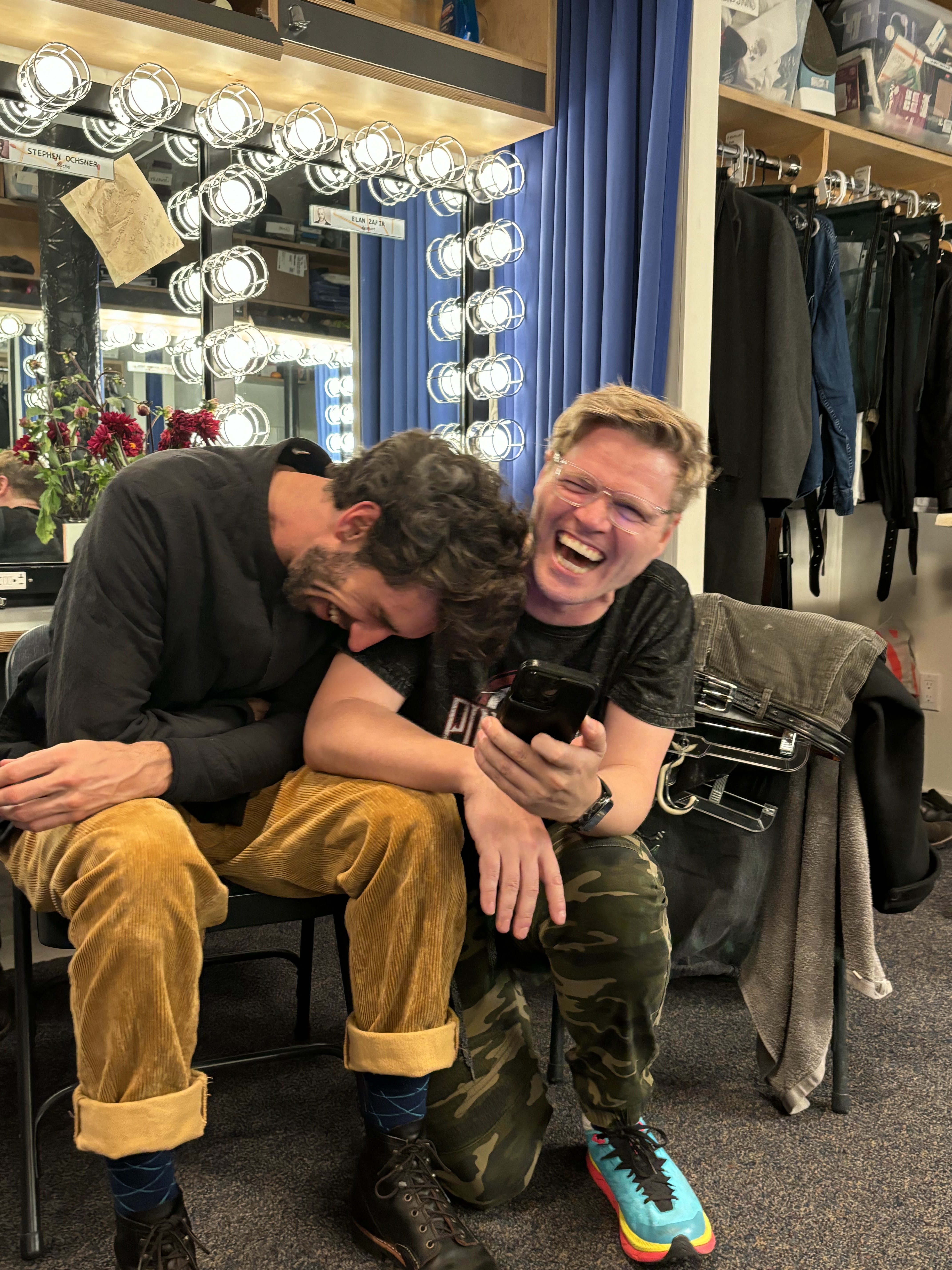
I couldn't have gotten through the last few months without these boys, and our "Annie Zuks--" wardrobe woman extraordinaire, always staying til 1am, doing our laundry and mostly getting chalk out of ... everything. 

 
We met almost every night post show. 
We greeted our friends in the lobby or outside, then we'd sauntered back within-- rip the curtain that divided the men's from the women's dressing rooms and in the still-small space, we'd turn the chairs toward one another and settle back in to relax for an hour before heading home. 
 
You would think we had spent enough time in that theatre (as in: all day, especially once we were doing double duty with Merchant of Venice). 
But it didn't feel excessive. 
It felt therapeutic. 
Necessary. 
Real. 
True.


We laughed. 
God how we laughed. 
We drank wine and bourbon. 
We solved the world's problems. 
We heard one another's. 


Stephen ate salads. 
Will ate nuggets. 
I ate nothing. 
Our hearts broke and broke open. 
We welcomed special guests (for truly all were welcome!)
And we carved into eternity, memories and bonds that only theatre can create. 


This is the why. 
The "why" of "why we do this" when almost everything else makes us forget. 
It's the people.
The friends. 
 
So thank you, friends. 
Gang Cult: over and out. 


08 October, 2024

Farewell, Ilia

Ilia. 
My Władek. 
I will miss you with my entire soul.  
 
What we built, created and shaped every day together as Marianna and Władek will stand out as the most unique partnership and subsequent creation of my career. It stands out like a rare, glimmering, inexplicably-created star.
 
Oh Ilia, we searched the entire world for you, and your preciousness was evident within seconds. (I’ll never forget after reading with you over Zoom, feeling that spark across the screen, then immediately calling our director Igor Golyak right away and saying “Can we keep him?!”)

I’m proud of you for prioritizing your health, and endeavor to share the exact same values. For without our health, we cannot hope to play another day.

But your absence leaves an Ilia-shaped hole in my, Marianna’s, and our entire class’s hearts, and while I will miss you with my entire being, your contributions, creation, character, and influence will be a part of this creation, and my heart, for eternity.

Forever waltzing with you,
Your Rachelka,
Al

X


All photographs: ©Jeremy Daniel


11 February, 2024

“PS. I bless you with all my heart”

Absolutely no words to encapsulate the experience of Our Class at BAM other than enormous:

Enormous was the challenge.
Enormous were the relationships formed
Enormous is my love of Rachelka
Enormous is my gratitude for having been a part of it.

Farewell for now, friends. 🎈

“PS. I bless you with all my heart”


19 January, 2024

The Eleventh Classmate

Originally published by Broadway World on 19 Jan, 2024

Stephen Ochsner as Jacob Katz
* 

Last spring, I came on board to participate in a casual reading of Our Class by Tadeuz Słobodzianek. Political polarization, disinformation, families and friendships in crisis over ideologies were front and center of all our minds that day:

How could ten ordinary classmates growing up through extraordinary times make such horrific choices, respond to traumatic events in such barbaric ways, inspired by so much fear and so little empathy?

The answers might be difficult to comprehend, but it is not hard to find contemporary evidence— it exists right before use every day. In the comments sections. In our direct messages. Across tense dinner tables. And screamed violently at parallel protests. It seems the global population have one thing in common for certain: we are all terrified.
And in our fear, we have all become more rigid, more intolerant;
    and far less capable of compassion, nuance and meaningful listening.
In that fear, is where our friendships, communities and wider societies begin to break down.

It feels virtually impossible to hold more than one truth these days, but it’s what I feel compelled to do. There’s the visceral: the outrage, the grief, the loss, the fear, the violence, the deaths, the horror. There’s the global proliferation of hatred from every angle. And there’s the relational: the how could yous and the how could you nots. Every day online and in the street I feel the pain going septic behind everyone’s rage.


In Our Class — ten Polish classmates — five Jewish, and five Catholic — grow up as friends and neighbors, then turn on one another with unutterable brutality; in traumatic, life and death consequences.  It is inspired by the real life events surrounding a 1941 pogrom in a small Polish village of Jedwabne.  

It is staggering.  Shocking. Stomach-churningly timely. We follow the lives of the classmates from the age of 5 through eight decades of the 20th century. It examines the nature of hate, and how we—as human creatures— have the potential for both brutality and love.

Yes, the play hits differently than it did last spring. Yes.


 FEATURING THE PERPETRATORS


    From the very beginning our visionary (Ukrainian-born and Jewish) director Igor Golyak told us what his most important concept was: it had nothing to do with visual imagery, playing-style or group dynamics. It was the central idea that we must not approach this play as a story that happened “back THEN, far away from here to and by people that are nothing like me.” We had to do everything in our power to center our own personal morality and humanity into the exploration of this play to make sure it was not a PAST-TENSE play. It was a PRESENT-TENSE play.
    Our Class is not history, it is our present and our future.

    We had to be courageous enough to reckon with that within ourselves.
How?
By making friends with confrontational thoughts.
Rather than asking ourselves
    “how could THEY?”
we were forcing ourselves into twisting our own psychology into an excruciating moral question mark:  
    “How might I? What would it take for me to behave in this way?”
By acknowledging that by the very nature of being human we have the capacity for great cruelty, we don’t distance ourselves from the perpetrators, we acknowledge that at any moment, we might very well become them, were the circumstances “just right” enough to push us over the edge of our own moral compass.
    It is—without exception— the most challenging, fully enacted moral exercise of my career.

Myself as Rachelka turned Marianna

This brings me to an interesting question on the lips of so many these days: how many more stories of oppressed peoples’ trauma (in this instance Jewish trauma) do we need to bear witness to? Haven’t we been through enough? How many times can we hear and see these stories played out and still not experience social change in a wider sense?

Fair questions. And I don’t have neat answers. What I can provide is an idea central to the import of Our Class: the featuring of the perpetrators.

Last week while speaking with a journalist, we discussed the rule in journalism that has become a kind of law— when an act of violence is carried out, do not feature the perpetrators, focus on the victims and their memory. Wise indeed in journalism— where we (at least we used to) get our neutral facts and information. No need to create cult heroes out of perpetrators of violence.

But art is a different matter. We look to artists to meet different needs within society— we “hold the mirror up to nature” and beckon audiences to examine themselves. More than just culture preservers, historians, or beauty-makers— artists have been crucial to social change, catharsis  and personal examination since the dawn of the art form in Ancient Greece. We need art in order to grow as a collective.

For the majority of the 20th century Holocaust art largely followed the focus on victims just as journalists did— it was almost a moral imperative as the last survivors were reaching the ends of their lives. Preserving the crucial stories of victims was the very definition of our collective sobriety toward hatred. It solidified a restored humanity in Europe and around the globe.

But by framing the Holocaust as a mystifying, totally incomprehensible evil to be exacted by “animals” we distance ourselves from the atrocities as impossible to see within ourselves. To view the events and the thinking that got us there, as— to quote Elie Wiesel—“the ultimate event, the ultimate mystery, never to be comprehended or transmitted,” we shield our consciousness from the absolute certainty of our own human capacity for evil.

Gus Birney as Dora

Our Class is no such piece of avoidance or moral circumvention.

Through Słobodzianek’s use of direct address, the audience is implicated— the characters speak not just to one another, but to the audience as the “11th classmate” asking over and over again the haunting question:

    “What could I do?”

Perhaps Słobodzianek is indeed asking us:
    What could we do?
    What are we doing?
    What will and might we do?
And perhaps most chilling of all:
    who are we to judge these characters if we never dare to fully observe ourselves?


That is what distinguishes this piece from others.


NEVER-FORGETTING


Every day I grapple with fear of forgetting. With the fact that I am two generations removed from the events of Our Class (and so many other stories I’ve had the privilege to tell on stage and page). I was not alive during the war — and these memories do not belong to me.


When people continually try to deny the reality of the Holocaust, being a dramatic story-teller complicates matters. These events truly did happen, and perhaps the fear is that if one makes it fiction, people will think it isn’t true.


But we have learned that the documents alone are not enough. A 2022 U.S. survey by the Anti-Defamation League found “widespread belief in anti-Jewish tropes, at rates unseen for decades.” In the first two months of 2023, attacks on U.S. synagogues increased 71 percent.

Second- and third- and soon-to-be-fourth generation storytellers from all genres — as well as those who are not direct descendants — attempt to combat this evaporation.

“Never forgetting” is a trope if it is not followed by meaningful action. And it seems that action is changing and shifting— as those charged with remembering inherit a different—but in many ways identical—world.


Despite challenging subject matter, Igor Golyak’s production features whimsy, music, laughter and even joy. It features 10 incredible performances by beautiful actors. It includes designers that are each the absolute top of their chosen art form— all coming together to tell this story with breathtaking beauty.

As my character Rachelka says:

“We all have our destiny. Our b’shet.”

Perhaps mine—at least in this era of my life— is a kind of theatrical never-forgetting.
We’ll see.