They brought a woman from the street And made her sit in the stalls By threats By bribes By flattery Obliging her to share a little of her life with actors
But I don't understand art
Sit still, they said
But I don't want to see sad things
Sit still, they said
And she listened to everything Understanding some things But not others Laughing rarely, and always without knowing why Sometimes suffering disgust Sometimes thoroughly amazed And in the light again, said
If that's art I think it is hard work It was beyond me So much beyond my actual life
But something troubled her Something gnawed her peace And she came a second time, armoured with friends
Sit still, she said
And again, she listened to everything This time understanding different things This time untroubled that some things Could not be understood Laughing rarely but now without shame Sometimes suffering disgust Sometimes thoroughly amazed And in the light again said
This is art, it is hard work And one friend said, too hard for me And the other said, if you will I will come again Because I found it hard I felt honoured
Never have I ever worked on a piece like this. In development for nearly 18 months, I am the "last-man-standing" from the earliest days of sitting around a table with a very silly idea, and this week, 11 actors we've collected along the way have poured their hearts, battle scars, war stories, tales of love and humor and loss, in to this beautiful new American play, Our Town, Our Table by Kirsten Gunther, conceived with Jack Cummings of the Transport Group.
It has been one of the greatest collaborative experiences of my life. The stories, the humanity, the problem solving, the laughter, the tears. An inexplicable bond formed across time and shared in a sparse space equipped with nothing but our words, memories, imaginations, and 11 humble props.
To speak of the content of this project would be to pepper it with spoilers, but suffice it to say it it "about" Thornton Wilder's Our Town, but about so much more. What we sacrifice for a life in the theatre. Who we met along the way. What is replaceable. What is ephemeral. What is eternal. And how to savor and cherish "every every minute" on stage and on earth.
* "It is not the fashion to see the lady the epilogue..." — William Shakespeare
1. This clearly touched a nerve.
I'm
vaguely in awe of the enormous response to my post regarding the talk
back. The shared outrage and anger surprised and moved me. I'm not
certain why— but perhaps it's because in my "Other" roles I so often
feel left hanging so I didn't expect such support.
But genuinely?
None
more so than as a woman. We don't allow women to speak.
And when we do, we don't listen very well, or at all.
2. Compassion first
I want to acknowledge that these older men (one declared himself to be
Jewish — the other spoke with the authority of someone who identified as
Jewish) seemed to be in a lot of pain. And you know what? I get it. I respect their pain. In some ways I share it.
I share the pain of a human being with a few "Other"
status' (like billions of humans) who thought they had not merely the hope but the firm belief that the arm of history was moving in the
direction of a more compassionate, loving world. When they look around, I
imagine these men see shadows of things they assumed were long gone, and feel despair.
And
something I have that they do not? Is more time. They have less time
on earth to see the world course correct. And it brings them grief and
outrage and fear and hopelessness that everything they've devoted their
lives to is evaporating.
I have more time to change the world than they do. I understand. If they had given me a chance, I would have validated their pain.
3. Demand no "pound of flesh"
Their valid pain? Is no excuse for further pain.
And the almost breathtaking irony is that this is the precise larger theme of The Merchant of Venice.
Oppression can warp us, if we allow it. And hurt people hurt people.
We must rise above our personal and collective agonies and demand no “pound of flesh”— no matter how "justified." We must heal ourselves and our communities so that we cause no further harm — micro and macro.
May the bringing of peace begin within the quietness of our own souls.
There were postponements, and too-many-jobs, and travels, and health battles won for two of our team! And in the end? What a joy to gather together once more and celebrate at 54 Below. I feel so especially grateful to gather together in health and wellness in the presence of Drew Wutke post-liver-transplant-miracle-man, and post-4th-bowel-surgery me. We are here!
This was our 10th I Wish (since the first one in 2018), and I struggled a little with what to sing. So many of my "wish" moments have been realized—in true productions, or within this glorious series. I had to think outside-the-box. And that often requires me to dig a little deeper...
*
In truth, what's been on my mind lately has been personal (and I hate that it currently feels political as well...).
I don't discuss it here.
At least I never have.
The subject feels like a phantom, a shadow of sorrow too tender to give credence to.
Giving it shape in words feels dangerous, unwieldy; too fully formed for a phantom.
Best let it haunt me.
I've left it not unexplored, but certainly un-uttered.
And what is this? Well. It is the fact that I will possibly never raise children, and certainly not give birth to them, biologically.
It's been on my mind since roughly 2015, when I was first diagnosed with UC. At the time I was just 32, chronically-sick-as-a-dog with no solutions in sight, not dating anyone seriously, and honestly I was so preoccupied with every kind of surviving that I honestly hadn't even thought about kids. I was never one of those women that had always dreamed of pregnancy or of parenting; I presumed the thoughts and sensations would present themselves organically...
Then one day, after a few failed attempted medical solutions, I was presented with an option: a very intense drug that worked for many people in helping quell ulcerative colitis. It worked for many, but was essentially chemotherapy in pill form. It could be magic bullet. It works for thousands of people, they said. But: it would forever compromise my fertility. I needed to give it some thought.
I did. My thoughts were that my options were slim and growing slimmer.
I did my due diligence and explored every corner of why people have children, what pregnancy meant or didn't mean to me, what mothering, parenting, legacy, biology... In the modern day, we truly have children for so many reasons. I figured none of these thoughts were going to do me or a child any good if I wasn't here, or well enough to care for either of us.
I went for it.
And in the end? The drug did not work for me.
. . .
I'm not usually lost for words, but the sense of loss was palpable.
Yet, this was one of the countless things I didn't (couldn't?) manage to cry tears about. Something about it felt self-indulgent. I went about with the regular unhinged programming of shoving it ever-downward in to my already sabotaged viscera! Keeping medical secrets from a Broadway company and presenting myself as Healthy Al. Nothing to see here. I haven't eaten solids or slept in weeks, I am on more steroids than a Soviet dead lifter, but everything is fine. I gave no further meaningful thought that year to the children I'd never have—Who had the time? After all, they were a figment, a not-to-be-hoped-for addition. And I was focusing on the "lucky-to-be-alive" part. At the time I had no partner to raise them with (something I insisted upon, when my imaginative musings drifted toward parenting), a chaotic schedule as an actor, with a volatile income, distant family infrastructure geographically far away. None of it seemed reasonable. Possible. Or above all: like something I was even "allowed to want."
By 2021 my surgery further solidified the story of a life without biological children. The scar tissue from the surgery would settle around my reproductive organs, and would mean IVF was the only option for pregnancy with anyone's eggs.
My surgeon was compassionate.
All his fellow associates and nurses too.
I signed 100 consent forms.
They checked and asked me over and over again—including moments just before the surgery itself—if I was "sure."
And when I said I was, my wonderful, taciturn-but-compassionate surgeon took a vulnerable leap and in a near-whisper, reminded me of a personal truth: that I had grown up with a sick parent.
He was right.
He reminded me that not merely my father's death, but my father's illness had been a source of tremendous pain. He wanted me to know that, for the record: he felt the choice I was making right now—to get well—set me up to be the best person I could for everyone I currently served in my life. And that was also true for anyone I welcome in to my family, in any manner, going forward.
I knew he was right.
Still. I went from an "I Don't Know If I Want" to a "Can't Have," within hours. The sense of grief has been unutterable. What began as a vibration became a whisper which became a roar, and over time it has only grown louder. So many of my close friends elected to have children and I delight in their happiness and expansion as human beings. But yes, it aches.
Over the years the feelings have evolved. I met Alec—younger than I and likely not even courting the concept of children when we started dating. The greatest tragedy feels like robbing him of being a father, biologically so, without a lot of say in the matter. But we both understood what we were walking in to as we continued to commit to one another.
Then JD V*ance started going on and on (and on) about "childless cat ladies." About "biological responsibility" and the selfishness of a woman who does not physically bear her own children for the generations to come. Again, there just weren't words to describe the experience of hearing that from an elected official, after everything.
I don't know that I'll ever have the words.
*
So with all this at the top of my mind in recent days, I turn to the best discussion of grief, parents and children and healing I know: The Secret Garden.
The story is about a family ravaged by illness and grief, that discover the ultimate healing exists within nature—all symbolized by a near-dead garden returning to life.
It’s also a story about parents and children…
In this song, Archibald Craven— unable to parent his son Colin because of the enormity of his grief, visits him as he sleeps and tells him an ongoing, bedtime fairy-story.
I know a lot about the themes of this story. (I once wrote about them, here) In so many ways I identify with the children— growing up with parents, lost— to death and to grief. But as I age I come to see myself in the adults too. And as so many parents are quick to remind me— I am not a parent. Yes, believe it or not, I am keenly aware that I don’t have first hand experience with raising children because I don’t have any of my own.
1. I can't believe it's been six years since our last interview together! At that time, you were starring in Camelot in Washington DC. How would you say you have changed the most since that time?
It’s almost unutterable how much I have personally changed and how much the world has too.
I have had a major organ removed and reconstructed. It saved my life. I fell in love and got married. I turned 40
There was a worldwide Pandemic. And the world is even more inside out and upside down.
2. This fall you are starring in an updated William Shakespeare's The Merchant of Venice at Classic Stage Company. What made you want to sign on for this re-telling of The Merchant of Venice?
It is a dream-like opportunity to portray one of Shakespeare’s great leading roles in New York City—a dream I have had since childhood. To be a Jewish actor (born into a Catholic-Jewish largely secular family) in this particular moment in world history, telling a story that involves Jew hated, feels like another sensitive, challenging and important task.
It’s a thrill to ask hard questions in the room, to know we might never find answers, and to be a vessel for complex dualities onstage and off.
3. Why do you feel audiences should come see this modern version?
We live in a world of knee jerk reactions, polarized camps and a culture that feels obedient to loudly chanting the “right” ideas for fear of estrangement from our communities, rather than arriving at points of view on our own — of much more nuanced.
I think The Merchant of Venice is a play that people have a knee jerk reaction about — assuming it cannot be done (and thus cannot be viewed) without a moral indictment of those both creating the production AND viewing it.
I welcome modern audiences to walk in ready to be confronted with very hard questions and thoughts and ideas— but leave room within themselves for growth and awe and surprise. Igor/our take on this piece is bold and yes, confrontational— but not in the ways you might assume. I welcome you to join us and be surprised. Have your expectations and your assumptions exploded. I won’t say more than that because of spoilers!
4. In the show, you are playing Portia. What do you relate to most about her?
Her loneliness and isolation. I’d like to think we share a fierce intellect and large capacity for love.
5. What is one quality of hers you are glad you yourself don't possess?
Even though your previous question asked about complimentary shared (pardon the expression) *qualities* It would be arrogant of me to assume that I — or anyone— don’t share all of Portia’s less favorable qualities as well. We contain multitudes.
And I’ll admit that while i do not love, and endeavor daily to overcome, them , I possess such negative personal attributes such as
self-obsession
self righteousness
Snobbery
Manipulation
Conscious and unconscious bias + “isms”
Selective memory
Elitism and classism
The list goes on.
Don’t you …posses those too? In some level, Don’t we all?
Knowing something is bad or wrong doesn’t eradicate it from our psyche — it gives us an opportunity to overcome it and behave differently despite ourselves. To offer ourselves and others grace and dare I say it? “Mercy.”
6. In this re-telling, Superheroes and their archenemies battle it out to protect good in the face of evil. Considering the tumultuous times we are living in, how do you protect the good of the world with so much evil lurking at every corner?
I strive to do what I can in the ways that feel natural and accessible to me. I have always been on the quieter, slower and more thoughtful side of political, philosophical and ethical thought—preferring long and deep conversations to protests or more traditional advocacy. That is where I think I thrive, and where my gift for humanizing the “other,” for empathy, asking deep questions, the power of story and story telling, can be a light in the face of darkness.
I don’t always succeed. Many days I flail and fail. Some days I hang out at my rock bottom. But I endeavor.
7. In our 2011 interview, you had mentioned that one day you hope to work with Director Matthew Warchus, act or sing opposite Audra McDonald, and be in the presence of John Adams. Have any of these come to fruition?
None. But I have new dreams now.
8. What is the best advice you've given, but not taken for yourself?
“Don’t wash wool.”
9. What is something that you and your best friend like to do together?
Send texts and voicemails that begin the middle of an ever-on-going conversation.
10. When you watch an episode of "The Golden Girls," the ladies would always solve their problems over cheesecake. If we were to sit down to Cheesecake:
* What problem of your own would you want to solve? * What kind of cheesecake would we solve this problem over?
Ohhhh nothing huge just: What in the heck shall I do with the time that has been returned to me post surgery, and that I blessedly have left on this earth?
Blueberry.
11. What didn't we get to talk about in this interview that you'd like my audience to know about you?
We weren't sure, so we called
ourselves "Gang Cult" and that was that.
I couldn't have gotten through
the last few months without these boys, and our "Annie Zuks--" wardrobe
woman extraordinaire, always staying til 1am, doing our laundry and
mostly getting chalk out of ... everything.
We met almost every night post show.
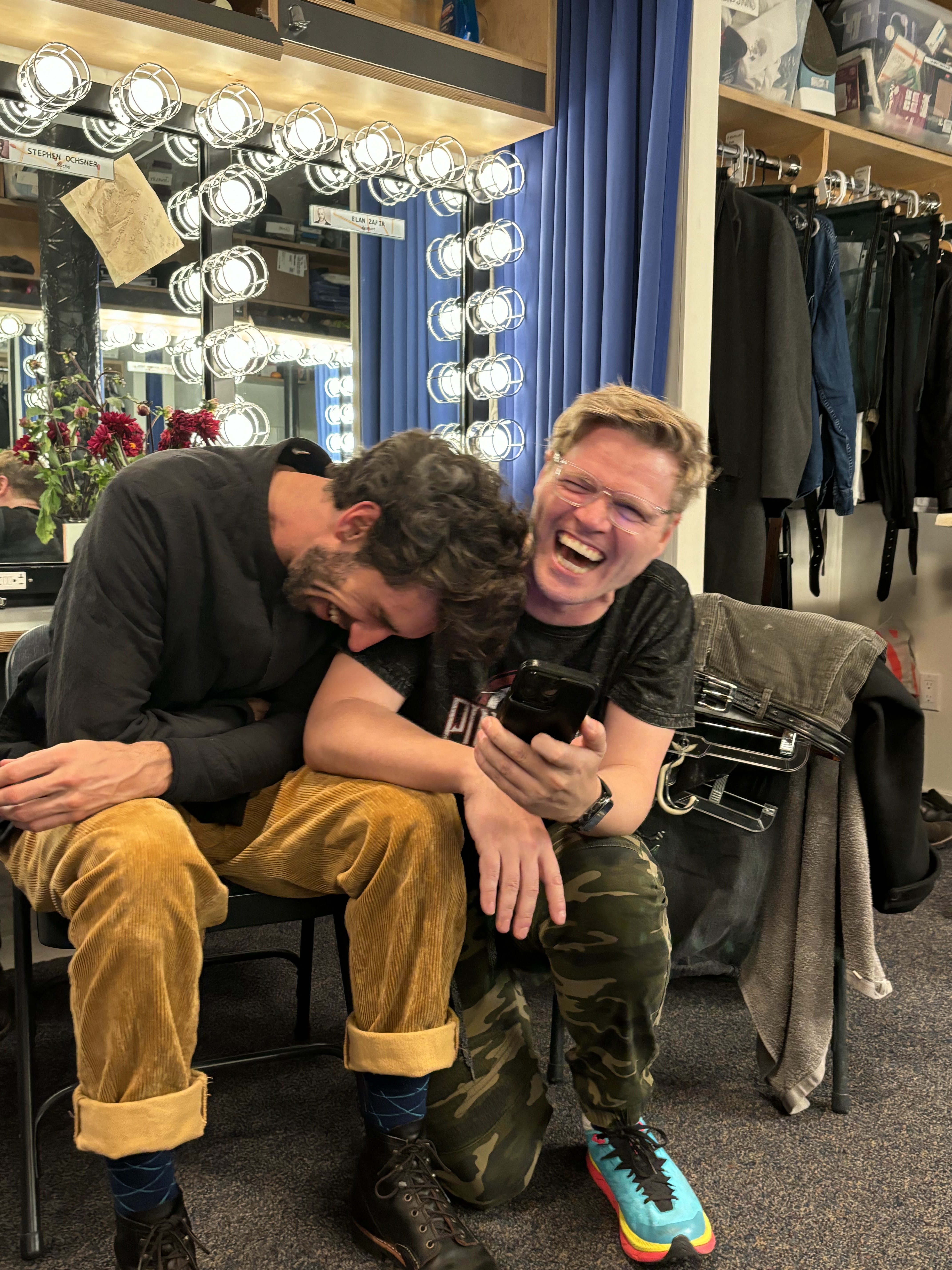
We greeted our friends in the lobby or outside, then we'd sauntered back within-- rip the curtain that divided the men's from the women's dressing rooms and in the still-small space, we'd turn the chairs toward one another and settle back in to relax for an hour before heading home.
You would think we had spent enough time in that theatre (as in: all day, especially once we were doing double duty with Merchant of Venice).
But it didn't feel excessive.
It felt therapeutic.
Necessary.
Real.
True.
We laughed.
God how we laughed.
We drank wine and bourbon.
We solved the world's problems.
We heard one another's.
Stephen ate salads.
Will ate nuggets.
I ate nothing.
Our hearts broke and broke open.
We welcomed special guests (for truly all were welcome!)
And we carved into eternity, memories and bonds that only theatre can create.
This is the why.
The "why" of "why we do this" when almost everything else makes us forget.
That’s a wrap on my first full musical production as director, and my first feature film as director, the glorious filmed musical, "Five Women at an Airport. "
This piece.
This experience.
This team.
These WOMEN.
I will never know what I did to deserve this perfect alchemy of passion, commitment, humor, depth and talent— but we got it all and then some, all in 20 days that felt like 20 years. What we achieved artistically, emotionally, and all ahead of schedule (?!) was a miracle.
A few months ago my dear friend lyricist, playwright, and musical book-writer David Goldsmith approached me about an idea conceived by the great Paul Gordon, who David describes as the "Jobs to his Woz," and this idea as the proverbial Silicon Valley garage. And you, dear audience will be the potential proof of their genius concept.
David and his fellow creatives Wendy Perelman (book) and John Kavanaugh (music) had a piece of material that they deeply believed in. A piece of musical theatre they felt needed to be seen. They called that piece “Five Women At An Airport.”
At the same time, we had a broken industry. Paul and David wanted to figure out a way to democratize more than merely was what was produced and celebrated within it, but what was ever seen at all. They came up with an idea, and called it Virtual Stage Lab. They wanted to film our musical within weeks, not months; and not as a finished product, but as a video demo filmed on a stage at the highest possible level. The focus would be on the story, music, lyrics, and the performances of the actors. And then they intended to post it online, for free. For anyone and everyone to see the work, and the work of their colleagues and collaborators. If any productions came of it—or any licenses derived from it—all of those artists would share in a royalty pool that, in success, would bring them revenue in perpetuity. Plus everyone would get some beautiful footage, doing beautiful work.
That was the idea.
I was entranced. And I cannot believe they asked me along for the ride. As the DIRECTOR. (I mean. Were they insane? Didn't they know the only thing I've ever directed in my life was countless scene study classes and like six Greek tragedies at a conservatory? What were shot lists? Who was going to costume this and design the lights and keep everyone on schedule? ME?! That's insane. That's for adults...)
They didn't care. David knew. He saw something in me I didn't even dare to see in myself. It also came with the unparalleled trust of its genius creators John, and Wendy— who created a work of such indescribable
truth and beauty; a work about real, mature, fully-embodied, nuanced women speaking to one
another like real human beings. These are roles women can savor, relish
and feast upon for eons to come.
I’ll never fully have the language to express what this three weeks meant to me. I’ll say until my breath runs out: in show business it is not the work you make, where you make it or the tens of dollars we are sometimes paid for the privilege. It is, above all, about who we share it all with.
None of this would have been possible without the entire technical team — Ian, Tais, Dylan and our magic MD Andy Collopy and genius Director of Photography, Konstantin Yelisevich. Dreamboats ALL. And above all; the literally jaw-dropping organization of our Stage Manager Morgan Holbrook who kept us on track at every turn.
But to my beloved ladies — Bryonha Marie Kate Rockwell, Elena Shaddow Katy Geraghty and Cailen Fu— I have never had an experience like this. One of instant collaborative and temperamental alchemy. From the word “go” you generously offered me not only your time and infinite talents, but your trust and hearts and souls. Thank you for making my first directing experience such a dream. I passionately love you.
And now? That’s a wrap.
See you at the movies.
Director (and Karole)—out.
Watch this space in 2025 for the full feature film.
Absolutely no words to encapsulate the experience of Our Class at BAM other than enormous:
Enormous was the challenge. Enormous were the relationships formed Enormous is my love of Rachelka Enormous is my gratitude for having been a part of it.
Last spring, I came on board to participate in a casual reading of Our Class by Tadeuz Słobodzianek. Political polarization, disinformation, families and friendships in crisis over ideologies were front and center of all our minds that day:
How could ten ordinary classmates growing up through extraordinary times make such horrific choices, respond to traumatic events in such barbaric ways, inspired by so much fear and so little empathy?
The answers might be difficult to comprehend, but it is not hard to find contemporary evidence— it exists right before use every day. In the comments sections. In our direct messages. Across tense dinner tables. And screamed violently at parallel protests. It seems the global population have one thing in common for certain: we are all terrified. And in our fear, we have all become more rigid, more intolerant; and far less capable of compassion, nuance and meaningful listening. In that fear, is where our friendships, communities and wider societies begin to break down.
It feels virtually impossible to hold more than one truth these days, but it’s what I feel compelled to do. There’s the visceral: the outrage, the grief, the loss, the fear, the violence, the deaths, the horror. There’s the global proliferation of hatred from every angle. And there’s the relational: the how could yous and the how could you nots. Every day online and in the street I feel the pain going septic behind everyone’s rage.
In Our Class — ten Polish classmates — five Jewish, and five Catholic — grow up as friends and neighbors, then turn on one another with unutterable brutality; in traumatic, life and death consequences. It is inspired by the real life events surrounding a 1941 pogrom in a small Polish village of Jedwabne.
It is staggering. Shocking. Stomach-churningly timely. We follow the lives of the classmates from the age of 5 through eight decades of the 20th century. It examines the nature of hate, and how we—as human creatures— have the potential for both brutality and love.
Yes, the play hits differently than it did last spring. Yes.
FEATURING THE PERPETRATORS
From the very beginning our visionary (Ukrainian-born and Jewish) director Igor Golyak told us what his most important concept was: it had nothing to do with visual imagery, playing-style or group dynamics. It was the central idea that we must not approach this play as a story that happened “back THEN, far away from here to and by people that are nothing like me.” We had to do everything in our power to center our own personal morality and humanity into the exploration of this play to make sure it was not a PAST-TENSE play. It was a PRESENT-TENSE play. Our Class is not history, it is our present and our future.
We had to be courageous enough to reckon with that within ourselves. How? By making friends with confrontational thoughts. Rather than asking ourselves “how could THEY?” we were forcing ourselves into twisting our own psychology into an excruciating moral question mark: “How might I? What would it take for me to behave in this way?” By acknowledging that by the very nature of being human we have the capacity for great cruelty, we don’t distance ourselves from the perpetrators, we acknowledge that at any moment, we might very well become them, were the circumstances “just right” enough to push us over the edge of our own moral compass. It is—without exception— the most challenging, fully enacted moral exercise of my career.
Myself as Rachelka turned Marianna
This brings me to an interesting question on the lips of so many these days: how many more stories of oppressed peoples’ trauma (in this instance Jewish trauma) do we need to bear witness to? Haven’t we been through enough? How many times can we hear and see these stories played out and still not experience social change in a wider sense?
Fair questions. And I don’t have neat answers. What I can provide is an idea central to the import of Our Class: the featuring of the perpetrators.
Last week while speaking with a journalist, we discussed the rule in journalism that has become a kind of law— when an act of violence is carried out, do not feature the perpetrators, focus on the victims and their memory. Wise indeed in journalism— where we (at least we used to) get our neutral facts and information. No need to create cult heroes out of perpetrators of violence.
But art is a different matter. We look to artists to meet different needs within society— we “hold the mirror up to nature” and beckon audiences to examine themselves. More than just culture preservers, historians, or beauty-makers— artists have been crucial to social change, catharsis and personal examination since the dawn of the art form in Ancient Greece. We need art in order to grow as a collective.
For the majority of the 20th century Holocaust art largely followed the focus on victims just as journalists did— it was almost a moral imperative as the last survivors were reaching the ends of their lives. Preserving the crucial stories of victims was the very definition of our collective sobriety toward hatred. It solidified a restored humanity in Europe and around the globe.
But by framing the Holocaust as a mystifying, totally incomprehensible evil to be exacted by “animals” we distance ourselves from the atrocities as impossible to see within ourselves. To view the events and the thinking that got us there, as— to quote Elie Wiesel—“the ultimate event, the ultimate mystery, never to be comprehended or transmitted,” we shield our consciousness from the absolute certainty of our own human capacity for evil.
Gus Birney as Dora
Our Class is no such piece of avoidance or moral circumvention.
Through Słobodzianek’s use of direct address, the audience is implicated— the characters speak not just to one another, but to the audience as the “11th classmate” asking over and over again the haunting question:
“What could I do?”
Perhaps Słobodzianek is indeed asking us: What could we do? What are we doing? What will and might we do? And perhaps most chilling of all: who are we to judge these characters if we never dare to fully observe ourselves?
That is what distinguishes this piece from others.
NEVER-FORGETTING
Every day I grapple with fear of forgetting. With the fact that I am two generations removed from the events of Our Class (and so many other stories I’ve had the privilege to tell on stage and page). I was not alive during the war — and these memories do not belong to me.
When people continually try to deny the reality of the Holocaust, being a dramatic story-teller complicates matters. These events truly did happen, and perhaps the fear is that if one makes it fiction, people will think it isn’t true.
But we have learned that the documents alone are not enough. A 2022 U.S. survey by the Anti-Defamation League found “widespread belief in anti-Jewish tropes, at rates unseen for decades.” In the first two months of 2023, attacks on U.S. synagogues increased 71 percent.
Second- and third- and soon-to-be-fourth generation storytellers from all genres — as well as those who are not direct descendants — attempt to combat this evaporation.
“Never forgetting” is a trope if it is not followed by meaningful action. And it seems that action is changing and shifting— as those charged with remembering inherit a different—but in many ways identical—world.
Despite challenging subject matter, Igor Golyak’s production features whimsy, music, laughter and even joy. It features 10 incredible performances by beautiful actors. It includes designers that are each the absolute top of their chosen art form— all coming together to tell this story with breathtaking beauty.
As my character Rachelka says:
“We all have our destiny. Our b’shet.”
Perhaps mine—at least in this era of my life— is a kind of theatrical never-forgetting. We’ll see.
Four years ago exactly I met Alec Silver on the first day of rehearsal
at Chicago Shakespeare Theatre. I introduced myself with a
shocked-but-casual “Hey Alec Silver I’m Al SILBER… we have the same
name!” He then proceeded to astonish me in the first table read. I knew
he’d go far. But I had NO idea how far we’d go together.
On Nov 6, 2018 sharing a night like this with Alec Silver would never have crossed my mind.
Last night, after a little over three years in New York City (two-and-a-half of which were a worldwide pandemic) Alec made his Off Broadway and New York acting debut in the profoundly moving GOOD ENEMY at Audible's Theater at Minetta Lane.
The play by Yilong Liu is gorgeous triumph of generational trauma and what we "owe" our family. It is directed by Alec’s greatest artistic advocate Chay Yew, is a triumph— superbly cast, acted, designed and executed by all involved.
Alec’s work was spellbinding. So skilled. Deeply observed and wildly out of his “type.” I barely recognized him as Dave and was equally if not more astonished by his work as I was by his Francis Flute on Nov 6, four years ago.
But what floored me, was the people that showed up to celebrate Alec in this moment. Friends, colleagues and Chosen Family all collected over the last four years that showed up in a ten-strong cheering section, evidence that lives worth living are BUILT— day by day, with every conversation, connection, good work done, generosity shared and promise delivered.
My Alec, four years to the day of being dazzled by you I am dazzled not only by your work, but by the life you have so courageously manifested. I am in awe. What an honor to celebrate you in this moment.
Thank you to Adrienne and Alex Balducci, Katie Spelman, Etai Benson, Alexandra Socha, Tony Cloer, Carman Lacivita, Elle Rigg, and Alley Scott for being a part of *The Silver Squad.*
When I arrived on the “shores” of New York City in the winter of 2011 I was what can only be described as a “total disaster human—” faking adulthood and literally living on Tyne Daly’s sofa. Don’t get me wrong— there are worse places to be lost, heartbroken, poorly dressed, couch-surfing and unfamiliar with such adult concepts as a credit score, the cost of milk, or how to get a mobile telephone despite being twenty-six years old and having had, prior to this moment, modest artistic success in London.
I feel like we’ve all been there: at the burnt out cigarette butt of a chapter of our lives, wondering if we’ll make it through until morning.
I’d arrived in America the previous year in need of a resurrection, (and absolutely acknowledge that I was privileged enough to be able to “start in the middle” of this circus called showbiz—with representation and some British experience under my hideous and poorly fitting belt—) and began auditioning. I didn’t know where the hell I was because I was managing to get lost (on a grid system—a grid system!), and, despite every effort to sabotage my life and reputation, I managed to book a few jobs as I wandered around North America zombie-sobbing between high notes.
It was during the era of my life that I met Jack Cummings and auditioned for Michael John LaChiusa’s masterwork, Hello Again.
And when I say I auditioned? I mean I hurricaned into Whatever Studios on Somewhere Street, New York, New York, holding 47-ish pages of sides and music as the team (with incredible actor, TG alum, and high school classmate, Nick Westrate reading) watched me give them every. single. female-identifying. character. in. the. play. With (sensible) outfit changes. And choices… It was the second-most preposterous audition* I’d ever offered (to date**), and I was certain after an hour or so of insanity, I had solidified my reputation as a genuine eccentric.
But by the end of the day I’d received what I would soon come to learn was a characteristic email from Jack Cummings III— effervescent, inspired, hilarious and perhaps most important for me at that moment in time: galvanizing. Someone had seen me in all my eccentricity and wanted me to be a part of something. Something deep and rich and strange and beautiful. And to be a part of it with a collection of human beings so talented, so singular, so epic in their giftedness and generosity, that they didn’t mind That Weirdo From London tagging along, singing “Tom” in my underpants, and giving me my first New York City family right when I needed it the most.
A few weeks later I was introducing myself to those glorious artists. They were Nikka Lanzarone, Max VonEssen, Elizabeth Stanley, Bob Lenzi, Bob Stillman, Blake Daniel, Jonathan Hammond, Rachel Bay Jones, and Alan Campbell— and that was just the cast. Every Edison lightbulb, every corset, stage manager, musical arrangement, and design, the team was a crucible of talent and the World of the Theatre I longed to be a part of. Before I knew it I taking my clothes off in a loft (with consent! with consent!) in the middle of SoHo, singing the most glorious music one can imagine, learning the true meaning of platonic intimacy and oh, that’s right: getting my Equity card.
We made memories that included Nikka and Cody Richard Renard being stuck in a service elevator, Alan Campbell graciously buying me lunch on the first day of rehearsal when my British debit card was rejected from a local diner, a midnight photo call, 3-am tech-rehearsal taxi rides home with Elizabeth Stanley, pretend-drowning on the Titanic, engaging in simulated acts of intimacy inches from the audience, the presence of a pet parrot, quick changes more impressive than NATO negotiations, the welcoming of members of the original 1995 cast at Lincoln Center; not to mention endless laughter, joy, belting, tears, pathos, sorrow, and community.
All for $245 a week. All of it shared… with human beings that started as strangers.
[THE WHORE] You You Hey there Where you goin’ soldier? [THE SOLDIER] Who me?
Isn’t that the miracle of the theatre?
The people. The chance
meetings. The new arrivals to our day-to-day that deeply and irrevocably
touch our lives for a moment, then poof: off it all goes into the
ephemera like so much mist. Artists open their chest cavities to these
emotional foreigners, and we sew them up just as deftly once the curtain
has fallen. 10 years later the cast is still on a text thread. Some
of those cast members and creatives are some of the closest
relationships I have enjoyed in my adult life on and off stage. The
group has shared it all from birthdays to silly inside jokes to huge
career and life milestones.
And really, at the end of the day, at
the end of all of this, isn’t that the medicine we all craved so
desperately during the darkest days of our quarantines? The prescription
we still crave: to bear witness, to be seen, to share intimacies, to
sing in harmony, to create and collaborate. To be together. And to be changed because of that togetherness.
Back in the days of Hello Again, I had so much to prove. Mostly to myself. Because
I didn't realize that the only requirement was to simply Be. We are all
worthy of love and belonging because we are human, and for no other
reason. And there I was—like so many of us have been and will be:
emotionally poverty-stricken and in the wrong outfit. But a group of
strangers took me in and said Hello. Again and again and again. And when
human beings do that for one another it is a transformative, deeply
miraculous thing.
These days we are starting to gather and
greet one another in person once more. We meet through face coverings
and vaccine screenings, scarred from the unutterable experience of what
we have all been through collectively, but also, not truly shared.
I
picture The Whore and The Soldier meeting by the Hudson River now.
Masked. Broken. But alive at the end of 2021, and starving for
connection. It rings differently now:
[THE WHORE] Look here Don’t you know my face?
[THE SOLDIER] No
[THE WHORE] You there Come and tell your sweetheart Where you’ve been It doesn’t matter Hello again…
* The first most preposterous audition is a now-infamous story of me being late for an audition for Terrence McNally’s Master Class at the Kennedy Center because I accidentally locked myself in the utility closet. Incidentally, I booked the job and the play transferred to Broadway. Because sometimes life is ridiculous. ** At least by 2010— I’m pretty sure Rachel Hoffman can attest I’ve been a huge weirdo in audition rooms since this story…
I came to know of and work with The Transport Group at the beginning of 2011 as a cast member of their immersive production of Michael John LaChiusa’s Hello Again—directed by Jack Cummings. It was my first job in New York.
When Jack gives me another chance to write for this newsletter, perhaps I will tell you all about rehearsing this play above the old (sadly now closed) Pearl River in SoHo, the parrot that lived there named Rudy, and the seemingly centuries-old elevator that Nikka Lanzarone (who played The Whore) was constantly getting trapped in. I can tell tales of our 3am tech rehearsals lit by the late night street lights of our beloved New York City.
I can also recount with vivid detail my epic hours-long audition for the project in which I read and sang for every.single.female.character. in the play, and yes, sure, brought little props and different outfits for each (and perhaps more remarkably, that everyone just sort of let me do that…)
I can recount the company’s first publicity photo session filled with a little bit of nudity and a whole lot of laughter, and, I, newly arrived in New York City, wore not much more than Bob Stillman’s arms.
Ultimately I was honored to play the Young Wife amidst a cast of some of our most gifted singing actors—as brilliant as they were brave, and it’s been a joy to see them skyrocket personally and professionally. It has been equally thrilling to still be on the same text thread with all of them 10 years later. It is a testament to the ferociously devoted companies The Transport Group builds, but also to the indescribably powerful bonds the theatre fosters; building families out of an aggregate of strangers.
But I am not going to write about those wonderful memories.
Today I am going to write about a memory emblazoned permanently on my mind as perhaps one of the greatest theatrical moments of my life. A small moment. A moment in which I did very little. Being an actor can be virtuosic, but just like in life, sometimes the magic happens in the silences.
On December 18 2017, I was participating in a benefit concert of Man of La Mancha for The Transport Group— a blinding collection of Broadway’s finest had been lined up to share the leading and supporting roles, and to sing every note of the score with a full orchestra.I was assigned some lovely moments that evening to offer my take on Aldonza — the whore Don Quixote perceives to be not only an angel, but his true love.
None of those moments was more precious to me than the scene leading into the finale of Act 1— the anthem of the evening and delivering the message of the play itself. I spoke a few words, I looked Jason’s Quixote in the eyes, and then? I listened. I bore witness to Jason Danieley singing “The Impossible Dream,” and it forever, alchemically, changed me.
At this time in my life I was rumbling with a crushing experience with a chronic illness (that I have now, gratefully, recovered from and cured). I didn’t know how to operate in the world, I didn’t know what it meant to be well— what kind of healing to ask the Universe for.
Jason (a genius I’ve respected for decades and a friend I’d made my Carnegie Hall debut with a few years before), was facing his own personal “windmills” that frankly, aren’t my stories to write about.
Both in rehearsal earlier that day, and backstage before the scene, we didn’t speak of any of it. We didn’t know the details of one anothers’ struggles exactly, nor do I believe we needed to. But as we stood in the wings preparing to walk out together I felt something connect us—like a chord of light wrapped gently around each of our hearts, not tugging, not forceful in any way, just joined. Anyone who has ever been in the theatre will tell you: there is no breaking-open of the heart quite like those moments silently shared in the hush of the wings.
We strode out and began the scene. Eyes locked, and unadorned. I had been in hiding with so many people in my life during that time, yet I felt no need to “hide” from Jason, no need to protect myself or preserve anything for my dignity. Our actor-selves just asked one another a question:
“What have you been through?”
Some questions are medicinal, just in their being asked. “What have you been through” is prime among them. It’s transformational to be in the presence of another human being with both a willingness and a capacity to hold space for the truth of another. Even while stuck in the dense mud of our own realities, even as our bodies are “scorned and covered with scars,” may we all endeavor to be the kind of person who says:
“Though I may not see this experience of life through the same set of eyes, I see you. I hold your feelings, fears, vulnerabilities and recognize our common humanity. I take your concerns to heart. And in remaining here with you for this moment, we are both transformed.”
That was what happened to and for me when I stood beside Jason as he sang “The Impossible Dream.” It is what happens when songs are really prayers.
Prior to the COVID-19 pandemic I don’t know that the world at large really knew how to listen. Perhaps it didn’t wish to. I am not immune—it is terrifying to really listen—and perhaps part of that culture is what made me ill, and it has only been in this silence of quarantine that I have had a chance to heal. Who knows? After this year I don’t think I know much for certain anymore.
But what I do know is that hurriedness is so entrenched in the ways that we communicate, that when something significant is shared between people it's often not given the proper time to breathe. To settle. To marinate, and ultimately absorb.
What would it be like if we were to normalize long pauses, deep breaths, and unencumbered gazes filled with compassion and without expectation? What if in our scenes, and pauses, and songs-as-prayers, we could, with our creations, push through the unfathomable cracks, the great gully-trenches and dried-up canyons of every broken heart? And what if in those songs the lyrics were:
“And I know if I'll only be true To this glorious quest That my heart will be peaceful and calm When I'm laid to my rest…”
What if in the making of art we could strive, with all of ourselves, to stand for something good? To tell the truth. To fight evils. And what if our greatest glory isn’t in the winning, but in the striving?
I don’t think that is an Impossible Dream. Because we do it in the theatre. When we are brave. And skilled. And, as I was that night with Jason, sometimes when we are just so broken open by life’s trials, that we cannot help but listen and get lucky.
The song ended. The experience of it left me trembling. Jason turned, and extended his hand to me. It was a gesture of something shared. We walked off stage arm in arm.
May we all strive, dear friends— with “our last ounce of courage.”




 Posts
Posts


