Showing posts with label Acting. Show all posts

16 June, 2026

"Hello, Désirée..."

     "Hm... I wonder if someone has made a clerical error."
 
This is how I feel about playing Désirée Armfeldt in Stephen Sondheim's A Little Night Music. Somebody is allowing me to do this in front of paying, living, customers, and I remain unconvinced that all relevant parties have been meaningfully consulted. I can only assume everyone involved is operating from incomplete information because letting me do this feels like the sort of decision that would normally require several permits and a psych evaluation. 
 
To stand in the middle of a theater, in one of my favorite theatre communities in America—Chicago—and sing one of the most iconic songs ever written for the musical theatre canon while removing articles of clothing in. the. round
 
Lord Almighty. 
 
Every day I arrive at work expecting to see an letter on official letterhead that begins, "After further review..." The entire thing feels like the sort of idea that should have been stopped by at least three responsible adults before reaching production.
 
And yet here we are.
 
 
Ah, time. You sneaky little bitch. One day you're Anne Egerman. Then you blink. You answer a few emails. You survive a global pandemic. You have a coupla life-saving surgeries. You discover that your knees now occasionally send weather reports. And suddenly you're standing on the cusp of forty-three, learning Désirée Armfeldt. 
 
The sunrise-sunset of it all has me staggered.
There is some grief in this reality.
Where did it go?
Where did she go?
 
The young woman who believed forty was impossibly distant. The girl who thought grown women possessed some secret map she had never been gifted. The actress perpetually trying to squeeze herself into categories that never quiiiiiite fit. For honestly, just like I did with "being young," I also always had to make ingenues work. Whatever ingenues I did play, I portrayed by smuggling my own strangeness inside them, bending the material around my oddly-shaped corners.
 
The women, though?
Ooooo the women are different.
Complicated. Funny. Wounded. Wise. Messy. Sexy. Flawed. The women know things. The 'women of the theatre' have lived badly and brilliantly—they carry history in their bodies and alter the temperature of a room. Suddenly I feel...equipped. Unapologetic. Ready. 
 
I've been waiting my whole life to portray the women that are now arriving.
Admittedly, perhaps slightly ahead of schedule? (Glynnis Johns was fifty when she originated Désirée) but maybe that doesn't mean I'm early. 
Maybe it means this is merely my first turn.
Maybe it means there will be more.
Maybe it means I can stop treating every new opportunity as if it is the last lifeboat leaving the dock.
Maybe it means I can simply be here.
 
*
 
Speaking of the nudity and sensuality of Désirée and and and—I've recently been recalling a realization I had several years ago while in the trenches of "eating disorder school" (which is to say: the first time Mount Sinai saved my life in the form of a rather strict in-patient treatment). For most of my teens and twenties, whenever an invitation involved swimming, I declined. Anything involving a bathing suit. The logic seemed airtight at the time: I genuinely believed I was protecting innocent bystanders from the burden of witnessing my body. And because this was the 1990s and early 2000s (a cultural era that looked women directly in the eye and cheerfully informed us that the less space we occupied, the better) we were all marinating in some fairly toxic nonsense.
 
The tragedy is that water is my favorite thing in the world. And I abandoned that water over and over again because I had become convinced that cellulite was a moral failure.
 
Recovery slowly arrived—and too-soon after, illness arrived. And I began to feel the betrayal. I had sold myself out thousands of times and missed irreplaceable experiences of swimming in the sea, of lakes on my skin, of canon balls and waterfalls and fjords—all because I was busy auditioning for a standard that did not exist. Convinced that if I just worked a little harder, sacrificed a little more, and occupied slightly less physical space, someone, somewhere, would finally hand me a certificate declaring me: Acceptable. And I did all of this with the intensity of a woman trying to secure the last helicopter out of Saigon.
 
What nonsense. 
 
When my body got mortally sick I realized I wasn't negotiating with perfection anymore, but with survival. Survival means the hierarchy of needs reveals itself with breathtaking efficiency. (I say this with truly PhD levels of expertise: survival is exactly like colonoscopy prep: there are no shades of grey, nuance or dilly-dallying. There is only what must go and what cannot stay.)
 
When you've spent years wondering whether you'll ever be healthy again, whether you'll ever feel strong again, whether you'll ever get another chance at an ordinary day, you start looking at your body differently.
At forty-two, do I love every inch of it? Absoluuutely not.
I remain a human woman.
But I am... alive. Astonishingly grateful to be alive.
And after 42 years on the fence, I've also arrived at the radical conclusion that at least some of me is extremely hot.
 
This, strangely enough, feels very Désirée. 
 
Désirée is a woman who has finally become more interested in truth than performance. Which may be why she feels less like a role I am playing, and more like a role I've been walking toward for decades. I have no idea the exact moment it occurred, but somewhere along the way, I stopped striving for perfection and perhaps more importantly, I stopped performing perfection. I stopped apologizing for being human before anyone had even accused me of it.

When I went to my callback, our director asked me: 
"Aside from the obvious glamorous reasons, why do you want to play this role right now?"
 I paused and really thought about it before answering: 
"Because... once, what feels like both yesterday and very long ago, I took final bows on very fancy stages. And then I got very, very sick. And lost so much. And gained so much. And now I just... want to be happy."

That's the real answer anyway. Perfection doesn't survive four surgeries and come back with scars. Or stand in the center of a theatre in Chicago, remove her makeup, her clothing, sing Sondheim's greatest hymn, and laugh at the absurdity of (please pardon the mixed Sondheim metaphor) being alive.
Breathing, living, human beings do.
 
And perhaps 
Cellulite.
Traumatic pasts.
Scars—literal and metaphorical.
The whole glorious mess.
is more than enough. 
 
And even though I spend almost every rehearsal waiting for the administrative team to dramatically burst through the theatre doors and yell, "WAIT! We meant the other Alexandra!"
 
I think I'm learning to applaud the vast, real, mess of it all. And if I don't fully succeed this time? 
"Well. maybe next year." 


© Joe Mazza for BraveLux (of course) 

31 March, 2026

"Our Town, Our Table" - A Workshop

Never have I ever worked on a piece like this. In development for nearly 18 months, I am the "last-man-standing" from the earliest days of sitting around a table with a very silly idea, and this week, 11 actors we've collected along the way have poured their hearts, battle scars, war stories, tales of love and humor and loss, in to this beautiful new American play, Our Town, Our Table by Kirsten Gunther, conceived with Jack Cummings of the Transport Group. 
 
It has been one of the greatest collaborative experiences of my life. The stories, the humanity, the problem solving, the laughter, the tears. An inexplicable bond formed across time and shared in a sparse space equipped with nothing but our words, memories, imaginations, and 11 humble props. 
 
To speak of the content of this project would be to pepper it with spoilers, but suffice it to say it it "about" Thornton Wilder's Our Town, but about so much more. What we sacrifice for a life in the theatre. Who we met along the way. What is replaceable. What is ephemeral. What is eternal. And how to savor and cherish "every every minute" on stage and on earth. 
 
Here's to the world seeing it manifest.  


18 June, 2025

Ask Al: The Power of Saying "No" — Part 1

Let’s talk about the holy word every artist needs to learn to wield like a bedazzled machete: NO.

This post is for every tender, brilliant, creatively exhausted soul who has said yes to an unpaid reading again, agreed to do someone’s weird indie podcast at midnight for “exposure,” or joined a 12-person devised theatre project because "you felt bad." 
 
There’s a moment—just before you type “Sure!” or say “Happy to!”—when your stomach drops.
You know that feeling. That little whisper that says, I actually can’t. Or I don’t want to.
But you override it. Because you’re grateful. Or scared. Or simply trained.
 
You know who you are. And? You are not alone.  

Here’s what I want to tell you, with love and no apology:
You don’t have to take every gig.
You don’t have to say yes just because it’s “something.”
Saying no doesn’t make you difficult—it makes you sovereign.
 
Furthermore: 
You don’t owe your creativity to hustle. 
You don’t owe your art to pleasing others.
You owe yourself honesty. 
 
That might sound like:
“Thank you for thinking of me. I won’t be able to take this on right now.”
 
It’s tender. It’s brave. And it’s allowed.
Your “no” protects your art. Let it.
  
Let’s get into the full-body liberation that comes from saying “nah,” “no thank you,” “not for me,” and my personal favorite: “lol no.”
 
 
1. Saying "No" Sets Boundaries — and Boundaries = Clarity
“No” is a door.
A boundary. A border. A line in the sand that says:
“I matter, too.”

When you say “NO” with clarity, you give others the map to care for and respect you properly. Clarity is respectful. Without clarity, everyone is just guessing—and often guessing wrong.

Repeat after me: “Boundaries are not cruelty.” What boundaries are are a series containers that helps us care for each other better, communicate limitations, and actually (statistically!) breed more trust, not less. Think of it this way: when we know where the lines on the road are, all parties relax and drive within the lines. 

Boundaries are also how we love ourselves. They’re how we say, “I am a whole-ass person with limits and needs and a spine.” 

As the great Dr. Brené Brown says: 

“Daring to set boundaries is about having the courage to love ourselves, even when we risk disappointing others.” 

But Artists, especially those of us who’ve ever gone through a dry spell (achem), often feel like we have to say yes to every crumb of opportunity, attention, or praise. Yet when you say yes to everything, you’re saying no to something else — like your time, your focus, or the sweet blessed act of sitting on your couch in silence eating honey mustard pretzels. So step one is first about knowing where your boundaries ARE, then practicing exercising them without having a people-pleasing meltdown. 
 
💡 Try this:
    •    Prompt: “When I said 'yes' but wanted to say 'no,' what did it cost me?”
    •    Write: Write a list of your non-negotiables— times you’re unavailable, projects you don’t want to do, vibes you will not tolerate. (More on this exercise in the next post!
    •    Action: Practice saying no to tiny things. Decline an invitation. Admit a limitation. Say no to cake (“Do you want dessert?” “No.” [But like… later, hell yes...]). 
 
PSA: Weathering the experience of not taking responsibility for other people's disappointment or squirrely reactions to the word "No," not because you lack accountability, but because not every emotional reaction is our responsibility, and disappointing someone's expectations is very different from causing harm. 
 
 
2. Saying "No" Is Self-Care, Not Selfishness
The next time someone asks you to do something and your first instinct is to cancel your own needs to accommodate them, pause. You don’t have to justify rest. Saying “no” to a gig, a favor, or even a social invite doesn’t mean you’re lazy or ungrateful — it means you know your bandwidth.

Self-care isn’t about sheet masks and bubble baths. Care of Self looks like sending an email that says:
    “Thank you for thinking of me—but I won’t be able to commit.”

You are allowed to protect your time, your energy, and your body. In fact, big picture? By doing do you are protecting your ability to keep serving the wider world long term. If life is a marathon and not a sprint, than making sure you don’t burn out in mile 1 is essential. 

As Audre Lorde said, “Caring for myself is not self-indulgence, it is self-preservation.” And I bet she didn’t write that quote while doing someone’s 11th rewrite for free.

💡 Try this:
    •    Prompt: “What would my ideal week look like if I said no to things that drained me?”
    •    Write: Make a “Hell Yes or No” list — if it’s not a full-body YES, it’s a polite NO.
    •    Action: Map out your schedule for the week. See what’s making your chest tighten? Start there. 
 
 
 3. Over-commitment = Slow Death and Burnout
There’s a very specific panic that comes from opening your calendar and seeing back-to-back commitments that sounded “manageable” when you agreed to them six weeks ago. Saying no helps keep your time, energy, and life force intact — so you can actually make that thing you’ve been dreaming about instead of ghostwriting someone else’s mediocrity.
 
Let me be blunt: if you say yes to everything, your work suffers. Your health suffers. Your people suffer because you become the cranky goblin version of yourself. Nobody wins.
 
Saying “no” reduces burnout
Over-commitment is a fast train to resentment.
And resentment is creativity’s death rattle.

If every “yes” is a withdrawal, then “no” is how you re-balance the books. Let yourself be a finite resource, not an infinite machine. 

💡 Try this:
    •   Prompt: Ask yourself: "If I say 'yes' to this, what am I saying 'no' to?" Be honest. 
    •   List: Inventory your current “yes” pile. Color-code by “joy,” “neutral,” and “WTF did I do this.”
    •   Action: Rehearse a graceful no: “Thank you for thinking of me! I can’t take that on right now.” (more on exactly how to craft these this in Part 2!)

 
4. Saying "No" Builds Confidence (and a Personality)
Confidence doesn’t magically appear. It comes from tiny, repeated acts of self-respect. Every time you say “no” with clarity and grace, you reinforce the truth that you matter. That your needs are real. That your time is valuable. That your boundaries are worth enforcing.

And suddenly, you’re not some trembling leaf hoping people like you— you’re a whole tree with roots, babe. Watch yourself stand taller. 
 
That’s the real muscle memory we need to build—not just for our art, but for our life.

💡 Try this:
    •    Prompt: “When did I say 'no' and feel proud of it?” Write the whole story. Including the "fallout," "consequences" and freedoms. Really examine which parts are yours and which are not. 
    •    Action: Practice your "no" in increasing levels. Start with “I can’t,” then level up to “I don’t want to.” Own it.
    •   Track: Notice how much energy you save when you stop people-pleasing. Track that.


 5. Healthy "No’s" Create Better Relationships
Contrary to your inner panic gremlin’s opinion, saying no does not mean everyone will hate you. In fact, clear boundaries make you easier to trust. People don’t have to guess where you stand. 
 
Saying “no” improves your relationships. When you say “yes” while seething on the inside, no one wins.
But when you say “no” with grace and clarity, you allow your relationships to be based on truth, not performance. Real love honors limits. 
 
And if someone does get mad at your no? That tells you something important about them. Spoiler alert: It ain’t good.

💡 Try this:
    •   Action: Practice saying no to someone safe (like a friend who gets it)
    •   Action: If someone guilt-trips you, pause and breathe. That’s about them, not you.
    •   Prompt: “How do I feel when others say 'no' to me? Can I offer myself the same grace?”
 
 
6. Saying "No" Enriches Your Life
Every “no” is a secret “yes” to something else.

Yes to your rest.
Yes to your writing.
Yes to not doing it all.
Yes to integrity.

Your life deserves to be built on choices that align with you.
 
When you’re not constantly performing favors, chasing approval, or duct-taping yourself into projects that don’t align with your spirit, you can finally hear your own voice again. THAT is where the good stuff lives. 
  
That’s where the best art is born. Not in the 14th “quick turnaround” you took out of guilt.

💡 Try this:
    •    Write: Write a mission statement for your artist life. Use it to guide your decisions (it'll help you when you get wobbly!)
    •    Action: Each week, say “no” to one thing that doesn’t serve you. See what happens.
    •    Prompt: “What do I want to make room for?”

7. Saying "No" Supports Mental Health 
Chronic yes-ing is a trauma response. It’s rooted in fear of rejection, scarcity, and shame. 
 
Your brain is not a bottomless buffet of resilience. Every “yes” chips away at your capacity. Saying no lets you preserve what matters. But healing begins when we realize: we don’t need to overgive to be loved. You are allowed to say no without explanation—and still be good, kind, and worthy.
 
It is an act of trust— in yourself, your future, and your worth. It is the artist’s version of spiritual exfoliation: clear away the gunk so you can SHINE.

💡 Try this:
    •    Observe: Notice the difference between “obligation yes” and “aligned yes.”
    •    Action: De-clutter your to-do list with the Marie Kondo method in reverse: does it spark dread? Toss it.
    •    Prompt: “What would it feel like to protect my peace like it was my [INSERT high-stakes answer here: i.e child/ identity/paycheck]?”


Conclusion (Or: A Love Note Wrapped in a “No”)

 
Saying no is not selfish. It’s not rude. It’s not a luxury reserved for the confident, the famous, or the “already successful.” It is a muscle. And the more you use it, the stronger it gets. So here’s your permission slip to say no— loudly, softly, awkwardly, eloquently, whatever works.

Say it while shaking. Say it with snacks nearby. Say it and then log off.
 Say it for the you that knows what you’re capable of.
 
Your “no” is a gift. 
To your creativity.
To your nervous system.
To your future self.
 
Let your no’s be clean. Let your yeses be whole.


11 April, 2025

¡VOS! – a world premiere

Opening Night of the world premiere of ¡VOS! at Two River Theatre.
 
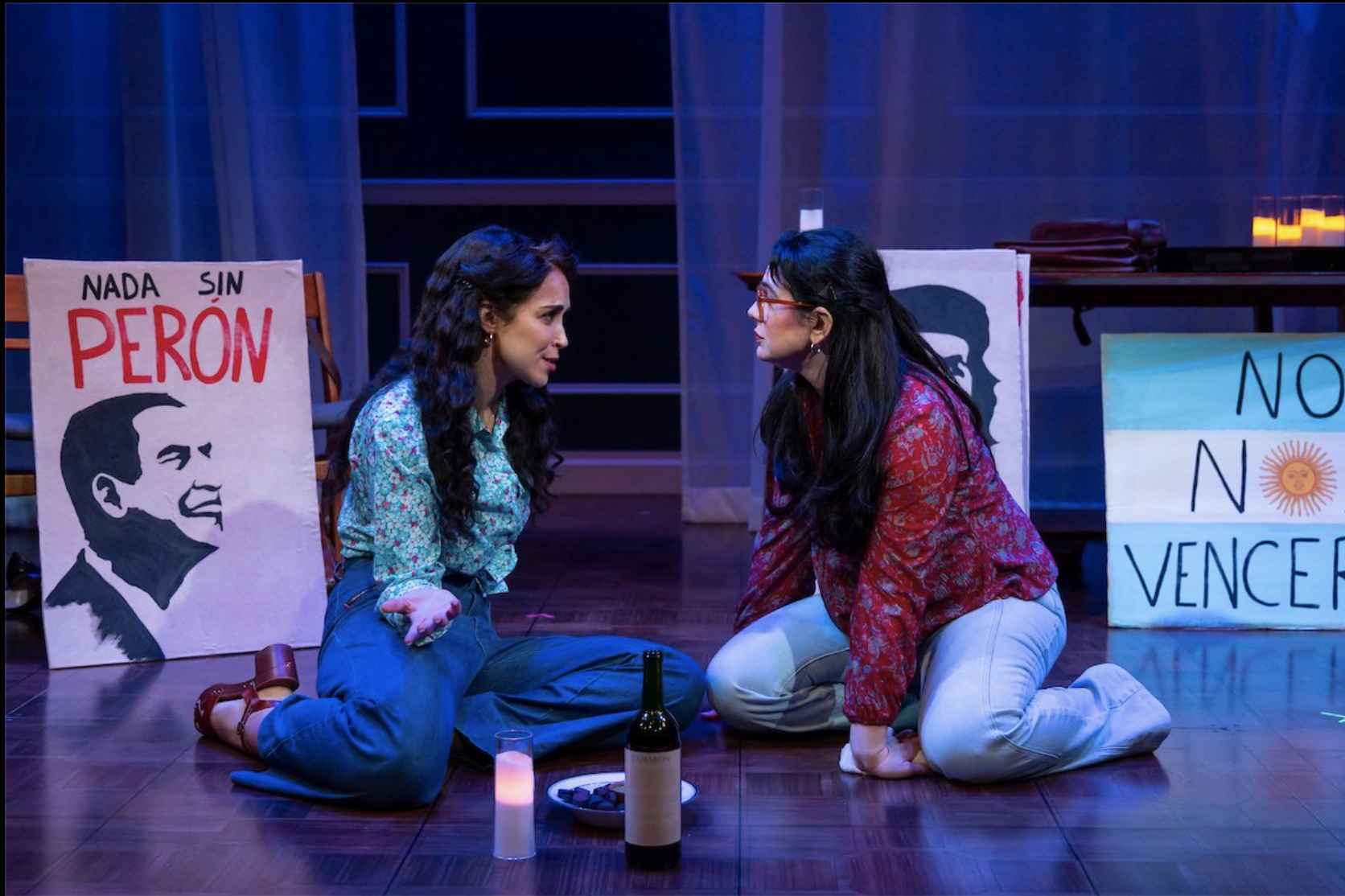
All hail this female TRIUMPH of a play. This glorious, funny, warm, loving, moving, beautiful story full of history and heart. It has been an honor to be a part of the BIRTH of this piece, create these characters alongside the brilliant actor/playwright Christina Pumariega and with the peerless leadership of Nicole A Watson. 
 
What a rehearsal room (of all women— including our glorious SM team, dramaturg and AD!) This also marks my first theatre contract as a Latina actor (this one is for you Noriega family—finally!), my 7th world premiere, and marks my 20th year in the professional theatre. 
 
I’m so proud to be a part of this show I could burst.
 
As Dr. Cossí says: “Okay we done!” 
 
Let’s party.

photo by @motendesigns (also our phenomenal scenic designer)


A play is nothing without the team that makes it. It takes a village. 

That village is:

Playwright: Christina Pumariega
Director: Nicole A. Watson
Scenic Designer: Lawrence E. Moten III Costume
Designer: Raquel Barreto
Lighting Designer: Carolina Ortiz Herrera Sound
Designer: Sinan Refik Zafar
Projection Designer: Kelly Colburn
Dramaturg: Sarah Rose Leonard
Dialects: Rosie Berrido
Intimacy Coordinator: Alex Might
Production Stage Manager: Jynelly Rosario
Rehearsal Assistant Stage Manager: Gracie
Carleton
Assistant Stage Manager: Abigail Medrano
Casting: Caparelliotis Casting and Joseph Gery
Assistant Director: Jessi Stier
Associate Scenic Designer: Danielle Delafuente
Assistant Lighting Designer: Hayley Garcia Parnell
Hair and Makeup Consultant: Carissa Thorlakson
Projections Consultant: Dylan Uremovich


05 February, 2025

Five Women at an Airport: The Full Film

It's here.  "Five Women at an Airport" is complete and ready for your viewing (in 4K!)

 I wrote about this incredible piece, project and experience last July, but here is a snippet of what I said:

"This piece. 
This experience. 
This team. 
These WOMEN. 


I will never know what I did to deserve this perfect alchemy of passion, commitment, humor, depth and talent— but we got it all and then some, all in 20 days that felt like 20 years. 

What we achieved artistically, emotionally, and all ahead of schedule (?!) was a miracle. 
[...]
I’ll never fully have the language to express what this 3 weeks— my first ever as a professional director of anything, let alone a movie musical—meant to me. [Lyricist and book-writer David Goldsmith] saw something in me I didn't even dare to see in myself.  It also came with the unparalleled trust of its genius creators John, and Wendy— who created a work of such indescribable truth and beauty; a work about real, mature, fully-embodied, nuanced women speaking to one another like real human beings. These are roles women can savor, relish and feast upon for eons to come. 


I’ll say until my breath runs out: in show business it is not the work you make, where you make it or the tens of dollars we are sometimes paid for the privilege. It is, above all, about who we share it all with. 
"


 So enjoy, dear friends. 

 
Click the link above, start watching below, or simply go to YouTube and type in “Five Women At An Airport.” 


Watch our film-capture. For free
 
Enjoy the breathtaking — truth-soaked, hilarious, skillful, heartbreaking, vocally astonishing and absolutely stunning — performances of Cailen Fu, Katy Geraghty, Bryonha Marie, Kate Rockwell and Elena Shaddow
 
The endlessly inventive, soaring, magical, moving musical theatre score of John Kavanaugh  the wit, wisdom and powerful insights of the book and lyrics by David Goldmsith and the co-bookwriter and conceptual matriarch, Wendy Perelman. 
 
Watch. 
Enjoy. 
See what's possible with like $300, and bags of delusional hope. 
 
Hit like. 
Hit share. 
Comment. 
Talk about it. 
Sing all the songs. 
Make it part of the conversation. 
 
The community. 

Our community. 


Let’s change how things are done. 
Let’s fix what’s broken. 

15 July, 2024

Take Off: Filming Five Women at an Airport

That’s a wrap on my first full musical production as director, and my first feature film as director, the glorious filmed musical, "Five Women at an Airport.
"
 
This piece. 
This experience. 
This team. 
These WOMEN. 


I will never know what I did to deserve this perfect alchemy of passion, commitment, humor, depth and talent— but we got it all and then some, all in 20 days that felt like 20 years. 

What we achieved artistically, emotionally, and all ahead of schedule (?!) was a miracle. 
 
A few months ago my dear friend lyricist, playwright, and musical book-writer David Goldsmith approached me about an idea conceived by the great Paul Gordon, who David describes as the "Jobs to his Woz," and this idea as the proverbial Silicon Valley garage. And you, dear audience will be the potential proof of their genius concept.
 
David and his fellow creatives Wendy Perelman (book) and John Kavanaugh (music) had a piece of material that they deeply believed in. 

A piece of musical theatre they felt needed to be seen. 

They called that piece “Five Women At An Airport.”


At the same time, we had a broken industry. 

Paul and David wanted to figure out a way to democratize more than merely was what was produced and celebrated within it, but what was ever seen at all. 

They came up with an idea, and called it Virtual Stage Lab. 

They wanted to film our musical within weeks, not months; and not as a finished product, but as a video demo filmed on a stage at the highest possible level. The focus would be on the story, music, lyrics, and the performances of the actors. 

And then they intended to post it online, for free. For anyone and everyone to see the work, and the work of their colleagues and collaborators. 

If any productions came of it—or any licenses derived from it—all of those artists would share in a royalty pool that, in success, would bring them revenue in perpetuity. 

Plus everyone would get some beautiful footage, doing beautiful work. 


That was the idea.
 
I was entranced. And I cannot believe they asked me along for the ride. As the DIRECTOR. (I mean. Were they insane? Didn't they know the only thing I've ever directed in my life was countless scene study classes and like six Greek tragedies at a conservatory? What were shot lists? Who was going to costume this and design the lights and keep everyone on schedule? ME?! That's insane. That's for adults...)
 
They didn't care. David knew. He saw something in me I didn't even dare to see in myself.  It also came with the unparalleled trust of its genius creators John, and Wendy— who created a work of such indescribable truth and beauty; a work about real, mature, fully-embodied, nuanced women speaking to one another like real human beings. These are roles women can savor, relish and feast upon for eons to come. 


I’ll never fully have the language to express what this three weeks meant to me. 

I’ll say until my breath runs out: in show business it is not the work you make, where you make it or the tens of dollars we are sometimes paid for the privilege. It is, above all, about who we share it all with. 


None of this would have been possible without the entire technical team — Ian, Tais, Dylan and our magic MD Andy Collopy and genius Director of Photography, Konstantin Yelisevich. Dreamboats ALL. And above all; the literally jaw-dropping organization of our Stage Manager Morgan Holbrook who kept us on track at every turn. 


But to my beloved ladies — Bryonha Marie Kate Rockwell, Elena Shaddow Katy Geraghty and Cailen Fu— I have never had an experience like this. One of instant collaborative and temperamental alchemy. From the word “go” you generously offered me not only your time and infinite talents, but your trust and hearts and souls. Thank you for making my first directing experience such a dream. I passionately love you.


And now? That’s a wrap. 

See you at the movies. 

Director (and Karole)—out.
 
Watch this space in 2025 for the full feature film. 
 

18 May, 2024

"There was love, all around..."

©aka liz lauren
There was love all around, but I never heard it singing…

One of the things I adore—and have truly learned—in the playing of this classic song (‘Til There Was You’) is the humble admission of something I know all too well (because I personally did it for years):

That, as individuals who desire to love and be loved, sometimes we participate in our own solitude. 

We perpetuate it by keeping the world at a safe distance. We think that a world kept at arms length cannot hurt us. But that isn’t how it works. A heart sealed in an airtight box does change— just not with scars or wounds. It calcifies and hardens.

For Marian— a woman who has an almost rigid rigor for upholding the 'absolute truth' — I think this line in this song is Marian’s greatest moment of vulnerability.

To fully admit (in song)—that despite all her research, her knowledge OF love stories, poetry and BALZAC— she didn’t just miss something, she missed everything. She missed the point of all of it: love “all around” her.

And she missed it not because of town gossip, or grief, or the lack of a suitable partner in the area,— she missed it because her own rigid walls were built up and buttressed so high that she almost tossed love aside even when it was right in front of her.

I relate.

And I celebrate her humility and admission because it is, in every way, my own.

Maybe it’s yours too.

(And I thank —infinitely— the love of my life, my beloved Alec, for patiently standing before me until the walls came down)

May you be brave enough to see the love all around you, whenever you are ready to fully receive it.

Love on.

© Marian at sunset by @brave.lux - What a dream it is.


29 April, 2024

Making Marian with Katie

Doing The Music Man in Chicago has been a great blessing to and for me, and a great break from the dark dark plays I've engaged with over the last few years. 

There have been SO many revelations—many that have occurred, artistic and personal—some simply because I am spending so much time outside of work by myself, in contemplation). Which, though I miss Alec and Tati terribly, is always fruitful for me. I am an introverted being after all. Solitude always seems to “force” something to the surface, outward, forward. 


It’s a fantastic room, and it’s profound to work with such a close friend
Katie Spelman as director/choreographer because I know she trusts me utterly. 

Katie is one of my best friends-- and, compared to some of my lifelong friendships-- she is a relatively new best friend; one I've made in the last 5 years. Something about that feels special. It's challenging to make friends in adulthood, particularly with fellow women (many of whom pair off and have children in this era of life-- so friend groups break apart and re-assemble around those choices through no "fault"). It's been an expansive relationship in every way.

Katie has visionary ideas but also encourages other great ideas and creates an environment where people can express them with ease. She is passionate but not rigid. She IS visionary — especially in the storytelling-through-dance part. 

But I’ll say the most beautiful thing I've experienced here is a kind of intimacy that I never expected — a feeling of closeness with Katie because we both sort of understand that in many ways I am playing a version of me, but more crucially a version of her. She is Marian at the top of the show, and I am Marian at the end. And together, we are weaving this new vision of Marian together. It's an act of total mutual creation and it feels sacred in its intensity and intimacy.
 

*

    We had an almost inexplicable moment of platonic intimacy the other day in rehearsal discussing the (beautiful, underestimated, gorgeous piece of theatre I utterly underestimated) second act scene when Harold Hill comes to call at Marian's house, and eventually invites Marian to "the footbridge."
 

There was a moment the other day when Katie was begging to cut the line “My dear little librarian…” 

And I took paused. Took a beat. First of all, it’s not my line (it is Harold's), but the ferocity of her passion for cutting it made me pause. I asked what bothered her about it. She said she thought it was "demeaning and diminutive and not Feminist." Despite her intellectualizing, I could see her emotion just below the surface. I love this person. I know her. This was a moment of Knowing.

I asked for a quick 5. 

It was time anyway, but it felt like a good moment to pause. Katie is a 37-year-old woman who if she had her choice, would have a significant life partner. She has some walls (who doesn't?), and it IS hard for her to find a worthy partner because she’s extra, extra extraordinary. But she’s also part of the problem. A problem I know and relate to very well. Because it is a problem I had myself… 


For years and years I was unavailable to real partnership and to the real reception of love because I was overwhelmed by childhood trauma, grief and self-loathing, then by illness -- and all of those contributed to the story that "no one could possibly want to love me." But the problem was not that I was unlovable— it was the fact that I believed I was. And with the belief so deeply rooted within my cells, in every action I took that I almost missed it standing right in front of me.
 
For in 2019, Alec Silver was RIGHT THERE. He was standing before me, totally in love with me, with MY EXACT F*CKING NAME

… and I almost missed him. Because of my stories. My insistence on my unloveability. I almost missed and blew the greatest gift of my life  because of my walls and fears. 
 
And this brings me to my next point— the line 
:
“I just can't. Please. Some other time, maybe tomorrow...” 


which oddly is the line before the “my dear little librarian” line. 


I cannot tell you how much this line shakes my soul.
Because again, Alec. And why I had to play this role after Alec.
Because love is right there.

Harold Hill is man making an actual bid to connect with Marian. He is, shockingly, truly worthy of her. They are both as lonely and broken and intelligent and isolated as one another, they both need each other. 

He is saying “please meet me— not just at the footbridge but in a place of intimate love” 

and she says “maybe tomorrow”

That was me.
Until Alec. 

"There was love all around, but I never heard it singing..."


So we broke, and I took her aside in private:


     “Katie… my whYfe. One of my very best friends. Part of Marian’s agony is that she is capable of so much love and passion, but her years and years of walls are preventing her from allowing herself to BE loved. And sometimes that allowance looks “soft” and “tender” and “feminine”…. none of that is negative. None of that is anti-feminist. Let’s try the line as a man who is making a bid to be soft with her. Who sees she needs softness. And then we can allow this woman who is terrified of being seen as 'girly' because she thinks it means she is weak... to be a creature of desire and of being desirED. And I think you’ll see it’s right. 
And to allow ourselves to be vulnerable is also the key to all of our liberation… when we’re ready”


Afterwards someone asked:    

         “What was that?” 


        And I replied: “That was love” 


13 April, 2024

Broadway World: The Music Man Q & A

© Joe Mazza

Originally published at Broadway World on April 13, 2024


Alexandra, stepping into the role of Marian Paroo, a character known for her complexity and depth, what aspects of her personality do you find most compelling to explore?
Given your extensive background in theatre, including roles in Fiddler on the Roof and Master Class, in what ways does portraying Marian challenge you in new ways
?

Having spent many of my marriageable and child-bearing years as a Midwestern, bookish spinster myself, I feel adequately prepared to portray the role…

Okay okay. Jokes aside,

    Being an actor is as fascinating — just when you think you have landed upon the next realization, stage of growth, place of acceptance, or the next “AHA,” another one presents itself to you. What a gift. While Marian is in many ways “in my wheelhouse” (as a golden-age soprano, an American [I play a lot of not-Americans], a bookish, aging woman) she’s presented great surprises.

What I recall from the era of my solitary life before I met my husband, Alec (met him, at the age of 35—) was how very full-to-the-brim with love I was, with nowhere to offer it. I think many people relate to that state of being. I was certain my life story would not be a romantic one (which is absolutely fine, if that’s your choice— but if I could have been honest with myself at the time, it was not my choice). I possessed an equal amount of
    1. Reasonable standards/ principles about what I wanted love and partnership to be, and
    2. deeply unhelpful made-up stories I was telling myself that ultimately just perpetuated my solitude.

No, I was not merely “drawn to unavailable people,” because the most unavailable person in the equation was me. I was in my very own way, terrified of being known or seen or allowing myself to be vulnerable enough to receive love.

This is Marian’s plight.

More than her rigidity, her isolation, or her status as an outcast.
 
And perhaps this plight is why I have not personally played her until now. Perhaps I had to personally be on the other side of Marian’s second act— to appreciate the agony of her self-sabotage and recognize myself in it. To acknowledge how much time I wasted with my heart encased in iron locks. To fully appreciate how courageous a thing it is to allow yourself to be loved, and of course: love’s utterly transformative power on the other side of all that terror. 

© Joe Mazza
As audiences experience this production of The Music Man, what message or feeling do you hope they take away from seeing you as Marian Paroo?


All of the above, plus:

    - Women are people.
    - Read banned books.
    - Let yourself be loved.
    - We need both facts and poetry.
    - It’s never too late.


The Music Man is celebrated for its classic American storytelling and memorable score. How have you approached singing Meredith Willson's iconic music, and do you have a favorite number to perform?

    It is hard to believe that even though I have done a great deal of singing in concert or cabaret settings in the last 5 years, I haven’t been in a “proper” musical production since before the pandemic! So the first challenge is the discipline, technique and stamina to perform such a powerhouse soprano role 8 times a week with consistency and facility of expression.

    And honestly, it’s been pure joy to go to the “vocal gym” and celebrate what I do feel is my natural sound.

    I love the entire score, but I think my favorite song to sing is the “Lida Rose/ Dream of Now” number in the second act with our tremendous barbershop quartet.
Two reasons.
First, Marian’s verse is a soaring dreamscape of fantasy and yearning. It’s almost erotic in how fully alive her yearning is— and I don’t think I had ever previously acknowledged that about this character. (I mean: the clues were all there, she reads Balzac for goodness sake!)

    Second, theatre is a team sport. So while I appreciate a lovely solo as much as they next soprano (LOL), there is nothing like making music in a group— and this particular group is world class.


This production brings together an incredible cast and creative team. What has it been like worth with the incredible ensemble of artists?

A chef is only as good as their tools and ingredients.
A painter only as good as their materials.
A tennis player made better by the quality of their opponents.
By this logic, a theatre artist is only as good as their playmates (and it’s called a “play” for a reason.)

    Every member of our creative team and ensemble is world class-- I’m particularly awed by Raquel Adorno’s costume designs and honored beyond language to share a stage (and a dressing room!) with the Chicago theatre legend that is Janet Ulrich Brooks as Mrs. Paroo, and the rising star that is Kai Edgar Joseph as Winthrop.

These are only a few of the team players that awe me, daily.

    The majority of my work occurs with KJ Hippensteel’s Harold Hill. KJ’s Harold is one of the most fully-realized, heartfelt portrayals of the role I’ve seen— he has the stage charisma of a cult leader and the endlessly likable charm of Dick Van Dyke, and though I don’t know a great deal about the finer details of his personal life, one can tell he really loves his wife (it’s something you can see in his eyes, in his work.) I think one can always tell when an actor knows/has known true love— it’s incredibly special to act with.
    KJ is also so willing and available to exposing the vulnerabilities of Harold Hill (which always, on some level, requires exposure of the actor-self too— and that takes a tremendous courage).  To borrow a metaphor from above, it’s a gift to play “pro-tennis” with him. Long may KJ Hippensteel lead companies.

    But the deepest gift of this experience has been collaboratively re-creating a new vision of Marian Paroo with our director-choreographer Katie Spelman. Katie and I met and worked together 5 years ago, and formed an intense adult-friendship bond that was instantaneous (and mutually insistent upon being permanent.)
    One of the things that has been breathtaking is how our deep knowledge of one another has informed and shaped the mutual creation of this “new” Marian. This Marian is informed by both of us, who share much in common with Marian herself, and with one another as deeply feeling, intelligent women with much to give the world and sometimes getting in our own (different) ways.
    The moments of side-splitting laughter, of debate, of shared vision, of exponential, mushrooming creativity are endless between us.
    But it is the moments of what I can only describe as platonic intimacy that have defined our collaboration. One rehearsal memory is so private and tender it doesn’t belong anywhere but in my memory, but suffice it to say the exchange in rehearsal silently expressed Katie saying “let me give this to you” and my silent reply being “let me do this for you.” The end result is an act of service to Marian, to all woman, to art, and to one another. I don’t know that I’ve ever had an experience like it.
 

The Music Man has a timeless quality that resonates with audiences across generations. What do you believe is the key to its enduring appeal, and how does this production capture that essence?

    In many ways The Music Man as written by Meredith Wilson in the 1950s is about “America” with a “capital A.” America in the early years of the 20th century, in many ways still young, self-absorbed and foolish, in many ways brave, visionary and pioneering. I think what Katie Spelman is attempting to lead us all to do is envision and embody an America that was and an America that could be, when the best of us comes together as a community.
    In our production the fictional River City has recently been through a terrible plague (not at all unlike our world in 2024), experienced individual and collective grief, and in many ways has spiritually “died.” Harold Hill brings River City back to life— even if it is by accident.

    What human being doesn’t empathize with the sensation of dreams and possibilities bringing our souls to life? That’s The Music Man’s enduring appeal.

    Aside from that? Come on: the score is a hit parade (as they kids say “no skips” on this album), the book is impeccable, the dance numbers are bangers, and there’s an unlikely love story. What’s not to like? 


Marian Paroo's transformation throughout The Music Man is pivotal to the story. How do you navigate her evolution from a skeptical librarian to someone who embraces change and love?

    Everything changes when Marian sees what Harold Hill’s poetic lie has done for her brother Winthrop. Her grief-stricken, shadow of a baby brother transforms into a joyous child. The power of Harold’s promise changes Winthrop’s life, and brings the town of River City back to life— and it is palpable, undeniable. She can’t deny that though he may be a literal charlatan, he is in touch with something powerful that exceeds her understanding. That crack— that one aperture in— lets the light in to her soul as well.

    Not every fact with a perfect citation contains the poetry that makes life fully expansive. Harold provides—almost accidentally—that poetry.

    And what I find most interesting?
Marian lives a truthful life, and Harold lives an untruthful life.
But neither of them live honest lives.
They are dishonest in their own ways— with the world and with themselves.
That is, until they are in the presence of the other— honest at last.


Why must audiences see this production of The Music Man?

- You will see a deeply explored version of this story in character and context.
- You will see bodies of color inside the story in an all-embracing way, allowing new people to tell this story.
- You will see 37 brilliant performers on stage in the round (the second largest cast in the Marriott’s history)  
- You will hear a gorgeous orchestra play this classic score
- You will laugh, you will cry, you will fall in love. You will want to go out and buy a trombone.

See you at the library.