Showing posts with label Friends. Show all posts

25 March, 2026

"All I Need is the Girl" from Broadway Backwards: 20th Anniverssary

From "All I Need is the Girl" with Robyn Hurder

‘ALL I NEED IS THE GIRL’ – 2026

There aren’t words to express what it meant to be invited back to share the stage with my forever girlfriend Robyn Hurder (arguably one of our *greatest* triple threats) and recreate this iconic scene and choreography from GYPSY (originally directed / put on us in 2019 by pal Tony Yazbeck  iconic Tulsa himself!)

Ohhhhh how the world has changed since then. How both of our lives, bodies, hearts and careers have evolved and shifted in those 7 years. And yet, like the magic that is emotional and muscle memory: there it all was, like not a moment had passed for this version of Tulsa and Louise. A very special take on the agony of unrequited love…

Thank you Broadway Cares for the honor and the gift. ✨

📸 📸: Michael Hull and Rebecca J Michelson
_________________


BROADWAY BACKWARDS
Written, Directed and Choreographed by Robert Bartley
Music Supervisors: @tedarthur, @marymitchellc
Music Director: @stevenmcuevas
Choreographer and Associate Director: @adamant9
Co-choreographers: @tinylamotte, @colby_q
Production Stage Manager: @esarab
Props Designers: Jenna Snyder, @alexanderwylie87
Lighting Designers: @jeffcroiter, @colleenashleyd
Sound Designers: Marie Renee Foucher, Josh Maszle
Costume Designers: @kittycassetti, @jgersz, Alex Rocky, @tiecarlton
Hair Designers & Supervisors: @meganburkeartistry, @wigkedtiff
Makeup Designers & Supervisors: @joshuabarrymua, @meganburkeartistry
Casting Consultant: @castingbyarc

22 March, 2026

(Re) Rehearsing for Broadway Backwards: 20th Anniverssary

There are certain nights in the theatre that feel less like performances and more like communal acts of remembrance. Broadway Backwards has always been one of those nights. For twenty years, this extraordinary event benefiting Broadway Cares/Equity Fights AIDS has gathered artists together not only to celebrate the LGBTQ+ community through the re-imagining of beloved musical theatre canon, but to remind us why theatre matters in the first place: because storytelling can raise money, yes—but more importantly, it can raise one another.
 
So to be invited back for the 20th anniversary celebration at the Gershwin Theatre was already beyond anything I could have dreamed. To be asked to revisit not one, but both of my previous numbers — “All I Need Is the Girl” with the incandescent Robyn Hurder and “One Day More” alongside this glorious company of artists—felt almost impossible to process emotionally. There are moments in a creative life where you feel yourself quietly admitted into the room you spent your entire childhood hoping existed. 
 
This was one of those moments. 


And what moved me most deeply was not merely the nostalgia of recreating these performances, but the realization that while the work remains frozen in time, we do not.
 
When Robyn and I first performed “All I Need Is the Girl” in 2019, I had just met Alec—my now-husband—and I could not possibly have imagined the life that was waiting for me. I had not yet endured four life-saving surgeries. I had not yet learned what it meant to rebuild a body, a career, and a sense of self simultaneously. Robyn, too, has transformed beautifully: artistically, personally, professionally. Watching her ascend has been one of the great joys of my life.
 
And when I stood in “One Day More” in 2022, the entire world still felt bruised and disoriented from the ravages of COVID. I was still struggling physically and emotionally in the aftermath of illness and survival itself. We were all, in some way, trying to remember how to gather again.
 
That is the strange and holy magic of theatre. We return to the same material, but never as the same people. Every revisit becomes a kind of archaeological dig into who we once were and who we have become. A lyric lands differently. A harmony carries new grief or gratitude inside it. The body remembers what the heart has lived through.
 
 
For aspiring performers, I think this may be one of the greatest lessons this art form offers us: your work will evolve because you evolve. Life will mark you. Love will mark you. Loss will mark you. Survival will mark you. And if you are fortunate, you will someday return to a familiar stage carrying a deeper humanity than the person who first stepped onto it.
 
What an honor to revisit the past in service of the future. What an honor to stand among this community. And what a privilege to still be growing inside the work.
 

27 October, 2025

The Bywater Scissors

     At the end of 2024, I was cooked. Fully crispy, charred artist-on-a-spit. Four major surgeries in four years, disillusioned, gaslit by the career I thought I loved, ghosted by people I used to admire, and filled with a creeping sense that I was the punchline to a cosmic joke called Show Business. I couldn’t even walk IN to a theatre, I couldn’t watch TV or movies, listen to music, or look at a stage without feeling totally nauseated.
Like I’d let down the ghost of my teenage self 
     and every hope of my long dead father 
          like I was in my own little Euripides play 
I joke now, but months ago? I was all dactylic hexameter and up-at-night, inter-generational questioning. 
My inner monologue had devolved into: “Why are you doing this to yourself?” 
 
I was staring into the void of my creative life and wondering if there was anything left to revive—ready to quit The Showbiz move to a small town and open a candle store called something tragic like Cutting Room Floor or Final Act (or something) and never speak of “the industry” again.
 
So when 2025 began, I made a very quiet, barely-uttered promise to myself: no more striving. No more hustling. No more saying ‘yes’ to things out of panic. Every project I took on needed to meet one simple criterion: it had to be nourishing. Not career-advancing, not résumé-polishing—but quite literally nourishing. Nothing I took on could be to impress anyone, gain me clout, or “advance my brand” (please stab me)— all it had to do was very simply make me feel vaguely human again. 
 
The rule was simple: if it didn’t nourish, it didn’t happen.


There comes a time in every working life when the great “why” that once powered you—the burning sense of purpose that made exhaustion seem noble—simply burns out. One day you wake up, and the thing that once filled you with wonder feels hollow. The rituals of your calling turn mechanical; the air goes out of the room. 

I think that’s the part no one warns you about: how meaning doesn’t vanish all at once, but by degrees. You bargain with it. You tell yourself the spark will return when the next job comes, or the next success, or when the world feels less cruel. When meaning leaves a person, it does not leave politely. It takes with it your sense of direction, your appetite for risk, even the reason to get out of bed in the morning. And when it finally does go quiet, the silence inside you is deafening. You start to wonder if you’ve been a fool to love something that can’t love you back.

But here is what I have learned in the slow rebuild: meaning is not an idea; it’s a practice. It returns not through revelation, but through repetition. Just like the art of theatre acting itself: the identical daily exericse. The play is not different, but the world is, and you are. And thus meaning sneaks back in during the work itself: line by line, scene by scene, hour by hour, shoulder to shoulder with other people who are also trying, also hoping, also just showing up. 
 
The doing becomes the proof. 
The companionship becomes the faith. 
 
And one day, almost without noticing, you feel the warmth again—the quiet understanding that purpose isn’t something you find, it’s something you make, together.
 

When Dial M for Murder at Drury Lane came along, I said ‘yes’ because my instincts told me it felt good. Not strategic, not glamorous—just good. I came back to Chicago—and found not only work, but warmth. 

First of all, Chicago is that girl. Warm, funny, affordable-ish, and full of theatre people who will drive you to Trader Joe’s when your loaner car craps out. I forgot how much history I had here. Colleagues. Friends. Kin. People who had called an ambulance, seen me single, sad, on morphine, knew every “bad side” and still answered my texts. I never like working far from home, but Chicago now feels like a second one, with (sorry, New York), superior hot dogs. 

And then there was the unexpected joy of finally sharing a contract with my high school friend of twenty-five years, Adam Immerwhar. Adam led with taste, humor, and (a helluva lot of) grace, and together we filled our utterly preposterous “digs” in the windowless attic of this actual theatre with something I think I remembered called joy. There were martinis. There was the wearing of costumes from the seemingly permanent “Christmas Carol” clothing rack, and as a result of all of this: THERE WERE BITS.

And my God, this cast. Unreal. Every single person was both a phenomenal actor and a functioning adult. One of the best companies of my career. 

We built our own little speakeasy backstage—a ramshackle bar affectionately named “The Bywater Scissors.” It became our gathering place, our late-night lounge, our hub of laughter, Erik-Hellman-prepared cocktails, and gentle mischief. 
 
Joy, shared. 
Exhaustion, witnessed. 
Kindness, on the rocks.
 
There was something sacred about it. 
 
This company has been a miracle of balance—funny, kind, honest, supportive; and all emotionally literate, have been around the block in The Showbiz, and all with a nice grasp on reality.  We managed to stumble into the anti–regional theatre cliché: no drama, no ego, no chaos. Just real grown-ups playing pretend together for a living fully committed to the backstage bar. 

 
Now, as the show closes and 2025 saunters to its end, I can say this: I’m not “fixed”—let’s not start that rumor—but I am better. 
 
It turns out, rehab doesn’t always happen in hospitals or cult-y Malibu retreats. Sometimes it happens at The Bywater Scissors, surrounded by people who remind you that there really IS still magic in the thing you loved when you were fifteen. 
Still here. 
Still showing up. 
Still loving a ridiculous, impossible art form that somehow refuses to let me go.
 
So, to the artists (Amanda, Erik, Ian, Jonathan et al) who maybe unknowingly helped me find my way back to wholeness—thank you.
 
And thank you, ‘The Theatre,’ for taking me back even after I ugly-cried and told everyone we were “on a break.”
 
There really are no people like show people.


17 October, 2024

All hail "Gang Cult"

Were we a "gang?" 
Were we a "cult?" 
Who knows? And who cares? 
We weren't sure, so we called ourselves "Gang Cult" and that was that. 
 
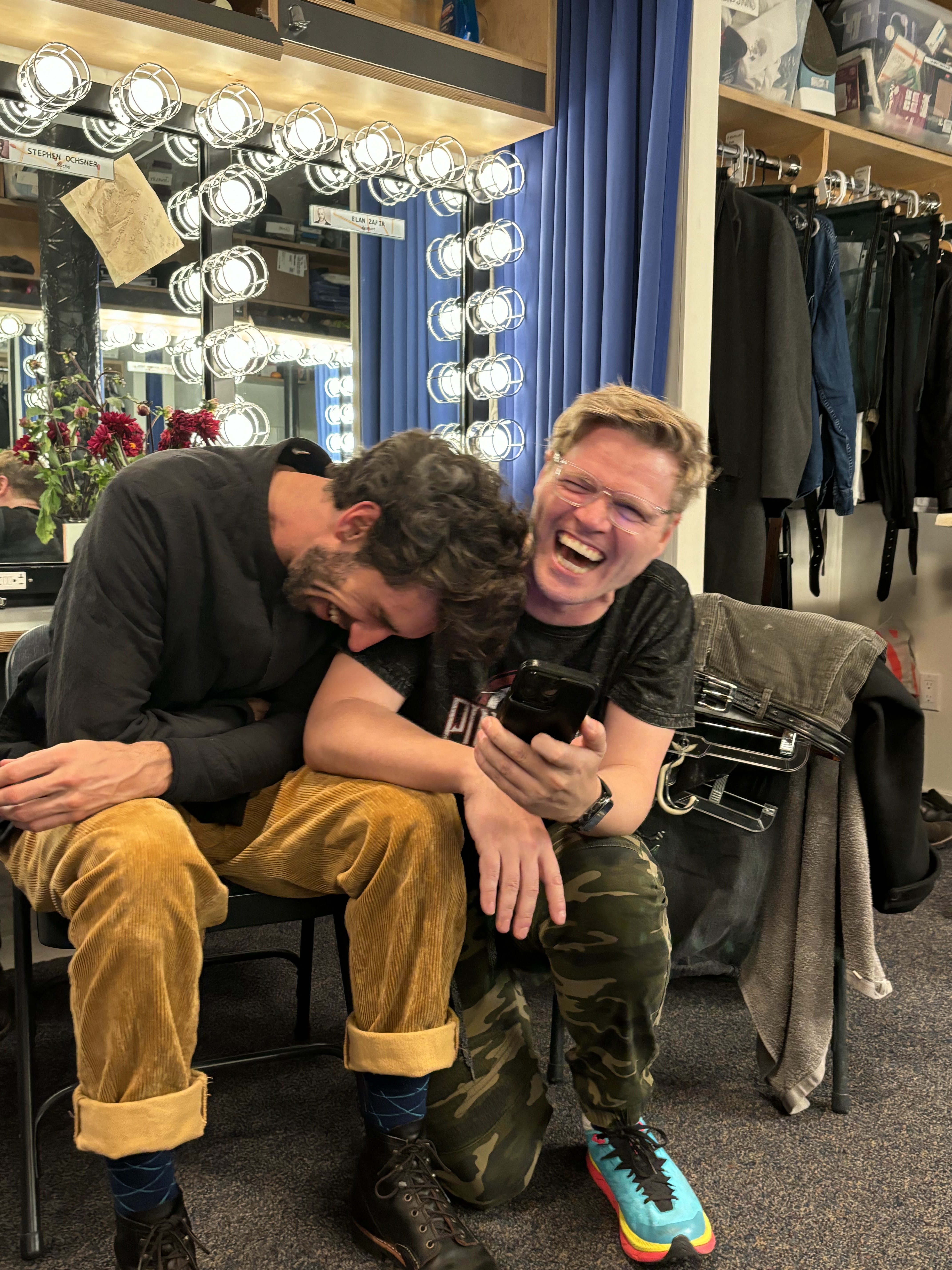
I couldn't have gotten through the last few months without these boys, and our "Annie Zuks--" wardrobe woman extraordinaire, always staying til 1am, doing our laundry and mostly getting chalk out of ... everything. 

 
We met almost every night post show. 
We greeted our friends in the lobby or outside, then we'd sauntered back within-- rip the curtain that divided the men's from the women's dressing rooms and in the still-small space, we'd turn the chairs toward one another and settle back in to relax for an hour before heading home. 
 
You would think we had spent enough time in that theatre (as in: all day, especially once we were doing double duty with Merchant of Venice). 
But it didn't feel excessive. 
It felt therapeutic. 
Necessary. 
Real. 
True.


We laughed. 
God how we laughed. 
We drank wine and bourbon. 
We solved the world's problems. 
We heard one another's. 


Stephen ate salads. 
Will ate nuggets. 
I ate nothing. 
Our hearts broke and broke open. 
We welcomed special guests (for truly all were welcome!)
And we carved into eternity, memories and bonds that only theatre can create. 


This is the why. 
The "why" of "why we do this" when almost everything else makes us forget. 
It's the people.
The friends. 
 
So thank you, friends. 
Gang Cult: over and out. 


26 August, 2024

The Final Update on my Non-Colon

So. Hi Everyone.

Al here—providing [what I hope is] the last blow-by-blow health update in the latest chapter of ‘Adventures of Al’s Not-Colon.’

As previously mentioned, in May I had an experience onstage during a performance of The Music Man where I experienced blinding, lightning-fast 10/10 pain in my viscera, and was carted off-stage mid-show and hospitalized. 
 
A few weeks of tests in the Chicago area commenced, liquid diet, pain management, and I was delighted once again as I navigated the labyrinthine rigamarole of the American-healthcare system, as I was required to re-integrate myself back in to the Mount Sinai hospital system after 3 years of stability. 
 
What was wrong? I had 2 complex twists in my small intestine that leads in to the J-pouch, creating an obstruction and preventing me from being able to properly digest and pass food. The plan was to untwist me, and "tack me down" to prevent further twisting. And and and also? SURPRIIISE: once they got inside they discovered I also had a hernia! What can I say? I was always an over-achiever.

Last week—three months later—I was finally able to get the corrective "tune up" surgery I'd been waiting for since May, and wahoo: angels sang. If you have been through the joy that is the American healthcare obstacle course, you know how sweet the moment is when you finally get the treatment you need! I was home the same day and healing began. Slowly.

How it went/how it's going: Physically: 
 
The gist: healing at home was slow and FAR more painful than I anticipated. 
 
- Digestive: Amazing. I feel REBORN. It feels incredible to have the digestive system working again, drama-free. And I have returned to solid foods— which was incredible having been predominantly eating liquids since May. 
- Pain (internal): Going great. It started to ebb at day 3. 
- Pain (incisions): The major pain was the incisions themselves which were *eye-watering* in their pain level. The meds did not even make a dent in to the chandelier-ing I experienced whenever I vaguely moved, coughed, sneezed or made direct eye contact with any living creature. No exaggeration: these first 8 days post-op were beyond anything I had experienced in the first three surgeries (and, as a ridiculous statistic a proctocolectomy [removal of the large intestine, etc— ie, my first surgery] is considered to be the 4th most painful surgery to recover from — which is? WILD. 


How I am: Mentally 
 
I won’t lie to you friends, I am struggling.
 
I have felt wave after wave of physical traumatic-memory flood my body and psyche constantly in the last few weeks— sensations I had long anticipated putting to bed for good. While I was working my ass off between appointments to pay for all of this, the experience of going through some of these old “motions” (places, sensations, people, smells, sounds, literal pains) has not been breezy, and oftentimes has been outright (a word we overuse in pop psychology but I am told by professionals is apt here) triggering. 

One of the more frustrating elements of this has been the medical rigamarole of begging the system for help, waiting. Not getting to who I need to get to without doing a complex dance of charm-offensive, bureaucratic paperwork and sparring but judicious use of the "speak to the manager" voice (my least favorite voice of all). 
 
 Begging and waiting for insurance to cover things. And of course: not knowing exactly what was actually wrong, etc etc. 

- The greatest doctors I saw approached me with the respect and seriousness that comes with being the best in the world (thank you, Sergei Khaitov). 
- Some doctors met me with a “breeziness” that perhaps seduced me in to thinking this recent blockage experience is “no big deal” and something that could be handled relatively swiftly and without major interruption.  
- And then there were the doctors who outright convinced me I was “stressed” and that this was “in my head” and essentially: calling me hysterical without calling me hysterical. (It really is AMAZING being a woman... inside a healthcare system…)

It was… confusing. 

Further, so much of this was also experienced physically-without Alec— because our various jobs have taken us to different parts of the world since March. That has been extra hard. 

All of it led to me— (some of it not to be helped, some of it the power of denial)—  not really mentally grasping the scale and magnitude of what was going on inside me, partially because, I don’t think I wanted it to be true. In general I’m kind of a “slap-a-bandaid-on-and-get-on-with-it” kinda person. Not only do I not want to make a big deal, I don’t WANT it to be a big deal. I also don’t want anyone to think I AM A GIANT WEENIE. I don’t want to bore you all. I don’t want to talk about this anymore! Plus, I want to be "tough." I want to be "strong.” But sometimes toughness and strength are in surrender… Sigh. I am learning… 

I am heartbroken to have not been as present as I have wanted to be for my friends and family—missing milestones, big events; big shows, being with your children; not having the bandwidth for conversations and get-togethers that sustain meaningful connections, and sometimes forgetting or missing out on things that DO matter to me very much, simply because I am “doing colitis.” I think this is this colitis' greatest theft.

To illustrate how caught off guard I was by all of it I’ll describe the “aha" moment from the day of surgery last week. Moments before I went in to the actual surgical room, Dr. Khaitov's second-in-command surgeon Jackie (so nice, we go way back) closed her clipboard, took me by the hands, and said:

“Alexandra I want you to know we understand this is your fourth major bowel surgery in as many years, and we recognize that you’ve had a totally traumatizing surgical history.”

I stared at her. I vaguely blinkblinkblinked. Jackie continued:

"What you’ve been through is olympic, is cruel and unusual, and you’ve truly been SO great about it. But we’re going to do everything we can to make sure this is IT.” 

And then I just… began to sob. Because it was only then, only when this really nice surgeon was saying the actual words, giving me the permission about how I am allowed to VIEW this entire experience, that any of it actually registered with me. 

“…OH. Right,” my brain finally clicked. "This has been sort of...incredibly horrendous…and hard... and very very serious?” 

So I am taking a vulnerability leap here with my closest actual friends by sharing that I believe I am now experiencing  that “tabled” emotional reality in great big waves. I see it, I accept it, I apologize for not getting it sooner so that I could communicate it accurately to ALL OF YOU, and I vow to do and be and get, better. Healing is not linear, and these emotions must and will, be dealt with. It’s part of the healing. I once again ask for your grace as I navigate it. (You know. While also doing two unbelievably challenging plays. Because, art. But also because, healthcare.)

To every single one of you for your extensions of love, care, prayers, vibes, jokes, meditations. Thank you for the support, the gifts, the texts and voice memos and calls. The drives to appointments. The random FaceTimes. Thank you for being on my team. Thank you for allowing me to be any part of your lives. I have often said that being alive is worth fighting for— it is. But each of you, our connections and our stories and our love, is what that fought-for life is truly about. I am hungry to get back to it fully, ASAP. 

With all my heart (and none of the guts),

Al

15 July, 2024

Take Off: Filming Five Women at an Airport

That’s a wrap on my first full musical production as director, and my first feature film as director, the glorious filmed musical, "Five Women at an Airport.
"
 
This piece. 
This experience. 
This team. 
These WOMEN. 


I will never know what I did to deserve this perfect alchemy of passion, commitment, humor, depth and talent— but we got it all and then some, all in 20 days that felt like 20 years. 

What we achieved artistically, emotionally, and all ahead of schedule (?!) was a miracle. 
 
A few months ago my dear friend lyricist, playwright, and musical book-writer David Goldsmith approached me about an idea conceived by the great Paul Gordon, who David describes as the "Jobs to his Woz," and this idea as the proverbial Silicon Valley garage. And you, dear audience will be the potential proof of their genius concept.
 
David and his fellow creatives Wendy Perelman (book) and John Kavanaugh (music) had a piece of material that they deeply believed in. 

A piece of musical theatre they felt needed to be seen. 

They called that piece “Five Women At An Airport.”


At the same time, we had a broken industry. 

Paul and David wanted to figure out a way to democratize more than merely was what was produced and celebrated within it, but what was ever seen at all. 

They came up with an idea, and called it Virtual Stage Lab. 

They wanted to film our musical within weeks, not months; and not as a finished product, but as a video demo filmed on a stage at the highest possible level. The focus would be on the story, music, lyrics, and the performances of the actors. 

And then they intended to post it online, for free. For anyone and everyone to see the work, and the work of their colleagues and collaborators. 

If any productions came of it—or any licenses derived from it—all of those artists would share in a royalty pool that, in success, would bring them revenue in perpetuity. 

Plus everyone would get some beautiful footage, doing beautiful work. 


That was the idea.
 
I was entranced. And I cannot believe they asked me along for the ride. As the DIRECTOR. (I mean. Were they insane? Didn't they know the only thing I've ever directed in my life was countless scene study classes and like six Greek tragedies at a conservatory? What were shot lists? Who was going to costume this and design the lights and keep everyone on schedule? ME?! That's insane. That's for adults...)
 
They didn't care. David knew. He saw something in me I didn't even dare to see in myself.  It also came with the unparalleled trust of its genius creators John, and Wendy— who created a work of such indescribable truth and beauty; a work about real, mature, fully-embodied, nuanced women speaking to one another like real human beings. These are roles women can savor, relish and feast upon for eons to come. 


I’ll never fully have the language to express what this three weeks meant to me. 

I’ll say until my breath runs out: in show business it is not the work you make, where you make it or the tens of dollars we are sometimes paid for the privilege. It is, above all, about who we share it all with. 


None of this would have been possible without the entire technical team — Ian, Tais, Dylan and our magic MD Andy Collopy and genius Director of Photography, Konstantin Yelisevich. Dreamboats ALL. And above all; the literally jaw-dropping organization of our Stage Manager Morgan Holbrook who kept us on track at every turn. 


But to my beloved ladies — Bryonha Marie Kate Rockwell, Elena Shaddow Katy Geraghty and Cailen Fu— I have never had an experience like this. One of instant collaborative and temperamental alchemy. From the word “go” you generously offered me not only your time and infinite talents, but your trust and hearts and souls. Thank you for making my first directing experience such a dream. I passionately love you.


And now? That’s a wrap. 

See you at the movies. 

Director (and Karole)—out.
 
Watch this space in 2025 for the full feature film. 
 

15 May, 2024

Janet: No People Like Show People

photo by @kulpy

Mama. 
Roomie. 
Legend. 
Emotional support animal 
and new Chicago bestie. 
Let’s hear it for JANET. ULRICH. BROOKS. 
 
You know? In the Business of Show it certainly isn’t the career volatility, or the total artistic unpredictability that *gets us going.* And it isn’t living far from home, or the job security; and it definitely isn’t the TENS of dollars we make for the privilege of dedicating our life to art. 
 It’s all about the PEOPLE WE SHARE IT WITH.

The honor of sharing this experience with the legendary talent that is Janet Ulrich Brooks has been more than a joy— in fact there aren’t words for all it has been, and you all know I’m very rarely speechless.

To my stage Mama— 'Widda Paroo,' talent beyond, 
and now dear, 
fiercely loyal, 
infinitely reciprocal, 
unimaginably generous, 
ambulance-calling, 
tradition-upholding,
 laugh-out-louding, 
make-your-own-kinda-music-singing, 
new Friend-with-a-capital-F:
     I love you beyond.

Thank you for allowing me to love you out loud.

You’re stuck with me forever.

photo by @kulpy

29 April, 2024

Making Marian with Katie

Doing The Music Man in Chicago has been a great blessing to and for me, and a great break from the dark dark plays I've engaged with over the last few years. 

There have been SO many revelations—many that have occurred, artistic and personal—some simply because I am spending so much time outside of work by myself, in contemplation). Which, though I miss Alec and Tati terribly, is always fruitful for me. I am an introverted being after all. Solitude always seems to “force” something to the surface, outward, forward. 


It’s a fantastic room, and it’s profound to work with such a close friend
Katie Spelman as director/choreographer because I know she trusts me utterly. 

Katie is one of my best friends-- and, compared to some of my lifelong friendships-- she is a relatively new best friend; one I've made in the last 5 years. Something about that feels special. It's challenging to make friends in adulthood, particularly with fellow women (many of whom pair off and have children in this era of life-- so friend groups break apart and re-assemble around those choices through no "fault"). It's been an expansive relationship in every way.

Katie has visionary ideas but also encourages other great ideas and creates an environment where people can express them with ease. She is passionate but not rigid. She IS visionary — especially in the storytelling-through-dance part. 

But I’ll say the most beautiful thing I've experienced here is a kind of intimacy that I never expected — a feeling of closeness with Katie because we both sort of understand that in many ways I am playing a version of me, but more crucially a version of her. She is Marian at the top of the show, and I am Marian at the end. And together, we are weaving this new vision of Marian together. It's an act of total mutual creation and it feels sacred in its intensity and intimacy.
 

*

    We had an almost inexplicable moment of platonic intimacy the other day in rehearsal discussing the (beautiful, underestimated, gorgeous piece of theatre I utterly underestimated) second act scene when Harold Hill comes to call at Marian's house, and eventually invites Marian to "the footbridge."
 

There was a moment the other day when Katie was begging to cut the line “My dear little librarian…” 

And I took paused. Took a beat. First of all, it’s not my line (it is Harold's), but the ferocity of her passion for cutting it made me pause. I asked what bothered her about it. She said she thought it was "demeaning and diminutive and not Feminist." Despite her intellectualizing, I could see her emotion just below the surface. I love this person. I know her. This was a moment of Knowing.

I asked for a quick 5. 

It was time anyway, but it felt like a good moment to pause. Katie is a 37-year-old woman who if she had her choice, would have a significant life partner. She has some walls (who doesn't?), and it IS hard for her to find a worthy partner because she’s extra, extra extraordinary. But she’s also part of the problem. A problem I know and relate to very well. Because it is a problem I had myself… 


For years and years I was unavailable to real partnership and to the real reception of love because I was overwhelmed by childhood trauma, grief and self-loathing, then by illness -- and all of those contributed to the story that "no one could possibly want to love me." But the problem was not that I was unlovable— it was the fact that I believed I was. And with the belief so deeply rooted within my cells, in every action I took that I almost missed it standing right in front of me.
 
For in 2019, Alec Silver was RIGHT THERE. He was standing before me, totally in love with me, with MY EXACT F*CKING NAME

… and I almost missed him. Because of my stories. My insistence on my unloveability. I almost missed and blew the greatest gift of my life  because of my walls and fears. 
 
And this brings me to my next point— the line 
:
“I just can't. Please. Some other time, maybe tomorrow...” 


which oddly is the line before the “my dear little librarian” line. 


I cannot tell you how much this line shakes my soul.
Because again, Alec. And why I had to play this role after Alec.
Because love is right there.

Harold Hill is man making an actual bid to connect with Marian. He is, shockingly, truly worthy of her. They are both as lonely and broken and intelligent and isolated as one another, they both need each other. 

He is saying “please meet me— not just at the footbridge but in a place of intimate love” 

and she says “maybe tomorrow”

That was me.
Until Alec. 

"There was love all around, but I never heard it singing..."


So we broke, and I took her aside in private:


     “Katie… my whYfe. One of my very best friends. Part of Marian’s agony is that she is capable of so much love and passion, but her years and years of walls are preventing her from allowing herself to BE loved. And sometimes that allowance looks “soft” and “tender” and “feminine”…. none of that is negative. None of that is anti-feminist. Let’s try the line as a man who is making a bid to be soft with her. Who sees she needs softness. And then we can allow this woman who is terrified of being seen as 'girly' because she thinks it means she is weak... to be a creature of desire and of being desirED. And I think you’ll see it’s right. 
And to allow ourselves to be vulnerable is also the key to all of our liberation… when we’re ready”


Afterwards someone asked:    

         “What was that?” 


        And I replied: “That was love” 


13 April, 2024

Broadway World: The Music Man Q & A

© Joe Mazza

Originally published at Broadway World on April 13, 2024


Alexandra, stepping into the role of Marian Paroo, a character known for her complexity and depth, what aspects of her personality do you find most compelling to explore?
Given your extensive background in theatre, including roles in Fiddler on the Roof and Master Class, in what ways does portraying Marian challenge you in new ways
?

Having spent many of my marriageable and child-bearing years as a Midwestern, bookish spinster myself, I feel adequately prepared to portray the role…

Okay okay. Jokes aside,

    Being an actor is as fascinating — just when you think you have landed upon the next realization, stage of growth, place of acceptance, or the next “AHA,” another one presents itself to you. What a gift. While Marian is in many ways “in my wheelhouse” (as a golden-age soprano, an American [I play a lot of not-Americans], a bookish, aging woman) she’s presented great surprises.

What I recall from the era of my solitary life before I met my husband, Alec (met him, at the age of 35—) was how very full-to-the-brim with love I was, with nowhere to offer it. I think many people relate to that state of being. I was certain my life story would not be a romantic one (which is absolutely fine, if that’s your choice— but if I could have been honest with myself at the time, it was not my choice). I possessed an equal amount of
    1. Reasonable standards/ principles about what I wanted love and partnership to be, and
    2. deeply unhelpful made-up stories I was telling myself that ultimately just perpetuated my solitude.

No, I was not merely “drawn to unavailable people,” because the most unavailable person in the equation was me. I was in my very own way, terrified of being known or seen or allowing myself to be vulnerable enough to receive love.

This is Marian’s plight.

More than her rigidity, her isolation, or her status as an outcast.
 
And perhaps this plight is why I have not personally played her until now. Perhaps I had to personally be on the other side of Marian’s second act— to appreciate the agony of her self-sabotage and recognize myself in it. To acknowledge how much time I wasted with my heart encased in iron locks. To fully appreciate how courageous a thing it is to allow yourself to be loved, and of course: love’s utterly transformative power on the other side of all that terror. 

© Joe Mazza
As audiences experience this production of The Music Man, what message or feeling do you hope they take away from seeing you as Marian Paroo?


All of the above, plus:

    - Women are people.
    - Read banned books.
    - Let yourself be loved.
    - We need both facts and poetry.
    - It’s never too late.


The Music Man is celebrated for its classic American storytelling and memorable score. How have you approached singing Meredith Willson's iconic music, and do you have a favorite number to perform?

    It is hard to believe that even though I have done a great deal of singing in concert or cabaret settings in the last 5 years, I haven’t been in a “proper” musical production since before the pandemic! So the first challenge is the discipline, technique and stamina to perform such a powerhouse soprano role 8 times a week with consistency and facility of expression.

    And honestly, it’s been pure joy to go to the “vocal gym” and celebrate what I do feel is my natural sound.

    I love the entire score, but I think my favorite song to sing is the “Lida Rose/ Dream of Now” number in the second act with our tremendous barbershop quartet.
Two reasons.
First, Marian’s verse is a soaring dreamscape of fantasy and yearning. It’s almost erotic in how fully alive her yearning is— and I don’t think I had ever previously acknowledged that about this character. (I mean: the clues were all there, she reads Balzac for goodness sake!)

    Second, theatre is a team sport. So while I appreciate a lovely solo as much as they next soprano (LOL), there is nothing like making music in a group— and this particular group is world class.


This production brings together an incredible cast and creative team. What has it been like worth with the incredible ensemble of artists?

A chef is only as good as their tools and ingredients.
A painter only as good as their materials.
A tennis player made better by the quality of their opponents.
By this logic, a theatre artist is only as good as their playmates (and it’s called a “play” for a reason.)

    Every member of our creative team and ensemble is world class-- I’m particularly awed by Raquel Adorno’s costume designs and honored beyond language to share a stage (and a dressing room!) with the Chicago theatre legend that is Janet Ulrich Brooks as Mrs. Paroo, and the rising star that is Kai Edgar Joseph as Winthrop.

These are only a few of the team players that awe me, daily.

    The majority of my work occurs with KJ Hippensteel’s Harold Hill. KJ’s Harold is one of the most fully-realized, heartfelt portrayals of the role I’ve seen— he has the stage charisma of a cult leader and the endlessly likable charm of Dick Van Dyke, and though I don’t know a great deal about the finer details of his personal life, one can tell he really loves his wife (it’s something you can see in his eyes, in his work.) I think one can always tell when an actor knows/has known true love— it’s incredibly special to act with.
    KJ is also so willing and available to exposing the vulnerabilities of Harold Hill (which always, on some level, requires exposure of the actor-self too— and that takes a tremendous courage).  To borrow a metaphor from above, it’s a gift to play “pro-tennis” with him. Long may KJ Hippensteel lead companies.

    But the deepest gift of this experience has been collaboratively re-creating a new vision of Marian Paroo with our director-choreographer Katie Spelman. Katie and I met and worked together 5 years ago, and formed an intense adult-friendship bond that was instantaneous (and mutually insistent upon being permanent.)
    One of the things that has been breathtaking is how our deep knowledge of one another has informed and shaped the mutual creation of this “new” Marian. This Marian is informed by both of us, who share much in common with Marian herself, and with one another as deeply feeling, intelligent women with much to give the world and sometimes getting in our own (different) ways.
    The moments of side-splitting laughter, of debate, of shared vision, of exponential, mushrooming creativity are endless between us.
    But it is the moments of what I can only describe as platonic intimacy that have defined our collaboration. One rehearsal memory is so private and tender it doesn’t belong anywhere but in my memory, but suffice it to say the exchange in rehearsal silently expressed Katie saying “let me give this to you” and my silent reply being “let me do this for you.” The end result is an act of service to Marian, to all woman, to art, and to one another. I don’t know that I’ve ever had an experience like it.
 

The Music Man has a timeless quality that resonates with audiences across generations. What do you believe is the key to its enduring appeal, and how does this production capture that essence?

    In many ways The Music Man as written by Meredith Wilson in the 1950s is about “America” with a “capital A.” America in the early years of the 20th century, in many ways still young, self-absorbed and foolish, in many ways brave, visionary and pioneering. I think what Katie Spelman is attempting to lead us all to do is envision and embody an America that was and an America that could be, when the best of us comes together as a community.
    In our production the fictional River City has recently been through a terrible plague (not at all unlike our world in 2024), experienced individual and collective grief, and in many ways has spiritually “died.” Harold Hill brings River City back to life— even if it is by accident.

    What human being doesn’t empathize with the sensation of dreams and possibilities bringing our souls to life? That’s The Music Man’s enduring appeal.

    Aside from that? Come on: the score is a hit parade (as they kids say “no skips” on this album), the book is impeccable, the dance numbers are bangers, and there’s an unlikely love story. What’s not to like? 


Marian Paroo's transformation throughout The Music Man is pivotal to the story. How do you navigate her evolution from a skeptical librarian to someone who embraces change and love?

    Everything changes when Marian sees what Harold Hill’s poetic lie has done for her brother Winthrop. Her grief-stricken, shadow of a baby brother transforms into a joyous child. The power of Harold’s promise changes Winthrop’s life, and brings the town of River City back to life— and it is palpable, undeniable. She can’t deny that though he may be a literal charlatan, he is in touch with something powerful that exceeds her understanding. That crack— that one aperture in— lets the light in to her soul as well.

    Not every fact with a perfect citation contains the poetry that makes life fully expansive. Harold provides—almost accidentally—that poetry.

    And what I find most interesting?
Marian lives a truthful life, and Harold lives an untruthful life.
But neither of them live honest lives.
They are dishonest in their own ways— with the world and with themselves.
That is, until they are in the presence of the other— honest at last.


Why must audiences see this production of The Music Man?

- You will see a deeply explored version of this story in character and context.
- You will see bodies of color inside the story in an all-embracing way, allowing new people to tell this story.
- You will see 37 brilliant performers on stage in the round (the second largest cast in the Marriott’s history)  
- You will hear a gorgeous orchestra play this classic score
- You will laugh, you will cry, you will fall in love. You will want to go out and buy a trombone.

See you at the library.