They brought a woman from the street And made her sit in the stalls By threats By bribes By flattery Obliging her to share a little of her life with actors
But I don't understand art
Sit still, they said
But I don't want to see sad things
Sit still, they said
And she listened to everything Understanding some things But not others Laughing rarely, and always without knowing why Sometimes suffering disgust Sometimes thoroughly amazed And in the light again, said
If that's art I think it is hard work It was beyond me So much beyond my actual life
But something troubled her Something gnawed her peace And she came a second time, armoured with friends
Sit still, she said
And again, she listened to everything This time understanding different things This time untroubled that some things Could not be understood Laughing rarely but now without shame Sometimes suffering disgust Sometimes thoroughly amazed And in the light again said
This is art, it is hard work And one friend said, too hard for me And the other said, if you will I will come again Because I found it hard I felt honoured
In January, I was convinced—for the twenty-sixth time in two years—that I was absolutely, for real, not-a-joke-this-time, quitting show business. All to say: jokes on me, I didn’t plan an extended stay in Red Bank, New Jersey to act in a play, which I believe the very definition of being in show business, at Two River Theater.
Let me be clear: I did not go to Red Bank, New Jersey, on any kind of overly earnest, self-healing pilgrimage. I went because I was having a Category 5 Identity Crisis™ and accidentally drove past the exit to my therapist’s office, then kept going because I didn’t feel like crying in front of someone with a quartz paperweight and aggressively kind eyes.
So, there I was in Red Bank. It sounded fake. (Doesn't it sound fake?) Like a town from a children’s book where woodland creatures run a gift shop. But there it was. A real place with real rivers. Two, in fact. The Navesink and the Shrewsbury. I know this because I Googled it while eating a panic hot dog in the car on the way there, twenty hours after completing jury duty.
Before I could take a Tums I found myself in the cutest little one bedroom you ever did see, situated along said rivers (a pro), nuzzled up to the industrial-sized garbage dump of the (quite fancy) retirement home next door (a significant con), and a hop-skip-and-a-jump from a tavern called The Molly Pitcher Inn (a hoot).
Tatiana in tow, I took the job, we moved in, and the first night I cried.
I've never been great at transitions, at change. A Cancerian through-and-through, I love my home, my nest, my comforts, and the first 72 hours in any new digs are always agony. I now know to just allow it to happen—the ploppy tears. I bring a few comforting things with me (and possibly get that 72 hours down to a respectable 48). It helps to ease me in to unfamiliar bed-sheets, cutlery, strange lighting and weird noises. A blanket from home. A heating pad. "Professor Owlinski" the stuffed owl I won in a poker game hosted by Tyne Daly sometime in the mid 20-teens... (and come to think of it, I brought these same three comforts to each of my surgeries in the hospital back in 2020-21. We've been through stuff...)
Human beings can adjust to a lot, but when time is of the essence, when you have to go to rehearsal and appear to be a functional person and work must get done? There is just something about one's stuff. Let's just say: after nearly 20 years in said-showbiz-I-have-yet-to-quit, I've learned how to "be on the road."
But this time? I was coming out of a personal landslide. Though even that sounds too dramatic for what it actually was: a slow, silent erosion of meaning, purpose and the former pert-ness of my cheekbones. I was hollowed out. Still churning out one-liners like a pro! But hollow.
This must be why stand-ups have drinking problems. I considered starting one, or nurturing another vice, or getting a 'shoulder crow,' but I was honestly too tired to really commit to becoming an "Interesting Town Character."
You ever completely fall apart in
such a boring, scenic place that your misery feels almost rude? That
was me. Sitting by the water, feeling like an exposed nerve while a
couple nearby named Gary and Lisa discussed crab cakes and laughed like no one had ever ghosted them on Instagram. I wanted to scream, HOW ARE YOU LAUGHING? THE WORLD IS MELTING! But
I didn't. And meh. Gary and Lisa wouldn't have reacted if I had anyway. This
was New Jersey, after all. These people have seen some shit.
After the show finished in the evenings I would walk over from the theatre, snuggle up with Tati and watch true crime shows—heists, mostly. It felt as though I was achieving something: I was solving crimes. Good job, me.
I read recently that people who watch true crime "to relax" have something deeply wrong with them and? Can confirm. 10/10 I am likely very unwell. At least I have been for the last year or so.
Emotionally more mature, better regulation skills, perspective and capacity to navigate the world? Definitely.
Size of the emotions? The same.
Dammit.
So fine: I had come undone, in a slow, creaky implosion! But bahahahahahahahaha my career was booming! I had worked 43 out of 52 weeks making art! Even some of it was great art! I had health insurance! A pay check worth tens of dollars! A literal financial plan! A cute haircut! Subscriptions to things!
But my sense of purpose was... missing, presumed dead and starring at me sadly from the back of a 1980s milk carton. I had reached that particularly dramatic point in a downward spiral where you start listening to Lana Del Rey on purpose. I kept whispering, "What is the point of anything?" like I was a sad Victorian boy with scarlet fever. And in one particularly preposterous moment I stared at my fingernails about to paint them before I quietly muttered "....why?" (Alec can attest to this, he bore witness. We laughed. But for a few seconds it was bleak).
But Red Bank just—let me be. No one in this town tried to fix me. The ducks ignored me. The barista slid me a free kitchen sink bar muffin without asking if I was okay. Even the rivers weren’t trying to teach me a lesson. They were just doing their thing, converging in the background like, “Hey, we’ve been here for 10,000 years and we didn’t figure our lives out either.”
One afternoon, I watched a seagull eat half a bagel off a park bench with such pride I almost cried. I thought: Maybe
I could do that. Not eat bagels off benches, necessarily, ya know: snatch at life. Find something small and beautiful and eat it like it was a feast. And also? rude that this is a seagull which is very theatre-coded and I get the message Universe, I am tryyyyying to get a grip over here.
But I didn’t. I just sat there
in sweatpants I definitely should have retired three emotional
breakdowns ago, and I watched the seagull do its thing, water swirl in that calm, competent
way only water can. Not trying to be inspiring, just being very busy and
wet.
In the end?
Red Bank didn't fix me. There was no lightning bolt of revelation, no cathartic sob on a riverside bench.
But something shifted. My thoughts softened. My hands unclenched. I stopped needing to name every pain, stopped auditing my life like a failing business. I didn’t throw my phone into the river (or the other river), or sell all my belongings and open a paint-your-own-pottery studio (a foolish idea anyway because there already is one called ' Time to Kiln' and it's adorable). I just... felt a little better. Like maybe I didn’t need to know what comes next to just exist.
Eventually I left, of course. You can’t hide in New Jersey forever. (Or maybe you can, I don't know your life.) But something stayed with me. A sense that even when everything feels like it’s falling apart, it’s still okay to eat fried clams, talk out loud to ducks, and let two unbothered rivers remind you that the world keeps flowing, whether you’re thriving or just trying really hard not to cry in public.
I didn’t get all the answers. But I did get a seder plate I painted myself at 'A Time to Kiln,' and to my great relief: a couple of weeks of peace.
Their friends looked shocked—said not possible, said how sad. The trees carried on with their treeish lives—stately except when they shed their silly dandruff of birds. And the ocean did what oceans mostly do— suspended almost everything, dropped one small ship, or two. The day beauty divorced meaning, someone picked a flower, a fight, a flight. Someone got on a boat. A closet lost its suitcases. Someone was snowed in, someone else on. The sun went down and all it was, was night.
For the last 18 months I have been taking an online poetry class over Zoom. Oh, how I loved it! It was a place of extraordinary artistic respite for me, a place where I did not have to be a professional artist, where I was unknown to my fellow classmates, and could safely learn and grow in the company of strangers. It was an appointment I treasured keeping week after week. I kept it when I traveled, and even when I was working in London (tuning in from 10pm- 1am!). Class is taught by a celebrated poet and teacher who I have become friends with online and off.
It was a truly joyous space for a long time.
The Class is filled with a grab bag of individuals who all came together for the shared joy of creating, loving words, and discussion of the human experience as analyzed through text. It was the part of being an actor I missed the most -- the "table work;" the part where the company sits around the table and discusses in rigorous detail the depths of the human experience, as crystalized through language, relationship and sociology. I think this need to discuss our humanity is what sends millions of people who are not "formal artists" in any way to spiritual texts-- for all branches of spirituality and theistic text is merely another lens through which we can know ourselves. Does it matter if the story is about Isaac, Shiva, the Knight of Swords, Mohammad or Othello?
I've made some wonderful connections in class too-- some individuals I may never meet in real life, and some I have already met. People that have really beautifully challenged me to grow, have been critical of my points of view, and of my work in tremendously productive ways. People that have affirmed my humanity, have empathized, and held me in tough moments as I shared slivers of my life through the poems I brought in, in the feedback I offered, and the private messages exchanged through the Zoom chat (the 21st century version of passing notes in class). Some of these classmates have become very real friends-- of all shapes, colors, sizes, geographic locations and walks of life. I am so grateful to have crossed paths with these people, and I hope they know who they are.
But my time in poetry class has come to an end.
And... I am devastated. The intensity of the emotions I am experiencing at the loss of this once safe space stuns me. I cannot even conceive of why it aches as much as it does. But it does. I have shed tears, and exhausted the pages of my journal, and finally come to the decision to step away from the beautiful space that was, acknowledging that the space has changed, the world around us has changed, and the digital portal to an oasis of language and humanity is longer what I remember, recognize, or require.
There is no need to discuss what happened in detail, because it doesn't really matter. I wanted to share this experience though because I often think we confuse "giving up" with "surrender." For many weeks I wondered if leaving the increasingly toxic environment would make me a "quitter," would insinuate that I wasn't "tough enough" or "emotionally strong" or that I was "too sensitive" or "couldn't take critique."
I rumbled with the decision to moonwalk out of class-- was I being a "weenie?" But logic tells me that to suggest these is preposterous. 1. Who could possibly suggest that having too much sensitivity for a poetry class is a bad thing? 2. To have the audacity to suggest I cannot accept critical commentary on my artistic work (a piece of advice no one could even possibly contemplate offering to a professional actor of 16 years, and a twice-published author with any degree of seriousness! Please: I am alllllmost immune to artistic criticism at this point!) But artistic criticism is not what this exit is about...
Week by week, this particular group of individuals came to critique my humanity more and more acutely, with ever-increasing personal remarks that were simply inappropriate. No boundaries. No consequences.
I came to class to have my artwork assessed. Not my humanity judged.
So. Farewell, poetry class. And from the bottom of my heart: thank you so much for all you gave me. But a lady always knows when to leave the party... and it is time to gather my things and exit with grace.
*
Dear readers, in my time here on earth I have come to learn that there is GIVING UP and there is SURRENDER. I have written about this before, but in brief:
- Giving up is a collapsed posture; I picture the human form in the fetal position, inward, downward and in a self-protective stance.
- Surrender is its opposite; I picture a human form wide open-- palms up and out, eye closed but trusting, chest, heart, legs wide and available to possibility.
I write this simply to share and to connect: if you have ever felt the loss of a community, however small, however seemingly insignificant, you are not alone.
Surrender, dear readers. And onward: with courage and integrity.
—I nodded. Removing my organs would save me, but the scar tissue from healing guaranteed biological theft. Yet how could I prize the possibility of a child over the certainty of my own demise? Plus, as the child of a sick parent, I knew I could never justify handing down the same agony, knowing what violence sick-parenting would commit upon them. The doctor held my intubated hand then all went dark.
I awoke cured— my insides packed with gauze to stem the bleeding the gauze stuffing mimicked pregnancy beneath my sliced up flesh, but I knew all it was, was air. From a Don’t Want to a Can’t Have.
And yet, new life.
Pregnant with the knowledge that perhaps the life I gestated the life I saved and bore was my own.
And that is enough.
II.
To start is to commit to something.
So many, in fear of committing to the wrong thing commit by proxy to nothingness— Awakening one day to solitude and silence
I think of my mother—who also awakes to solitude— at least waters ever-blossoming memories of a once-in-a-billion love. And of me, her progeny.
Absence hurts, but what of the absence of a life not unloved, but worse: un-participated-in.
Who is unborn? The child you will never have? Or you?
III.
This vessel which cannot, and shall never carry a life shall also not know the animal-knowledge of womanhood of grandchildren or legacy.
Perhaps these words are my legacy The creation I participate in, the birth I give, is utterances lines books music and snatches of memory— of lives I may have touched— some known some never known.
I shall mother the world. I shall tuck it in at night and sooth it when it scrapes its knee, is uninvited from the party, does not win the championship. When it wins its next victory and when its heart breaks open for the first and millionth time.
I like Rosh Hashanah late, when the leaves are half burnt umber and scarlet, when sunset marks the horizon with slow fire and the black silhouettes of migrating birds perch on the wires davening.
I like Rosh Hashanah late when all living are counting their days toward death or sleep or the putting by of what will sustain them— when the cold whose tendrils translucent as a jellyfish
and with a hidden sting just brush our faces at twilight. The threat of frost, a premonition a warning, a whisper whose words we cannot yet decipher but will.
I repent better in the waning season when the blood runs swiftly and all creatures look keenly about them for quickening danger. Then I study the rockface of my life, its granite pitted
and pocked and pickaxed eroded, discolored by sun and wind and rain— my rock emerging from the veil of greenery to be mapped, to be examined, to be judged.
As we wake in another, searching for sense and stability, practicing
the practice of life within chaos theory, I asked Jane to read for us
one of the most beautiful and perspectival poems from this miraculous
book — a poem of consolation by way of calibration; an invitation to
broaden our perspective — scientific, temporal, and humanistic — and
weigh the immediate against the eternal."
*
TODAY, ANOTHER UNIVERSEby Jane Hirshfield
The arborist has determined:
senescence beetles canker
quickened by drought
but in any case
not prunable not treatable not to be propped. And so. The branch from which the sharp-shinned hawks and their mate-cries. The trunk where the ant. The red squirrels’ eighty-foot playground. The bark cambium pine-sap cluster of needles. The Japanese patterns the ink-net. The dapple on certain fish. Today, for some, a universe will vanish.
First noisily,
then just another silence. The silence of after, once the theater has emptied. Of bewilderment after the glacier,
the species, the star. Something else, in the scale of quickening things,
will replace it, this hole of light in the light, the puzzled birds swerving around it.
This week, many of us will celebrate a Passover that is different from all other Passovers. Instead of inviting guests into our home — or heading out to attend someone else's sacred seder gathering— we will be huddled in our own homes, while a plague swirls outside. Much like our ancestors in Egypt who celebrated the first Passover in a state of anxiety and preparation, listening to sounds of death all around, we too experience Passover this year in a state of heightened worry, plague, and frantic anticipation. And like them, we hope for redemption in the morning.
Today, I offer you some unique and simple ways to think about and reinterpret Passover prayers and rituals for this unparalleled moment in our contemporary history.
Of course, it’d be wonderful if we could all find copies of the well-worn haggadot we’re used to reading from each year, but that’s not always possible in the virtual world! Zadie’s Haggadah isn’t accessible to us this year so what is the next best thing? A digital Haggadah!
I wrote this Haggadah last year for my Passover seder with my closest friends, and it was a huge hit. Minimal Hebrew (not that there is anything wrong with Hebrew of course! It is just that this experience can be more accessible for all! In my instance, I personally perform all the Hebrew parts with great pride and joy) and my secular and of-faith but non-Jewish best pals had a profound experience as we gathered together and read from this very collection of thoughts.
Last year: Passover, 2019
Some things become clearer when our world goes Quiet. When life as we knew it moves inward. Much like our ancestors of old, across the globe, we too in this moment of uncertainty are being asked to travel great distances to find safety and redemption. It is just that our journey today is not geographical, it is internal. The journey we are taking is ever-inward and one of self-reflection. That can be as harrowing as any geographic journey, and sometimes filled with far more confrontation and perceived danger.
“In quarantine and isolation, many of us are realizing, or admitting, what is true in our most intimate relationships. We notice how we feel about being home with our significant other for the indefinite future, or how we feel about being alone. We notice whether seeing a particular name pop up on our phones awakens anxiety or joy. Suddenly we can perceive who in our lives provides us comfort or a good laugh, which favorite foods or songs can carry us through a challenging time, or when we long for solitude.”
Recently, this photo was circulated across the media of two brave, essential, and inter-faith health workers in Israel. The photo is of these men pausing amidst the chaos of their emergency Coronavirus-related workload to pray next to their shared ambulance. One man is Jewish, draped in his tallit, the other man is Muslim, kneeling on his prayer rug— one faces Jerusalem, the other Mecca. This moment is shared, profound and sacred on a thousand immeasurable levels. These workers are the human beings who valiantly act from hope instead of fear, in their integrity and in their purpose. Like Moses, Miriam and Aaron, who led the Israelites out of Egypt, they are building relationships and coalitions in order to forge a pathway out of this crisis. They choose generosity and action, even at great personal cost or risk.
Here is to you, essential workers of the world: you are made up of all creeds, colors, and backgrounds, but we share the common root of the human being’s capacity to endure.
*
So let’s begin this Passover Seder!
Below is my own take on the Haggadah—with personal additions of my favorite poetry and prose to match the sentiments of the stages of the seder— for your own digital or in-person enjoyment.
Traditionally at the end of the Passover seder, we say “Next year in the Holy Land.”
This year, that holy land is back together. So I say (inspired by the beautiful online hashtag campaign by my new obsession, the extraordinary lifestyle blogger, “Made by Rebekah:”)
“Next year, in person.”
Amen.
*
INTRO
THE PASSOVER SEDER
The Passover Seder is one of the most important celebrations on the Jewish cultural calendar. It provides a setting of family love and unity in which all Jews can rededicate themselves to the ideal of human freedom and growth.
The ritual of the occasion involves the use of certain symbolic foods:
P'RI HA-GAPHEN "the fruit of the vine" - wine or grape juice
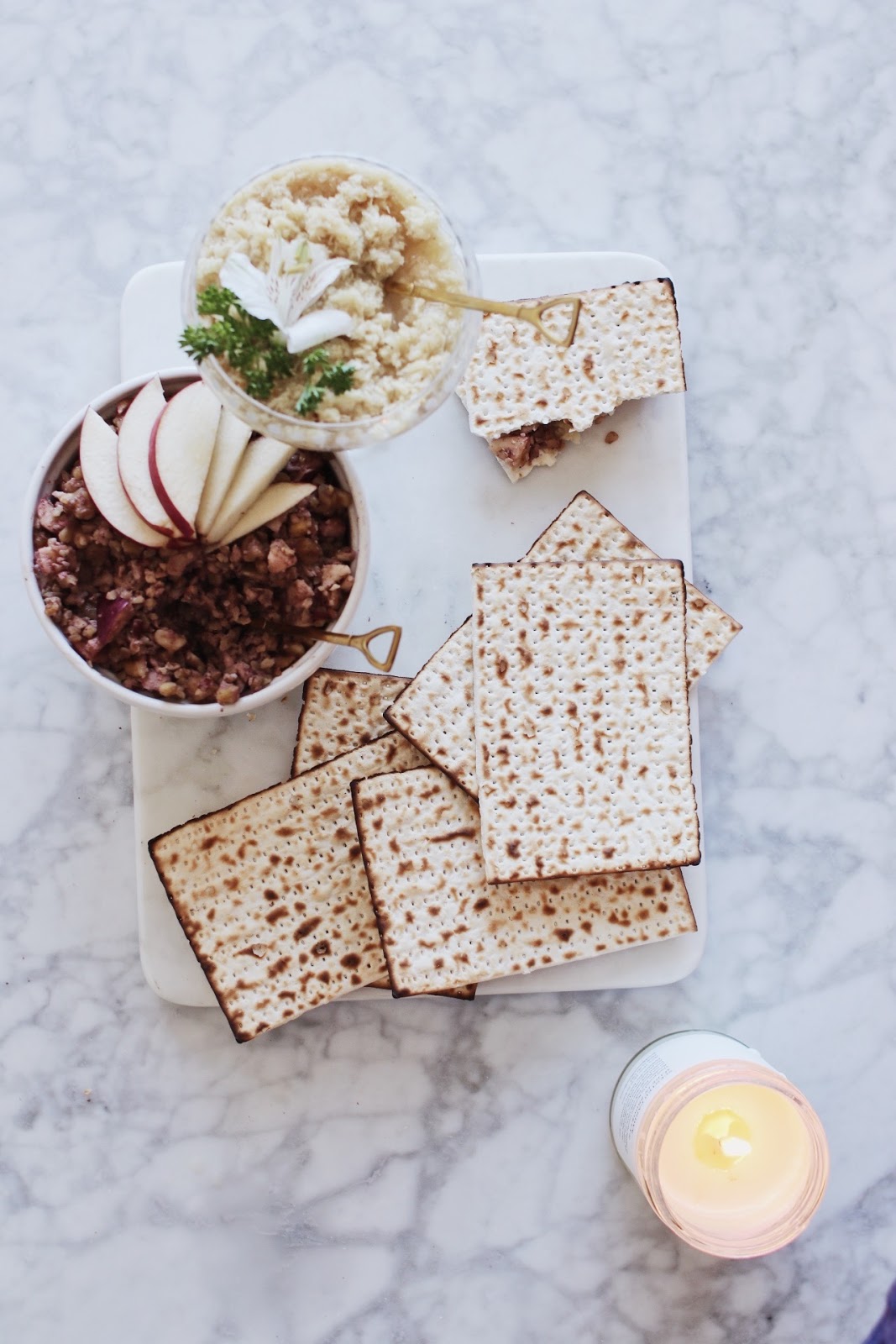
MATSAH unleavened bread
MAROR a bitter herb (horseradish, green onion, or romaine lettuce)
KARPAS parsley or celery
Z'ROAan animal bone or a beet (for vegetarians)
BEITSAH an egg, hard-boiled then roasted
TAPPUZ an orange (a recent addition)
HAROSET a condiment made from fruits, nuts, spices, and wine
WHY WE ARE TOGETHER TONIGHT
LEADER:
We have come together this evening for many reasons. We are here because Spring is all around, the Earth is reborn, and it is a good time to celebrate with family and friends. We are here because we are Jews, because we are members of the Jewish nation, with its deep historic roots and its valuable old memories and stories. We are here to remember the old story of the liberation of the ancient Hebrews from slavery in Egypt - a great struggle for freedom and dignity. We are here because the struggle for human freedom never stops. We are here to remember all people - Jews and non-Jews - who are still struggling for their freedom.
ALL: Behold, how good and how pleasant it is when peoples* dwell together in unity!
*
this year? use whatever you've got!
1. NEROT - CANDLES
LEADER: Let us begin!
[Begin taking turns reading. Each person is invited to read a grouped set of lines - or to pass.]
◆ It is said, there is nothing new under the sun, yet nothing remains the same.
◆ Against the backdrop of eternity, the earth displays an ever-changing countenance. The sun rises and the sun sets, yet each day and each season is fresh and new.
◆ Slowly, one season emerges from another. The harshness of ice and snow yields to gentle, nourishing showers.
◆ Inevitably, the cold, dark days succumb to the warmth and light of Spring.
◆ We rejoice in the warm light and rich blessings of this season.
◆ The celebration of Passover represents the perennial rebirth and survival of the Jewish people and the world of nature.
◆ The light of these candles symbolizes a renewal of life, a reaffirmation of freedom.
READING:
“I
learned without her saying a word that there are truly many ways to
pray, and lighting a candle is one of them.” ― Pat Schneider
ALL: Let us bless the light as we gather together to kindle the festival candles. With the light of liberation let us bless life.
[The candles are lit.]
*
L'Chaim you guys!
2. KIDDUSH - DEDICATION - THE 1ST CUP OF THE FRUIT OF THE VINE
LEADER: Let us all fill our glasses with the fruit of the vine.
[Resume taking turns reading. Each person is invited to read a grouped set of lines - or to pass!]
◆ Spring is the season of new growth and new life. Every living thing must either grow or die; growth is a sign and a condition of life.
◆ Human beings are perhaps unique among the Earth's inhabitants. Our most significant growth takes place inwardly. We grow as we achieve new insights, new knowledge, new goals.
◆ Let us raise our cups to signify our gratitude for life, and for the joy of knowing inner growth, which gives human life its meaning.
READING [this is the traditional Hebrew prayer, the transliteration, and the English translation]:
Attention, gentlemen, [rabbis, and my teachers]! Blessed are You,
Lord our God, King of the universe, who creates the fruit of the vine.
(Amen)
Blessed are You, Lord our God, King of the universe, Who chose us from all the nations, and elevated us above all tongues, and sanctified us with His commandments. And You gave us, Lord our God, with love,
[Sabbaths for rest and] festivals for happiness, holidays and times for
joy, this day of the Festival of Matzos, the time of our freedom
◆ Together, with raised cups, let us say: The fruit of the vine - with it, let us drink "To Life!"
ALL: “L’Chaim!”
*
"A Mac-a-baby's gotta do what a Mac-a-baby's gotta DO!"
3. THE MEANING OF THE PASSOVER STORY
LEADER: Passover is the celebration of life.
The story of the Jewish people is truly a triumph of life. Against the odds of history, the Jewish people have done more than merely survive - we have adapted creatively to each new time, each new place, from the birth of our people to the present day.
[Resume taking turns reading. Each person is invited to read a grouped set of lines - or to pass!]
◆ Even though death has pursued us relentlessly, time and time again, we have chosen to live.
◆ During the many centuries of the Jewish experience, memories of destruction are tempered by the knowledge that the world can also be good.
◆ We have endured slavery and humiliation. We have also enjoyed freedom and power. Darkness has been balanced by light.
◆ Our forebears traveled the Earth in search of the safety and liberty they knew must exist. We have learned to endure. We have learned to progress. We are proud survivors.
READING, from After Anatevka:
“Human
life is to be lived, my sons,” said the rabbi to the whole group once
more. “The Israelites are told to ‘choose life.’ They are promised a
long and fruitful life if they abide by God’s commandments. If the
purpose of life is to live it, then the Exodus from Egypt is a journey
from death into life—from a culture that focuses beyond this world to
one that embraces it. And thus the theological questions changes too, as
we ask whether a God who loves life would ask God’s children to throw
their gifts away in any kind of slavery. Do you see?”
LEADER: We celebrate our good fortune and seek the advancement of all oppressed peoples.
ALL: Here here [or, Amen.]
*
4. MAGGID - STORY-TELLER
[Take turns reading.]
LEADER: Let us tell a story of Jewish hope.
◆ The tale of our people's first quest for freedom from slavery in Egypt was written so long ago that no one knows how much of it is fact and how much is fiction. Like all good stories, however, its moral lessons are valid and important.
◆ It is written that long ago, during a time of famine, the ancient Israelites traveled to Egypt. According to this legend, the Israelites at that time were all in a single-family - Jacob and his children. One of Jacob's sons was Joseph. He was so wise that the ruler of Egypt - the Pharaoh - made Joseph a leader over all the people of Egypt. But as time passed, another Pharaoh became the ruler of Egypt. He did not remember Joseph and his wise leadership.
◆ This new Pharaoh turned the Israelites into slaves and burdened them with heavy work and sorrow. After the Israelites were in Egypt for over 400 years, a man named Moses arose among them. He demanded that Pharaoh let his people go! Many times he risked his life to insist on the freedom of his people until he finally succeeded. At our Passover Seder, we celebrate the story of Moses and the people he led out of slavery 3000 years ago. We celebrate the struggle of all people to be free.
◆ Throughout the centuries, the story of Moses and the exodus from Egypt has inspired Jews and non-Jews in times of persecution and hardship.
◆ Let us remember that the thirst for freedom exists in all people.
◆ Many centuries after the legendary time of Moses, African people were brought to America as slaves. These slaves longed for freedom, and they were inspired by the story of Moses and the ancient Israelites.
LEADER: The freedom we celebrate tonight is not only freedom from slavery. It is also the freedom to live in peace, with dignity and with hope for a bright future. This constant vision has inspired the Jewish people since ancient times when the Bible was written.
◆ For centuries, most Jews lived in Europe, where they were often persecuted. They were driven from place to place, and their lives were often filled with terror and despair. There came a time when many Jewish families learned of a place called America, where people could live without fear. This was the promise that America held out to them and to many other suffering people. By the thousands, and then by the millions, year after year they crossed a large ocean.
◆ Enduring separation from all they had known, they faced the dangers of a long voyage before reaching the shores of America. For a time, many suffered from poverty and disease. Yet their courage, perseverance, and skills helped to advance the freedoms that we celebrate here tonight.
◆ This evening, as we celebrate our own freedom let us take notice of the on-going struggles toward freedom here and in many other parts of the world. Let us celebrate all these struggles, with our ultimate American freedom poem, which is a prayer for America being (and remaining), a country of welcome:
READING -
"The New Colossus" By Emma Lazarus
Not like the brazen giant of Greek fame, With conquering limbs astride from land to land; Here at our sea-washed, sunset gates shall stand A mighty woman with a torch, whose flame Is the imprisoned lightning, and her name Mother of Exiles. From her beacon-hand Glows world-wide welcome; her mild eyes command The air-bridged harbor that twin cities frame. “Keep, ancient lands, your storied pomp!” cries she With silent lips. “Give me your tired, your poor, Your huddled masses yearning to breathe free, The wretched refuse of your teeming shore. Send these, the homeless, tempest-tost to me, I lift my lamp beside the golden door!”
* * *
PART 2
5. OUR PLEASURE DIMINISHED BY THE PAIN OF OTHERS
LEADER: Let us all refill our cups. [refill your wine, whee!]
My "Plagues of Egypt" eggs (because I hate feeling left out...)
Tonight we drink four cups of the fruit of the vine. There are many explanations for this custom. They may be seen as symbols of various things: the four corners of the earth, for freedom, must live everywhere; the four seasons of the year, for freedom's cycle must last through all the seasons; or the four matriarchs: Sarah, Rebecca, Leah, and Rachel.
A full cup of wine symbolizes complete happiness.
The triumph of Passover is diminished by the sacrifice of many human lives when ten plagues were visited upon the people of Egypt.
In the story, the plagues that befell the Egyptians resulted from the decisions of tyrants, but the greatest suffering occurred among those who had no choice but to follow. It is fitting that we mourn their loss of life, and express our sorrow over their suffering. For as Jews and as Humanists we cannot take joy in the suffering of others.
Therefore, let us diminish the wine in our cups as we recall the ten plagues that befell the Egyptian people.
As we recite the name of each plague, in English and then in Hebrew, please dip a finger in your wine and then touch your plate to remove the drop.
In the same spirit, our celebration today also is shadowed by our awareness of continuing sorrow and oppression in all parts of the world. Ancient plagues are mirrored in modern tragedies. In our own time, as in ancient Egypt, ordinary people suffer and die as a result of the actions of the tyrants who rule over them. While we may rejoice in the defeat of tyrants in our own time, we must also express our sorrow at the suffering of the many innocent people who had little or no choice but to follow.
LEADER: As the pain of others diminishes our joys, let us once more diminish the ceremonial drink of our festival as we together recite the names of these modern plagues:
Hunger
Last year: at the Winter Palace
War
Tyranny
Greed
Bigotry
Injustice
Hatred
Violence
Intolerance
Poverty
Abuse of Animals (and those who cannot verbally speak for themselves)
Ignorance
Inequality
Pollution of the Earth
Indifference to Suffering
and, this year of 2020 in particular:
Global Pandemic and Plague
LEADER: Let us visit a poem expressing hope:
READING:
"The Hope I Know" by Thomas Centolella, 2017
The Hope I know doesn’t come with feathers. It lives in flip-flops and, in cold weather, a hooded sweatshirt, like a heavyweight in training, or a monk who has taken a half-hearted vow of perseverance. It only has half a heart, the hope I know. The other half it flings to every stalking hurt. It wears a poker face, quietly reciting the laws of probability, and gladly takes a back seat to faith and love, it’s that many times removed from when it had youth on its side and beauty. Half the world wishes to stay as it is, half to become whatever it can dream, while the hope I know struggles to keep its eyes open and its mind from combing an unpeopled beach. Congregations sway and croon, constituents vote across their party line, rescue parties wait for a break in the weather. And who goes to sleep with a prayer on the lips or half a smile knows some kind of hope. Though not the hope I know, which slinks from dream to dream without ID or ally, traveling best at night, keeping to the back roads and the shadows, approaching the radiant city without ever quite arriving.
*
6. THE SECOND CUP DEDICATED TO THE STRUGGLE FOR PEACE AND FREEDOM
[Take turns reading.]
LEADER: The second cup of wine is dedicated not only to the struggles of the Jewish people, but to all people seeking a secure life free of fear and persecution. We hope and work particularly for the Israelis and the Palestinians that they may all learn to live together in freedom and peace—but also our own broken country of Left and Right.
READING: Let us strive to fulfill the words of the prophet Micah:
"They shall beat their swords into plowshares and their spears into pruning hooks. Nation shall not take up sword against nation, they shall never again know war. But they shall sit every one under their vines and fig trees, and none shall make them afraid" (Micah 4.3-4).
LEADER: Let us all raise our glasses in a toast to peace and freedom for all:
ALL: "To Peace and Freedom!"
LEADER: And now it is time to answer the FOUR questions about what makes this night different from all other nights!
*
7. ARBA QUSHYOT - FOUR QUESTIONS!
LEADER: One of the customs of the seder is the asking of questions - questions about what the ritual actions of the seder mean. The Passover tradition involves the youngest children asking - actually singing - about these matters. (If there aren't any kids, no problem. Just peer pressure the youngest person present to do the asking. Last year, Alec was the youngest person in attendance and he asked the questions with very little grumpiness and to great aplomb...)
1Q. Why is this night different from all other nights?
1A: On all other nights we eat either bread or matzah.
2Q. Why, on this night, do we eat only matzah?
2A. On all other nights we eat herbs of any kind.
3Q. Why, on this night, do we eat only bitter herbs? Why, on this night, do we dip them twice?
3A. On all other nights, we do not dip our herbs even once.
4Q. Why, on this night, do we eat while leaning?
4A. On all other nights, we eat either sitting or leaning.
ANSWERS!!!
MATZAH - UNLEAVENED BREAD [Matsah held up for all to see.]
LEADER:
1. Why is this night different from all other nights? Why, on this night, do we eat only matzah?
[Take turns reading]
Matzah is the symbol of our affliction and our freedom.
Legend has it that when Moses and his followers fled Egypt, they moved so quickly that the bread they baked did not have time to rise.
However, scholars have noted that long before the Jews celebrated Passover, Middle Eastern farmers celebrated a spring festival of unleavened bread.
This was a festival where unleavened bread was made from the fresh barley grain newly harvested at this time of the year.
The old fermented dough was thrown out so that last year's grain would not be mixed with this year's.
Therefore, the new season began with the eating of unleavened bread - matzah.
Later on, the Jewish people incorporated this agricultural festival into the celebration of freedom and renewal we now call Passover.
LEADER: Let us now say a blessing for the matzah! Let us bring forth matzah - food from the land - so we all may be satisfied and sustained.
Let us all now eat a piece of matzah!
[All eat] MAROR - THE BITTER HERB - [Maror held up for all to see.]
LEADER:
2. Why, on this night, do we eat only bitter herbs? Why, on this night, do we dip them twice?
[Take turns reading.]
Why do we eat maror?
Tradition says that this bitter herb is to remind us of the time of our slavery.
We force ourselves to taste pain so that we may more readily value pleasure.
Scholars inform us that bitter herbs were eaten at spring festivals in ancient times.
The sharpness of the taste awakened the senses and made the people feel at one with nature's revival.
Thus, maror is the stimulus of life, reminding us that struggle is better than the complacent acceptance of injustice.
LEADER: As a blessing for the maror, let us all sing this song about striving to be fully human. Then we will all take a taste of horseradish on a piece of matzah.
BLESSING: Where people are less than human, strive to be fully human.
DIPPING GREENS IN SALTWATER MATBILIN KARPAS
LEADER:
3. Why do we dip our food in saltwater two times on this night? The first time, the salty taste reminds us of the tears we cried when we were slaves. [Greens held up for all to see.]
Parsley and celery are symbols of all kinds of spring greenery.
The second time, the saltwater and the green can help us to remember the ocean and green plants and the Earth, from which we get the water and air and food that enable us to live.
LEADER: Let us bless the fruit of the Earth. [Please dip your parsley into saltwater two times and eat it.]
M'SUBIN - LEANING
LEADER:
4. Why, on this night, do we eat while leaning?
[take turns reading]
Why do we eat while leaning on this night? In ancient Rome, rich people used to eat while lying on a couch leaning on one elbow as slaves and servants fed them. Some ancient Jews saw this relaxed type of eating as a sign of freedom and prosperity, so they would lean to one side eating at the seder on Passover, the festival of freedom. Some modern Jews, working with others, helped create greater liberty and well-being for the world. Today, we celebrate freedom and equality by sitting up and feeding ourselves, but the leaning question remains in the service as a reminder of how it was when our people longed for freedom.
* MORE QUESTIONS!
We have now answered the four traditional questions! But there are still more questions to be answered.
There are other special foods on our Seder plate:
a bone (z'roa)
and a beet,
a roasted egg (beitsah)
and an orange, and, many people's favorite, the sweet condiment (haroset).
Why are they here?
Z'ROA can mean a shank bone - the bone of a forelimb - or a vegetable. This lamb's bone is the symbol of the ancient shepherd's festival of Pesah or Passover. It was celebrated at the time of the full moon in the month lambs and goats were born. At that time, each family would sacrifice a young lamb or goat at a spring feast. Jews ended these sacrifices when the Jerusalem Temple was destroyed. Since z'roa also means vegetable, a beet can be used instead of an animal bone on the seder plate. The Jewish people are very diverse, so the rabbis who wrote the Talmud acknowledged this vegetarian alternative.
BEITSAH - EGG
Beitsah is the egg of life, a symbol of the birth of the young in spring. Each of us begins as an egg and grows to adulthood. The egg reminds us of our evolutionary past and of the gifts of human inheritance. But the egg is fragile. It represents potential that can be destroyed. Left alone, its life would perish. Growing life needs warmth and love and security, guidance, hope, and vision. To achieve their full potential, human beings need the support and encouragement of family and community. Beitsah symbolizes the fragility and interdependence of life.
[All who so desire may now eat a piece of egg.]
TAPPUZ - ORANGE
We place this fruit among our ceremonial foods as a symbol of our efforts to make sexual minorities feel acknowledged in our community. We recognize the contributions made by these family members and friends. By inviting and welcoming all with open hearts and open minds, we celebrate diversity and freedom. We put an orange on our seder plate as a new symbol of liberation around sexuality and gender roles.
[All may eat a piece of orange.]
HAROSET - CONDIMENT
Fruits, nuts, spices, and wine are combined to make this sweet condiment. Being the color of clay or mortar, it reminds us of the bricks and mortar used by slaves - Jews and others - in building the Pharaohs' palaces and cities. Yet the taste of haroset is sweet, and thus reminds us of the sweetness of freedom. Leader: Let us now all eat haroset on a piece of matzah. We now make a little sandwich - called a "korekh" or a "Hillel sandwich;" tradition credits Rabbi Hillel with creating this sandwich 2000 years ago. By eating some bitter herb (maror) and some haroset between two pieces of matzah, you can taste the "bittersweet" meaning of Passover.
◆ During this festival of life, let us remember our lost sisters and brothers - the millions of Jews enslaved and killed in the Holocaust. We remember them along with all the others who suffered.
◆ They were all parts of the rainbow - of ethnic, religious and sexual minorities, of progressive activists, resistance fighters, and people with disabilities. Their experiences of anguish and death are with us, even in our times of celebration. We resolve that their memory shall not be lost.
◆ We accept the responsibility of working to prevent such suffering from ever again occurring on this earth. We remember the heroism of those who fought against fascism and tyranny in the forests and the cities of Europe. Men, women, and children who loved freedom and humanity struggled with their own hands against the powerful armies of those who sought to oppress and kill them.
LEADER: We were slaves in Egypt and we were slaves in fascist Europe— and an ever-growing Fascist world today. We have much to remember. Let us raise our glasses to those who were taken from us, for those who are currently threatened still today, and to those who fought and continue to fight for freedom and life.
ALL: "L'Chaim!"
[All drink the third cup.]
*
9. FOR A BETTER WORLD - THE FOURTH CUP
LEADER: Let us all refill our cups. [Leader picks up the cup for all to see.]
This is the cup of hope. The seder tradition involves pouring a cup for the Hebrew prophet Elijah. For millennia, Jews opened the door for him, inviting him to join their seders, hoping that he would bring with him a messiah to save the world.
Yet the tasks of saving the world - once ascribed to prophets, messiahs, and gods - must be taken up by us mere mortals, by common people with shared goals. Working together for progressive change, we can bring about the improvement of the world, tiqqun ha-olam - for justice and for peace, we can and we must.
ALL: Let us make peace in the world.
LEADER: Peace is our responsibility, the responsibility of all peoples in the world.
ALL: Let there be peace for us all.
LEADER: Let us now symbolically open the door of our seder to invite in all people of goodwill and all those in need to work together with us for a better world.
READING:
"The Guest House" by Rumi
This being human is a guest house. Every morning a new arrival.
A joy, a depression, a meanness, some momentary awareness comes As an unexpected visitor.
Welcome and entertain them all! Even if they're a crowd of sorrows, who violently sweep your house empty of its furniture, still treat each guest honorably. He may be clearing you out for some new delight.
The dark thought, the shame, the malice, meet them at the door laughing, and invite them in.
Be grateful for whoever comes, because each has been sent as a guide from beyond.
LEADER: Let us raise our fourth cup as we dedicate ourselves to the improvement of the world.
[All drink fourth cup.]
*
10. YAHATS - BREAKING THE MATSAH
LEADER: We have drunk the wine and tasted the special foods of the Passover celebration. To remind us of these values as we go back out into the world, at the end of our festival meal, we shall return to have a final taste of matzah - our symbol of suffering and liberation, of renewal in nature and humanity.
I am breaking this matzah into two pieces.
One half I will return to the table.
[Leader breaks matzah, sets down half, and holds up half as the `afikoman.]
The other half I will wrap in a napkin and save until the end of the meal. This piece is called the `APHIQOMAN - Without it, the seder cannot end, so I must make sure that it does not get lost. Of course, I am very forgetful, so I may need help finding it if I do misplace it. In fact, I manage to lose it every year - it ends up seemingly "hidden.” So just figure that I'll be asking all you younger folks to help me find it pretty soon.
*
11. DINNER!
LEADER: Now it is time for our leisurely Pesah meal.
LEADER: [Announces the name of the child or children who found the `afikoman.]
Let us continue our seder by eating one last little piece of matzah to leave us with the taste of freedom's struggles. [Everyone eats a last piece of matzah!]
Now, let us conclude our seder...
LEADER:
We have recalled struggles against slavery and injustice.
We have sung of freedom and peace.
We revisited times of persecution and times of fulfillment.
Only half a century ago, Nazis committed the crimes of the Holocaust.
Today, as Human Beings living in the United States in the 21st Century, we take for granted that we are freer than at any other time.
Yet Jewish history shows that life is ever-changing, and we must learn how to survive under all conditions.
When we are persecuted, we must struggle for our own freedom.
The more freedom we attain, the more we must help others attain freedom.
This is the lesson of Passover.
This is why we celebrate the Festival of Freedom.
LEADER: Let us now conclude our celebration of Life, of Freedom, and of Peace by standing to listen to say: NEXT YEAR, PEACE! NEXT YEAR IN THE HOLY LAND!
ALL: NEXT YEAR, PEACE! NEXT YEAR IN THE HOLY LAND!







 Posts
Posts


