They brought a woman from the street And made her sit in the stalls By threats By bribes By flattery Obliging her to share a little of her life with actors
But I don't understand art
Sit still, they said
But I don't want to see sad things
Sit still, they said
And she listened to everything Understanding some things But not others Laughing rarely, and always without knowing why Sometimes suffering disgust Sometimes thoroughly amazed And in the light again, said
If that's art I think it is hard work It was beyond me So much beyond my actual life
But something troubled her Something gnawed her peace And she came a second time, armoured with friends
Sit still, she said
And again, she listened to everything This time understanding different things This time untroubled that some things Could not be understood Laughing rarely but now without shame Sometimes suffering disgust Sometimes thoroughly amazed And in the light again said
This is art, it is hard work And one friend said, too hard for me And the other said, if you will I will come again Because I found it hard I felt honoured
The Dressing Room Project is the brain child of Michael Kushner (my friend and fave photographer of my face), where he takes his camera, his discerning eye, his incredible person-ability to bring the best out of actors preparing to go onstage, all married with his unparalleled taste to bring you images unlike any other. Actors preparing. Actors before the world sees them. Intimate, Engaging.
Michael was generous enough to come out to Two River Theater to photograph Christina and I before VOS, and how lucky we were and are. Enjoy.
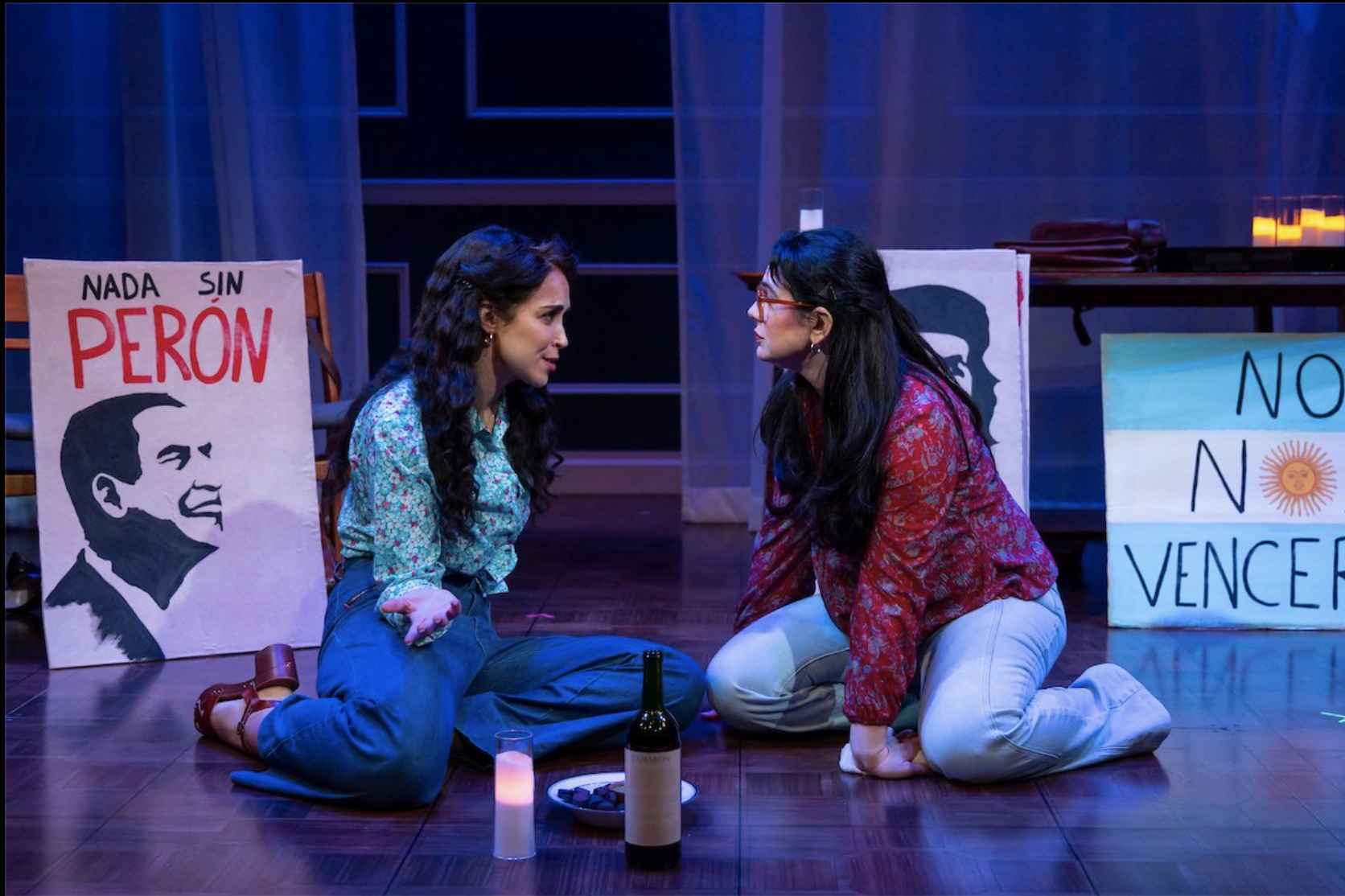
Opening Night of the world premiere of ¡VOS! at Two River Theatre.
All
hail this female TRIUMPH of a play. This glorious, funny, warm, loving,
moving, beautiful story full of history and heart. It has been an honor
to be a part of the BIRTH of this piece, create these characters
alongside the brilliant actor/playwright Christina Pumariega and with the peerless leadership of Nicole A Watson.
What a rehearsal room (of all women— including our glorious SM team, dramaturg and AD!) This
also marks my first theatre contract as a Latina actor (this one is for
you Noriega family—finally!), my 7th world premiere, and marks my 20th
year in the professional theatre.
I’m so proud to be a part of this show
I could burst.
As Dr. Cossí says: “Okay we done!”
Let’s party.
photo by @motendesigns (also our phenomenal scenic designer)
A play is nothing without the team that makes it. It takes a village.
That village is:
Playwright: Christina Pumariega
Director: Nicole A. Watson
Scenic Designer: Lawrence E. Moten III Costume Designer: Raquel Barreto Lighting Designer: Carolina Ortiz Herrera Sound Designer: Sinan Refik Zafar Projection Designer: Kelly Colburn Dramaturg: Sarah Rose Leonard Dialects: Rosie Berrido Intimacy Coordinator: Alex Might Production Stage Manager: Jynelly Rosario Rehearsal Assistant Stage Manager: Gracie Carleton Assistant Stage Manager: Abigail Medrano Casting: Caparelliotis Casting and Joseph Gery Assistant Director: Jessi Stier Associate Scenic Designer: Danielle Delafuente Assistant Lighting Designer: Hayley Garcia Parnell Hair and Makeup Consultant: Carissa Thorlakson Projections Consultant: Dylan Uremovich
April books: the books you read with a window cracked open, letting in the smell of new grass. The kind you flip through lazily on a park bench, feeling virtuous for finally sitting outside. In April the days stretch, juuuust a little longer, and the first true rains of the season drum against the windows—not the relentless, chaotic, personality-disordered downpours of March, but the gentler, softer showers that turn the world green overnight.There’s something about this month—half spring, half something else—that calls for stories with a little moodiness.
- A big ol’ novel that shifts between sunlight and shadow. - A collection of poems that brims with the promise of newness; read in snippets, between peeks at the tulips. - A story that is best read with the window cracked open, so the smell of rain and freshly turned soil can mingle with the scent of well-worn pages. - A classic you’ve been meaning to get to, because April always feels like a fresh start (until you realize it’s just March with better PR).
And thus, it deserves books we reach for when the sky darkens at two in the afternoon, and you think, Well, if April is going to be like this, I might as well… READ.
So, in honor of the month of new beginnings, sudden downpours, and the eternal debate of jacket vs. no jacket, here are the best books to read in April—stories that bloom, that rain, that whisper of change.
*
1. The Enchanted April by Elizabeth von Arnim
I know I know I know—I have listed this novella in my “Spring Reads” collection, but how can I neglect re-mentioning it? A novel about escaping from one April to another—specifically, to an Italian villa bursting with wisteria from the gloomy rain of "between the wars" London.
A story of blossoms forming where one was certain of a branch’s death.
A story of second chances.
A perfect, dreamy read for when you’re longing for warmth but still stuck in sweater weather.
2. Spring by Ali Smith Smith’s novel is like April itself—unexpected, shifting, unruly, full of thaw and tension. A meditation on art, politics, and the changing seasons, it’s part of her Seasonal Quartet but stands beautifully on its own. Ali Smith’s novel is both fiercely political and deeply lyrical, weaving together fractured narratives of disconnection and rebirth. Like the month of April itself, Spring resists simplicity. It is not just a celebration of renewal; it is an interrogation of it.
Smith’s writing pulses with the restless energy of the season. She juxtaposes stark realities—immigration detention centers, Brexit-era disillusionment—with moments of sudden, almost mythic beauty. A lost filmmaker, a cynical older man, and a mysterious girl moving through the world like a force of nature—all collide in a story that feels as unpredictable as April’s shifting weather. Smith writes in a way that mimics spring’s own rhythms: fragmented yet whole, sharp yet tender, unafraid of moments of stillness before sudden, torrential movement. To read Spring in April is to be reminded that the season’s promise is not gentle; it is urgent.
But what makes Spring the perfect April novel is its insistence on possibility. Smith, like the season itself, is relentless in her belief that change is coming—even if it arrives in fits and starts, even if it is difficult, even if it asks us to reckon with the past before moving forward. April is a threshold, a moment when we must decide whether to step through or turn back. Spring is a book that urges us to step through. It does not offer easy answers, but it offers something better: the certainty that something new is always just about to begin.
3."As One Listens to Rain by Octavio Paz A single, stunning poem that captures the feeling of April rain—not just falling, but soaking into memory and thought. A reminder that poetry belongs to spring as much as birdsong does.
Spring has always been the season of poets—and Octavio Paz, with his relentless curiosity and lyric precision, is a perfect guide for this awakening. "As One Listens to Rain" one of his lesser-known but deeply evocative works, reads like a meditation on transience, a book where each page shimmers with April’s dual nature: beauty and uncertainty, light and shadow. The title alone suggests something more than mere precipitation—it suggests an atmosphere, a presence, a self dissolving and reforming in the rain. His language does not settle; it moves, like water, through history, myth, and personal reflection.
In"As One Listens to Rain," he writes of love as something fluid, time as something porous, identity as something always in motion. This is poetry for the in-between spaces. Paz was a poet obsessed with thresholds, with the liminal, with the moment just before something becomes something else. And what is April if not a threshold?
4. A Little Life by Hanya Yanagihara This one is a heavy hitter—if you’re looking for an emotionally intense reading experience, A Little Life is a stunning and, at times, painful masterpiece. Following four college friends as they navigate their adult lives in New York City, the story zeroes in on Jude, whose traumatic past emerges slowly, layer by devastating layer.
Yanagihara’s writing is visceral, unflinching in its depiction of suffering and survival, and yet there’s a strange beauty in her exploration of friendship, loyalty, and the human need for connection. It’s a novel that stays with you long after you've finished it, one that might make you rethink what love and friendship mean. Perfect for a long, reflective read.
5. Pilgrim at Tinker Creek by Annie Dillard
No one Pays Attention like Annie Dillard. April is a month of noticing, and no book teaches the art of attention better than Pilgrim at Tinker Creek. Annie Dillard’s Pulitzer Prize-winning meditation on nature is, at its heart, a book about seeing—about standing still long enough for the world to reveal itself in all its teeming, chaotic, exquisite detail. And what is spring if not the perfect time to learn to see again?
Dillard’s writing crackles— she does not merely observe the natural world; she interrogates it, turns it over in her hands, studies it with the curiosity of a scientist and the wonder of a mystic. She watches frogs being swallowed alive by giant water bugs, muses on the violent abundance of a newly hatched praying mantis nest, and kneels in reverence before a floodplain crawling with new life. Her prose— almost incantatory—mirrors April itself, a season of bursting and breaking, of terrible beauty and raw becoming. Pilgrim at Tinker Creek’s world is churning, restless, alive in ways both thrilling and unsettling.
But perhaps what makes this book most suited to this time of year is its deep, abiding sense of wonder. Dillard does not shy away from the brutal mechanics of nature, but she never loses her awe. She reminds us that the world is strange, that it is extravagant, that it is—despite all its cruelties—staggeringly beautiful.
- play an entire set of American Vaudeville and English Hall variety songs on the ukulele
- spend a night stargazing in the Sahara
- play the accordion, virtuosically
- see the Northern Lights in Iceland
- spend Shabbat in Tzfat
- witness birds migrating
- scuba dive
- drive a race car
- travel the length of Japan by train
- make mosaic artworks (I’d especially like to beautify broken urban spaces like Emenem, It’s so inspiring to make the work a better and more beautiful place, one pothole at a time)
- spend an entire month in silence, in the literal or proverbial woods, living at the speed of a poet
As March arrives, bringing with it the promise of early spring, Women's History Month, and the festive revelry of St. Patrick’s Day. The literary world offers us tales of renewal, strength, and history. This month, we celebrate not only the invigorating green of the season but also the empowering stories of women throughout history.
Daylight is adding up, about three minutes more each day as March progresses, give or take. Spring hasn’t arrived yet, but the plane is circling the tarmac. Welcome back, light! This time of year is The Great Unclenching, for when the light returns, something unclenches in us all.
March offers the perfect opportunity to dive into novels that inspire and enrich. Here’s a carefully curated list of books that will fill your days with literary joy, perfect for curling up with during those first glimpses of warmth.
*
March Theme: Women’s History Month
Women are amazing. Good Gd how we hate them. Let's uplift them instead.
1. Little Women by Louisa May Alcott
Little Women remains one of the most beloved and enduring classics of all time. The story follows the March sisters—Jo, Meg, Beth, and Amy—through the trials and triumphs of their adolescence and early adulthood during the Civil War.
There is a certain magic in Louisa May Alcott’s Little Women that no film adaptation—no matter how lovingly crafted—can fully capture. The silver screen has given us many beautiful versions, from the golden glow of the 1933 and 1949 classics to the heart-wrenching performances of the 1994 and 2019 renditions, but nothing compares to the original novel, with its gorgeous prose, recognizable characters, effortless warmth, wisdom, and its deeply personal intimacy.
Alcott doesn’t just tell the story of the March sisters—she invites us into their magical attic, lets us sit by the fire as Jo scribbles away long in to the night, as Meg dreams of simple, beautiful things, as Amy yearns for greatness, and as Beth’s quiet kindness radiates through the pages. The novel pulses with life, with all the small joys and sorrows that make up a girlhood, and it is this depth—this richness is what truly makes Little Women not just a beloved book, but one of the great literary classics in the canon.
For at its heart, Little Women is about the messy, bittersweet journey of growing up—about the triumphs and disappointments, the laughter and heartbreak that shape us into who we become. Who hasn’t felt Jo’s frustration as she cries, “I’m angry nearly every day of my life!”? Who hasn’t longed to leave their mark on the world, or wrestled with duty and desire when torn between home and ambition?
2. "The Yellow Wallpaper" by Charlotte Perkins Gilman
Charlotte Perkins Gilman’s masterpiece novella is a fever
dream wrapped in the suffocating folds of Victorian domesticity. The protagonist, suffering from what is diagnosed as a “nervous
condition,” is confined to a room in her home by her husband, where she
becomes obsessed with the room's yellow wallpaper.
Written in 1892, the story explores the mental and physical confinement of women in the 19th century, it is a tale
that simultaneously drones with claustrophobia and crackles with the desperation
of a woman unraveling beneath the weight of total oppression.
From the very first lines, we are drawn into a world where the walls themselves seem to whisper, where the sickly yellow of the wallpaper morphs into a living, breathing tormentor. This is not just a tale of one woman’s descent into madness—it is a searing indictment of a society that silences and stifles, that mistakes a mind in turmoil for mere female "hysteria." Every creeping tendril of the wallpaper, every shadow shifting in the dim light, becomes a manifestation of our narrator’s struggle; her rebellion simmering beneath layers of repression until it spills over in a dizzying, mesmerizing climax.
What makes The Yellow Wallpaper so hauntingly unforgettable is its intimacy—the way Gilman locks us inside the narrator’s fractured psyche, forcing us to see the world as she does, to feel her isolation as palpably as the stale air of her sickroom. The language is hypnotic, looping and circling like the patterns on the cursed wallpaper itself, mirroring the slow dissolution of self that takes place within those four walls.
And when, at last, the narrator succumbs to the madness that has been tightening its grip around her soul, we are left breathless, horrified, yet strangely exhilarated. Gilman doesn’t just tell a story; she drags us into the heart of a nightmare that feels all too real: a cautionary tale that still resonates fiercely today.
*
March Theme: St. Patrick’s Day
There are too many exquisite Irish novels, plays and collections of poetry to even begin to narrow them down. From classics such as Dubliners, Star of the Sea and The Country Girls, to contemporary classics like Angela’s Ashes, there is nothing quite like an Irish writer talking about LIFE.
3. Angela’s Ashes by Frank McCourt
As St. Patrick’s Day approaches, what better choice than Frank McCourt’s memoir Angela’s Ashes, a heartbreaking yet darkly humorous look at the author’s impoverished childhood in 20th-century Ireland. ButFrank McCourt’s Angela’s Ashes is not just a memoir—it’s a symphony
of sorrow and resilience that transforms
even the bleakest of childhoods into something fiercely beautiful. With
prose that sings like an Irish ballad—both mournful and full of
unexpected humor—McCourt paints a portrait of Limerick that is as
rain-soaked and poverty-stricken as it is brimming with life.
Every page pulses with the raw, unfiltered voice of a boy who endures hunger, loss, and shame, yet somehow never loses his wide-eyed wonder at the world. “When I look back on my childhood I wonder how I survived at all,” he begins, and from that moment, we are swept into a story whose power lies in its stark refusal to submit to self pity or to sentimentality; in its ability to find poetry in the gutters and grace in the struggle. It is not just a memoir—it is a testament to survival, to storytelling, and to the indomitable spirit of those who dare to dream beyond their circumstances.
4. Ulysses by James Joyce
Ulysses was first serialized in parts in the American journal The Little Review from March 1918 to December 1920. It has been called one of the most important works of Modernist literature. No other book captures the soul of Dublin with such ferocity and
tenderness, stitching together the passage of Leopold Bloom through Dublin during an ordinary day, 16 June 1904,
with a depth and complexity that transforms the ordinary into the epic. To read Ulysses is to walk the streets of Dublin in 1904, to feel the
rain on your face, to hear the chatter of pub-goers and the distant
tolling of church bells, to live inside the thoughts of characters.
James Joyce’s Ulysses is not just the crown jewel of Irish
literature—it is its beating heart, its wildest dream, its most defiant
and dazzling creation. Joyce hammered a job on the novel so complete that he became a category unto himself. This is a novel that dares to contain multitudes—history and myth,
comedy and heartbreak, the sacred and the profane—all flowing together
in an intoxicating stream of consciousness that changed literature
forever.
Every literary style was mist to his grill, as he might have said, and his plotting, if such it can be called - two men who take all day to meet each other - paved the way for, among others, Samuel Beckett.
Above all he taught every writer the importance of naturalistic dialogue; with his fine tenor voice Joyce knew better than most that we read not with the eye but with the ear.
And yet, Ulysses is more than just an ode to Dublin—it is the very soul of Irish literary ambition; the book that shattered conventions and redefined what a novel could be. Joyce takes the English language, that instrument of colonial rule, and bends it to his will, infusing it with the rhythms of Irish speech, the poetry of everyday thought, the sheer audacity of a mind unchained. It is a book that demands everything from its reader, but in return, it gives back a universe— in which a single day can contain all of human existence.
“Yes I said yes I will Yes,” Molly Bloom declares in the novel’s final, breathtaking lines, and in that moment, Joyce doesn’t just conclude a masterpiece—he affirms life itself, in all its messiness, all its beauty, all its infinite possibility.
If one book must stand as the pinnacle of the Irish literary canon, let it be Ulysses.
*
March Theme: The Ides of March
With this addition, Julius Caesar rounds out the list perfectly, infusing the month of March with both the classic weight of Shakespearean tragedy and a timely nod to the historical moment that defines it.
5. Julius Caesar by William Shakespeare
March is synonymous with the ominous "Ides of March," and what better way to dive into the drama of fate, ambition, and betrayal than with William Shakespeare’s Julius Caesar? Julius Caesar—the mighty general and leader of Rome—is on
the verge of absolute power, but a group of conspirators led by Brutus
and Cassius believes his rule will bring tyranny. While this ticking-time-bomb of a play is set in the heart of ancient Rome, it reads (and plays!) like "DC Noir" made popular on television in the 21st Century. It explores the tension
between personal loyalty and political duty through the all-too-human lenses of loyalists and conspirators.
William Shakespeare’s Julius Caesar is so much more than "just "a history play—it is a timeless political thriller; a study of power, ambition, and the chaos that ensues when the line between patriotism and personal ambition blurs. And in 2025, as the world grapples with populist movements, political conspiracies, misinformation, high emotions and a desperate common man, the ever-present question of who truly wields power reveals that this classic feels more relevant than ever.
The fickleness of the Roman crowd, swayed so easily from love to uncontrollable rage, mirrors the way modern public opinion shifts with a single headline or viral video. “The fault, dear Brutus, is not in our stars, but in ourselves, that we are underlings,” Cassius warns, and his words ring truer than ever in an era where leaders rise and fall within 24-hour news cycles at the whims of public perception. The senators, believing they act in Rome’s best interest, justify their actions with noble rhetoric, yet their violence only breeds more instability—a cautionary tale for any modern political upheaval.
Even more striking is the play’s exploration of the power of speech, leveraged emotions, and misinformation, something that resonates in an age dominated by social media and manipulated narratives. Mark Antony’s funeral oration is a masterclass in persuasion, as he subtly turns the crowd against the conspirators without ever directly condemning them: “I come to bury Caesar, not to praise him.” What follows is a perfect example of how a skilled orator can bend public sentiment to his will, a lesson we see played out daily in modern media and politics. Observe Damien Lewis deliver Marc Anthony's eulogy-as-political-excoriation, here:
The chaos that erupts in the wake of Caesar’s death, where reason is drowned out by outrage, echoes our contemporary political divisions as they spiral into violence, dis and misinformation, and violent power struggles. Shakespeare’s Rome is not so different from our world in 2025—ambition, manipulation, and the ever-looming question of who truly holds power remain as urgent and dangerous as ever.
You. Yes, you. The one with notebooks full of snippets, bits n' bobs of nice words, characters, plot lines rolling about in your skull.
Okay, listen. I don’t have some magical MFA or a sexy oak desk overlooking the ocean where I write the Great American Novel in linen pants while sipping something with a twist of whatever. I wrote my first real thing in dressing rooms across the earth, between scenes, and then back at home hunched over a laptop with two-day-old pizza on my shirt and a vague sense that maybe I had something to say, if only I could stop binge-watching crimes shows long enough to say it.
So, you’re standing at the edge of the writing world — heart full, hands unsure. You’ve got the spark. Maybe even a brilliant idea or a dozen, and perhaps even a quiet ache at the pit of your gut because you know there’s something in you waiting to be written— but you’re not quite sure how to begin.
I remember that feeling. It’s not hesitation; it’s frozen passion. And it means you care deeply— which is already a good sign that you very well might write something worth reading.
If you're reading this because you think
you might want to write but also you're overwhelmed, terrified, deeply
lazy, or just don't know where to stick the first sentence —
congratulations! You are already one of us! Let me throw some tips at
you like a big sister who’s been through it, swears a lot, and wants you
to win even though she can’t find her bra. What follows is not a list of tips. Just tips! Heaven preserve us from any more RULES. Just some tidbits I wish someone had whispered in my ear when I was where you are now (and even some tips very generous people literally did.)
Think of these as a series of invitations: to risk, to observe, to refine, to endure. Writing is less like architecture than it is like gardening: full of dirt, revision, quiet growth, and the occasional, inexplicable blossom.
*
1. Write for Yourself You are your first reader. Always. If you're not excited, curious, or emotionally invested in what you're writing, it’s unlikely anyone else will be. Someone will always criticize your work (or, ya know, a lot of other things like your face or your character or the way you compost or whatever because the internet can be a cesspool). So! Please yourself.
If you’re trying to write the next Pulitzer-winning novel because you think that’s what Smart People™ do, please stop. Write the thing that makes you laugh, cry, cringe, or text your best friend at 2 a.m. That weird little idea you think is too personal or too embarrassing? That’s the one. You are your first and only guaranteed reader, so make it weird, make it yours. Forget market trends and imagined critics! Forget that grouchy English teacher who told you you’d never amount to anything!
The number of times I followed a rabbit hole of curiosity and ended up with a new draft.
The number of ideas that started from simple questions, that became research trips to literal Siberia.
A pandemic poetry class + a love of Greek mythology = the birth of a major manuscript.
Get curious. Geek out and get to work. Write the book you’d stay up all night reading.
That’s where your truest voice will emerge from, find its strength and very likely show you things you never even knew to be possible within you.
2. Start Ugly. Start Scared. Just Start. Look. Your first draft is supposed to be trash. That’s like... the LAW. If your first draft looks like it was written by a raccoon with a caffeine addiction, congrats, you’re doing it right. Get it out. Don’t light a candle or wait for inspiration or buy another fancy notebook. Barf out the words. Pretty comes later.
Dr. Brene Brown has researched perfectionism extensively and has stated:
“Perfectionism is a self-destructive and addictive belief system that fuels this primary thought: If I look perfect and do everything perfectly, I can avoid or minimize the painful feelings of blame, judgement, and shame.”
All perfectionism does is keep you stuck. It also makes you miserable and often, quite insufferably judgmental of others which gets you uninvited to parties.
All to say: write your sh*tty, imperfect thing. Don’t wait until you’re “ready” or until everything is perfectly mapped out. Don’t wait for a good hair day or for inspiration to strike. Don’t wait for anything. Perfection never arrives. Conditions will never will be ideal.
Sh*tty First Drafts are allowed to be wild, rough, incoherent, even embarrassing. They’re meant to be. That’s why they’re not called Genius First Drafts. I know someone that brilliantly calls them “Fertilizer Ideas.” I love this! Because sure fertilizer stinks, but it makes things grow!
Think of first attempts as sketches, not sculptures. Think of them as the first horrendous stumble-through of the play you’re rehearsing (you know the one where someone broke a toe, props went missing, we accidentally skipped 34 pages. A disaster. But a start!) The first draft is allowed to be chaotic, overwritten, full of clichés or clunky metaphors. It’s supposed to be. Your only job at that stage is to get the words out of your head and onto the page. The CRAFT comes later — in the revision.
3. Create a Routine That Respects Your Energy You don’t have to write at 5 AM like some bootstrappy productivity robot. You don’t need to write every day, and you don’t need to lie to yourself about “finding the time.” You don't need to write by candlelight. Or in a leather-bound journal with a quill. What matters is that you show up consistently in a way that supports your life — not disrupts it.
Are you sharpest at night? Carve out 30 minutes after dinner. Care-taking? Steal 15 minutes during breaks, meal, naptime. Make actual time — even if it’s ten minutes in your car outside Target — and do what you can. Nobody’s giving out gold stars for suffering.
Your writing rhythm should support your life, not fight it. Find what works for you and truly honor the ritual the way you would meet any other part of your needs, your wellbeing.
4. Gracefully Accept Rejection
Rejection sucks and you will absolutely take it personally. Then you’ll eat a cookie, watch four hours of Love Is Blind, and live. That “no” doesn’t mean you’re garbage— it just means that particular person wasn’t into it. Maybe they have bad taste. Keep going. Be petty and persistent.
When you start offering your work, expect rejection. Rejection is not a verdict on your worth — it’s a rite of passage. Every author you admire has been rejected (often many times over). It stings, yes. But it also toughens you, teaches you resilience, and sometimes, if you’re open to it, gives you clues on how to grow. Don't let a "no" from someone else become a "no" from you.
Rejection is a human experience that can be very stressful and unpleasant. That is why many people do anything they can to avoid it. But just like many stressful and unpleasant things, the more you accept the sensations, allow the feelings of discomfort to move through you like a wave that WILL break and ebb should you allow it to follow nature’s course, bearing it becomes much more, well, bearable! We feel stressed when we assume an outside circumstance is beyond our ability to cope. Unpredictability, uncontrollability, overwhelm, self-worth being challenged. Give yourself the gift of these experiences. They breed true maturity. So. Be business-like about submitting your work. Keep track of who you've sent out pieces to and file feedback, especially positive comments. When a story or poem is rejected, just send it to the next person on your list; keep going until no options remain. After you've finished a piece, start something new. Put the old one aside for now. Remember that plenty of novelists have two or three unpublished manuscripts under the bed.
5. Don't Give Up You will doubt yourself.
You will wonder if it’s worth it.
You will be tempted to quit — maybe more than once. Don’t. Keep going.
Take breaks, revise your goals, let the draft sit if needed — but don’t let self-doubt have the last word. The world needs your stories. More importantly, you need your stories. Don't give up because you're not some jerk’s definition of “successful.” Just keep creating. Unapologetically and with all your heart.
There will be days when you want to quit and take up knitting or go fully off-grid. That’s normal. But if writing is your thing— even if it’s just kind of your thing— you owe it to yourself to keep going. Take naps. Cry. Write again. You’re allowed to take breaks, but you don’t get to ghost yourself.
Also? You never know what will happen later in life or even after you are dead. A historian in times to come may discover your diary and recognize its unique insight into twenty-first-century life. A poem you wrote many years ago may suddenly appeal to someone and be published or get chosen in a competition. A novel that was rejected 30 times might get dusted down and see the light of day many, many years after you first wrote it. Plenty of good novels don't get published and lots of indifferent ones do. Despite what the world wants us to believe, life is not a meritocracy, and it certainly isn't fair.
Don't get mad about it. I mean, or do. Punch a pillow or two. Eat your feelings. But then move on. Keep going, live in hope and be open to whatever happens— and more crucially, whatever could happen that you might not even have the capacity to conceive of yet.
6. You are a Writer Because You Write Not because you’re published. Not because someone approves. Not because you have an agent or book deal. Not because your sentences are flawless. You are a writer because you sit down, listen to your thoughts, and try to shape them into something meaningful. Or, in a more Eastern approach to creation: you trust that your work is out there, existing, and your job is to take away everything that is NOT the art. Remove the marble that David is trapped within. That is the work. That is the art.
You don’t need anyone’s permission to begin — but if it helps, let this be it. Start where you are. Use the voice you have. Write the thing that won’t leave you alone. I’m cheering you on, always.
I wrote about this incredible piece, project and experience last July, but here is a snippet of what I said:
"This piece.
This experience.
This team.
These WOMEN.
I
will never know what I did to deserve this perfect alchemy of passion,
commitment, humor, depth and talent— but we got it all and then some,
all in 20 days that felt like 20 years. What we achieved artistically, emotionally, and all ahead of schedule (?!) was a miracle.
[...]
I’ll never fully have the language to express what this 3 weeks— my
first ever as a professional director of anything, let alone a movie
musical—meant to me. [Lyricist and book-writer David Goldsmith] saw something in me I didn't even dare
to see in myself. It also came with the unparalleled trust of its
genius creators John, and Wendy— who created a work of such
indescribable
truth and beauty; a work about real, mature, fully-embodied, nuanced women speaking to one
another like real human beings. These are roles women can savor, relish
and feast upon for eons to come.
I’ll say until my breath runs out: in show business it is not the
work you make, where you make it or the tens of dollars we are
sometimes paid for the privilege. It is, above all, about who we share
it all with. "
So enjoy, dear friends.
Click the link above, start watching below, or simply go to YouTube and type in “Five
Women At An Airport.”
Watch our film-capture. For free.
Enjoy the
breathtaking — truth-soaked, hilarious, skillful, heartbreaking, vocally astonishing and absolutely stunning —
performances of Cailen Fu, Katy Geraghty, Bryonha Marie, Kate Rockwell and Elena Shaddow
The
endlessly inventive, soaring, magical, moving musical theatre
score of John Kavanaugh the wit, wisdom and powerful insights
of the book and lyrics by David Goldmsith and the co-bookwriter and conceptual matriarch, Wendy Perelman.
Watch.
Enjoy.
See what's possible with like $300, and bags of delusional hope.
Ah,
February. The month of winter’s last gasp, of small joys, and, yes, of
love—whether it’s the romantic, the familial, or the self-love that
comes from curling up with a good book.
To help you make the most of
these cozy, cold evenings, here are five books that should take you on
unforgettable journeys. From classic tales of unrequited love to
dazzling modern narratives, these picks will keep your heart warm as the
chill lingers outside.
Love can blossom where you least expect it. At least that seems to be the case in Sarah Waters’s twist-and-turn Victorian masterpiece, Fingersmith.
The novel tells the story of Sue Trinder, an orphan, abandoned as an
infant in the care of Mrs. Sucksby, a conniving and resourceful ‘baby
farmer,' whose bread and butter comes from raising children to become
petty thieves—fingersmiths—in London' notorious East End.
Sue’s world changes
forever when 'Gentleman,' a sophisticated con-man arrives
with a tantalizing proposition. He offers her the chance to take part
in a clever ploy to steal the inheritance of Maud Lilly, an isolated and
vulnerable heiress, by posing as her maid and encouraging her to marry
Gentleman.
But nothing is quite how it seems. Sue and Maud soon
kindle an unlikely friendship that becomes a passionate love affair.
Waters is peerless in how she crafts exhilarating and unforgettable journeys through the
Victorian underworld, filled with villains, deception, debauchery and,
ultimately, love.
2. The Remains of the Day by Kazuo Ishiguro
Not all love stories have happy endings. Some, in fact, barely even have beginnings, such as in Kazuo Ishiguro’s novel The Remains of the Day.
There is something about February’s subtle melancholy that makes The Remains of the Day
a perfect fit. Ishiguro’s subtle, almost painful prose will transport
you deep into the life of Stevens, an English butler. Stevens has devoted his
entire existence to service, and the story follows him as he reflects on the
misguided loyalty of his past and attempts to reconnect with Ms Kenton,
the housekeeper who worked alongside him— the woman he desperately
loved, but for whom he never dared crossed a professional line.
While
Stevens hopes for a resolution at their reunion, Ms Kenton alludes to
what might have been but concludes ‘there’s no turning back the clock
now. One can’t be forever dwelling on what might have been’.
As
Stevens reflects on his past in a long, meandering road trip across the
English countryside, the narrative reveals the complexities of duty,
missed opportunities, and suppressed emotions. Ishiguro’s
prose is— like Stevens’
emotions— buried deep beneath the surface, ready to surface in
poignant moments that will linger long after you’ve turned the final
page.
And
so one of literature’s most heartbreaking love stories ends with a
devastating whimper.
February Theme: Black History Month (because here at London Still, Al is still celebrating diversity because I am not threatened by thoughts, histories and ideas that might de-center my own lived experience or, Gd forbid, possibly make me the slightest bit uncomfortable...rant over. For now.)
2. "Beloved" by Toni Morrison
February is the perfect month to dive into Toni Morrison’s Beloved, a novel whose beauty lies in its raw, unapologetic exploration of the dark, terrible legacy of the enslaved people of the United States. Set in post-Civil War Ohio, Beloved follows Sethe, an escaped enslaved woman who is haunted by the ghost of her dead daughter.
Morrison’s writing is both lyrical and haunting—each sentence is a carefully wrought piece of art. The narrative swings between hauntingly beautiful prose and brutal truths, making for a reading experience that is as exhausting as it is revelatory. This is a book that demands your full attention, and rewards you with layers of meaning in return. If you haven’t read Beloved yet, February is the month to do it.
February Theme: Lunar New Year (and yes, I know that sometimes Lunar New Year is in January.)
Lunar New Year is a time for reflection, celebration, and renewal (and DUMPLINGS) making it an ideal occasion to explore books with Asian characters or themes. For me personally, being married to a Chinese-American makes me plump for Chinese-forward picks, but the Asian literary canon is infinite in its richness and rewards–it would be impossible to choose.
However, choose I must, and below are two exceptional reads that offer profound insight into Chinese culture, history, and the human experience and each offer a rich and varied portrait of life, love, and the pursuit of meaning. They also happen to be stalwarts of world literature.
4. The Joy Luck Club by Amy Tan
Amy Tan’s The Joy Luck Club is a masterful exploration of the generational divides between Chinese-American mothers and their daughters. Told through the interconnected stories of eight women, the novel spans decades, alternating between the perspectives of the mothers, who arrived in America as immigrants, and their daughters, who grapple with the weight of their cultural heritage.
Tan’s writing is deeply empathetic, her prose rich with the nuances of family dynamics, identity, and the immigrant experience. Each chapter captures the delicate interplay of hope, sacrifice, and love, weaving an intricate tapestry of Chinese-American life that’s as heartwarming as it is heartbreaking.
The Joy Luck Club is an enduring work that beautifully portrays the complexities of the immigrant experience and the delicate ties that bind generations together.
5. The Tea Girl of Hummingbird Lane by Lisa See
Lisa See’s The Tea Girl of Hummingbird Lane is an exquisite exploration of family, tradition, and identity, set in the lush, remote mountains of China. The novel follows Li-yan, a young girl from an ethnic minority group in the far southwest of China, whose life is deeply shaped by the ancient traditions surrounding tea cultivation. As Li-yan grows up, her life is marked by love, loss, and the complex relationship between personal ambition and cultural heritage.
See’s writing is lyrical and immersive, drawing on the beauty of the Chinese landscape while delving into the complex social structures that define Li-yan’s world. The novel is also a poignant exploration of motherhood, with themes of separation and reconciliation as Li-yan’s path crosses with that of her daughter, whom she must give up.
The Tea Girl of Hummingbird Lane is a heart-wrenching and thought-provoking read that will transport you to a world that is both timeless and strikingly contemporary.
February’s
slow, still air offers the perfect backdrop for diving into these
books, each of which brings something unique. Curl up in a corner,
drink your hot cocoa, and lose yourself in these extraordinary tales.
You’ll emerge from the month not just with the memory of a good book,
but with a deeper understanding of the human heart—both its beauty and
its flaws.




 Posts
Posts


