Showing posts with label Training. Show all posts

27 July, 2018

Ask Al: FAQs! - Part 5

Lucky me. :)
1. Who is your favorite leading man you have ever worked with? 

How could I ever choose among this crew of men? I’m the luckiest lady on earth.


2. You’ve performed so many classic Broadway musical roles, from “Fiddler on the Roof” to “My Fair Lady,” “She Loves Me,” and West Side Story.”  Is there one song you never get tired of singing?  Is there a classic Broadway role you would most love to get a chance to perform?


As long as I live I will never tire of singing “Will He Like Me” from She Loves Me. Amalia is a parallel of me is so many ways, and that song, in particular, is a battle cry of the deeply-feeling introvert (which I personally identify as.) I’ve had the honor of playing her with a full symphony orchestra (the Orchestra of St Luke’s) opposite one of my oldest friends on earth, Santino Fontana.

I’m at the stage of my life where I am looking forward to moving out of the ingenue and into the role of the woman or “leading lady” as it is often termed. I'm not a girl anymore and I don't mind one bit! In the more immediate future I look forward to Yelena in Uncle Vanya, Rosalind in As You Like It, Fosca in Passion, and in the more distant future, I look forward to Shakespeare’s Cleopatra and Hello Dolly’s Dolly Levi (I see so much of my lover-of-life, widowed mother in Dolly, and I’d love to honor her that way someday).


3. Do you have any regular self-care routines or habits?

- I am (for the most part) on the Auto-Immune Protocol diet. It's the right diet for my body. I recommend doing lots of research and trial-and-error for your body. Then stick to it and rememebr you get one body and one life so friendly reminder: don't treat your one glorious vessle like a garbage truck.

- I prioritize the import of, and get a lot of, sleep (I have great "sleep hygene"

- I engage in non-punitive exercise (I used to go to the gym with the attitude of murdering myself into shape. That was boring and sad. Now I run along beautiful paths, I bike, do yoga, and walk everywhere. Exercise now has a life-affirming vibe, not run-from-Satan-because-you're-worthless vibe. That vibe totally sucked.)

- I drink lots (4L per day) of water (because of my medicaitons, I get dehydrated very easily, so I guzzle water and sometimes add electrolyte capsules).

- I have a really kick-ass therapist (Roberta my "feelings doctor") and I go even when I'm feeling great, the way a person goes to the dentist before there's an emergency.

- I took my time to find a very good, knowledgeable, compassioante GP and I see him regularly. Dr Steven Foscious saved my life.

"AP Introverting".
- I also have great friends, a great mother, and a very famous cat.

- I'm an introvert and thus require lots of time alone— which I advocate for. I use that time to process life, really listen and hear myself and my body, do things I love, and take care of things I don't love. I try to prioritize the things and people that I identify as "nourishing."

- I took a little time to get in touch with and identify things that soothe me (heat, water and “soft things”). This helped a lot when I was in constant physical pain, but now it has carried over to more mundane aspects of anxiety, so when I’m in distress I still use those to start the calming process.


4. You have performed in the UK and the USA often. Is there anywhere on your performance bucket list you have yet to play?

Yes! Japan and Australia are at the top of the list.


5. What do you think of the advice (that is so often given) "If you can picture yourself doing anything other than being an artist, you should do that and not be an artist?"

     Let me start by saying this: sometimes people offer wacky advice. Sometimes, good advice comes in weird sentences. And sometimes? People are jerks! This "acting only" piece of advice could be any one of the things stated above.
Here is what I really think:

     I think the advice (if taken in the spirit of self-reflection) can be utlized to promote a sense of true rigor about a very challenging and sacrificial vocation. I don't know that it is entirely productive if taken literally. But I do believe, when taken theoretically, it can be used to evoke answers to questions within the aspiring artist to test whether or not their pesonality, temperament and values, match their chosen vocation. "Can my soul thrive within the realities that are required to make such a life work" is a great question for anyone to ask themselves.

     Temprement matters. All good things in life usually come at a cost—what matters in this conversation is what "price" is each individual willing to "pay" to pursue thier dreams. Just like beng an astronaught or Olympian, just like being a parent! In that vein, any kind of artistic work is going to be a constant borage of rejection and failure, followed by bright sparks of victory. Not every extremely talented (or celebrated in childhood) individual is going to innately possess or be able to develop the internal personality/temperament to match their talent. In many cases temprement is as if not more important that talent and skill.

     A recent (and profound) example from one of my closest friends on earth, comes immediately to mind.

Bobby. Happy.
     Bobby Steggert became my best friend in adulthood. He grew up outside of Baltimore an intelligent, sensitive child with huge gifts in the performing arts. He graduated from the NYU Acting program and immediately started his Broadway career—he won job after job and accumulated enormous success quickly. He originated several roles in now-iconic plays and musicals, he has a host of recordings, fans, and two Tony nominations.
     But at 31, Bobby “woke up.” He realized he had everything he thought he had ever wanted, but was internally miserable.
     After much self-reflection, Bobby left show business at the height of his successful performing career, went back to school (at Columbia no less) to major in social work. He recently graduated, and now works with immigrants and the LGTBQ communities. He writes vividly and profoundly about his decision to leave the theatrical world in this article for 'The Medium' that I daren’t say anything further without allowing Bobby to speak for himself.


     I cite this example because— by all intents, Bobby, was as high-flying a young artists as it was possible to be, with all the talent required for a career in the arts. But as time churned along, Bobby mined his soul for more, and discovered that his temperament, personality, and overall value-system was not in line with a happy career serving in the arts. His life mission, he discovered, lay elsewhere.

    One can never say if this “all or nothing” guidance would have been helpful or pertinent to Bobby early in his life, but this story of a brilliant, vibrant, contributing and by all accounts hugely successful adult that started in the arts, and walked away from his initial passions to pursue others does not make him a “failure” as an artist. It makes him a huge success of a a human being.

     In short, I think this “acting only” advice is offered to start the process of that self-reflection.

     In addition to Bobby, I know so many other talented actors and singers— some far more talented than I, who discovered their temperaments were better suited to other jobs in life! I say “better suited” incidentally, because I don’t want anyone out there to think that this is about “having what it takes” or not having what it takes. You have what it takes, dear readers/listeners, you have exactly what it takes for your life and perfect path. Whether that matches up with the artistic job of your teenaged dreams is neither here nor there.

05 December, 2016

Ask Al: Cherish the Climb

    The other day I had an incredible conversation with one of my former students. I realized that instead of the traditional “Ask Al” format, I would preserve the conversation in its dialectic essence, so you could see how beautifully the thoughts progressed.

    I also feel that the subject matter, though specific to acting, is utterly universal to anyone meeting difficulties in pursuing a dream of any kind. It could be about family stuff, relationships, work, or a major life event. In general, anything that is difficult, unconventional, or described as really “going for it” will always carry personal shame and self-doubt. It will also likely carry jealous, controversy, fear, and often total misunderstanding from the most well-meaning (and sometimes not-so-well-meaning!) of people.

    When we are in pain or distress we want the discomfort to ease right away so we look for familiar “fixes.” These might work temporarily, but ultimately discomfort is necessary in order to truly grow.

    My student was in the middle of a true growing pain, and they made what I considered to be a slightly impulsive decision to go to back to school, perhaps without examining all the emotional “evidence.”

    Here is a modified transcript from our conversation. When I tell you that teaching has brought richness into my life, I mean it. This conversation helped me hugely, maybe as much as it did my student. I hope it helps you too.

(And yes, you theatre nerds, in the tradition of Richard Boleslavsky’s Acting: The First Six Lessons, why yes I did decide to name my student “The Creature.”)

***

Al:
Grad School?!

The Creature:
     Honestly I thought I would never want to go back to any type of school ever. But I had the thought today and I figured why not apply and at least see if I get in? The most I have to lose is the cost of the application.
    These past couple months have been very eye-opening and challenging for me and I realized that straight acting and TV and film is what I really want to pursue. I also feel a huge amount of pressure from my parents to book acting work right now, and that's just been really hard.

Al:
    Would it be okay to talk about this a little bit more deeply? Especially if I'm going to write a recommendation. I really just want to understand what you're looking for. My word means a lot to me, and I want to put it to good use. You know how I feel about your talent, I just want to make certain you're applying for the right reasons. When a person just sees a request for a recommendation in their inbox without any prior knowledge, it can be a little arresting. It just makes me want to ask some follow up questions!

The Creature:
    I totally understand... To be completely honest I think in underlying reason for me wanting to go back to school in particular is because I've been missing the opportunity to express myself every day.
    Perhaps it's also subconsciously a way to prove to myself that I'm still worthy of this career?
    I've been doubting myself lately which is hilarious because I really haven't been going on very many auditions. It's been very slow, Al, I just feel like something is really off and I don't quite know how to put my finger on it..

Al:
    That's okay. What I'm hearing is a sense that this choice is coming from a place of fear and distress, not a place of peace. So I think if we talk more deeply, we might address the underlying situation before you take the next step forward.

The Creature:
    I think you're right. I think my fear is coming from the sudden reality of this as a business and the ability to make it a living. Especially financially.

Al:
    My sweet, you know this career has ups and downs. It gets slow. Sometimes very slow. You truly need to cultivate patience more than ever now.
    The golden question is this: HOW CAN I TAKE CHARGE OF MY *OWN* ARTISTIC EXPRESSION? You are capable of expressing yourself every day, just not necessarily in a formal performance setting. There are studios, notepads, classes to take, plays to read out loud alone or with a group of pals, poems to write, dances to choreograph. Part of this adjustment period out of school is figuring out how you scratch that itch for yourself without being given "permission" to do so by others.

The Creature:
    I know. I'm the worst at patience. I need to get more practical too... Okay... Now I'm starting to think that maybe grad school was more of an impulsive fear based/retreating decision... But there's also a part of me that really does want to get more core training. I feel like I went into this with really no plan I guess.

Al:
    You did not have a plan, no. But sometimes that is good! It is always in our toughest moments that we really become ourselves.

The Creature:
    All I had was a strong gut feeling. This is definitely a low, but I have learned a lot of things about myself and its been a test of my spiritually and faith and purpose.

Al:
    That’s all good. You know, sometimes in life we fall in love with the Result of a dream: the feeling of being on stage in front of people. But we must also being in love with the process of getting there. The crappy auditions, the dark days of despair, and the stupid things we do for money. If we never try hard enough to really Fail, then we have to accept that we didn't like to climb, we just liked to imagine the summit. We want the victory, but not the fight. We must Cherish the Climb, so to better appreciate and deserve the view from the summit. In life, we are all defined by what we are willing to truly fight for.

The Creature:
    Woah.
    ...You just dropped the mic.
    And I think you just fixed my problem

Al:
    Tell me why we just fixed your problem. Teach it back to me.

The Creature:
    - We fall in love with the result of a dream (such as the feeling of being loved by an audience.)
    - Rather, we need to fall in love with the process of getting there, part of which is about accepting failure.
    - Right now I feel like I have a strong sense of purpose that I'm meant to act, I just don't know how I'm going to get there, and the fear of not knowing how is terrifying. (That's something I've realized about myself—that I hate not knowing the answers. I have to constantly remind myself to live the questions)
    - Getting a survival job does not mean I'm submitting to failure.
    - And, no one “gives me permission" to express myself. All I have to do it give myself permission (I think that goes back to me always wanting to please authority figures and teachers), I have to learn to please myself.

Al:
    A+. This is huge.

The Creature:
    Thank you Al. I truly don't know what I would do without you. I feel like I've lost all touch and connection every everyone and everything. I'm grateful for my connection with you because I've never felt so on my own more than I do now. But it's all good for me.

Al:
    Well I am always here.
    You don’t need a new school. At least not right now, or for these reasons.
    You need you.

The Creature:
    Wow.

Al:
    After exploring this, do you see how going to grad school might just be postponing feeling these exact feelings, just in a few more years?

The Creature:
    I do. I see it clearly now.
It would be like keeping my fears at bay and remaining "safe” by replicating a familiar environment. It was my subconscious way to maintain a known, and a structure, because right now I feel a lot of fear and uncertainty.

Al:
    Exactly right. You no longer have authority figures and teachers to please, so you are scrambling to get that heroine-like stream of approval and validation from external sources. When all the while, the TRUE source of approval is available within you. Self love and self approval is a real thing. It is not arrogant, it is you accepting yourself for all your truths—good and bad!

The Creature:
    Yes.

Al:
    This pattern is so real and so valid. It happens to almost everyone (well, at least every self-reflective person) in some form or another. People use food, relationships, over-working, drugs, sex, exhibitionism, even social media to find that feeling. The answers are not “out there.” Truuuust me.

The Creature:
    I can definitely relate. I've used food and people in the past.
Okay. Wow. I’m feeling much better now. THANK YOU.

Al:
    I’m always proud of you, but this was a really big moment.

The Creature:
    I'm really glad we talked today. I have been hiding lately; I've been hesitant to ask for any help from anybody because I feel ashamed.

Al:
    And listen: a few final things.
1. Go get a survival job without shame.
    We’ve all had them in whatever form. Get one that allows you to enjoy your life and gives you time to do the stuff that makes you happy.
     My best friend plays oboe at American Ballet Theatre, then she pops over and subs for us at Fiddler, and is pursuing her doctorate in music from Rutgers. She was the principal oboe of the Chilean National Orchestra for 8 years for gods-sake. You know what she also does? She works at a jewelry store Uptown. Why? Because she likes books and food and coffee and groceries and ya know, not growing a huge fear-based tumor about rent. She also likes the people, and it means she can enjoy her life. My best friend is NO loser. She's feisty, talented and also? Pragmatic. People who make time to enjoy their lives…ya know, enjoy their lives.
    Shame has been your big demon for the first 22 years. Let’s kick shame in the teeth. You don’t need that jerkface anymore.
     In addition,
    -  [Tony-nominee] is working is getting his masters in Social Work at Columbia.
    - [Broadway friend] makes websites and sells electronics.
    - [Other Broadway friend] is pre-med online and does PR work on Instagram.
    - And let's not forget that I teach. I taught YOU.
    - Plus! Great story: one of our amazing Fiddler vacation swings STILL WORKS AT A RESTAURANT. One day he was even in the middle of a shift, no longer technically at Fiddler, and lo and behold, Fiddler called him in a total panic and begged him to play Mordcha the Innkeeper at 2pm. He covered his restaurant shift and made it to the theatre just in time. Broadway called. Rockstar moment.
    All of the = bye bye shame!

The Creature:   
Wow!! This is all very inspiring.

Al:
    Okay second of the last “things:”
2. Don’t talk to anyone in your life who does not totally understand the lifestyle of being an artist.
    At least for a little while, while you are getting your sea legs. Most adults are used to a somewhat steady income, and not a lot of job related passion or strife. But an artistic life is very unconventional: income is volatile, disappointments are many, auditions come and go, and they sometimes go badly, and all of this can make the (very sweet, but totally ignorant) worry-worts panic, and this sends the artist into any number of spirals.  If this is your mean Aunt Edna, schmeh, fine. That's easier to overlook...
     But it might also be your truly loving parents (or friends, or partner, or whomever). That is okay. There is a lot to talk about with them while you are figuring this part out. But going over every little bump in the road is just going to cause their fear monsters to attack them, and via them, you. Talk to supportive artsy or showbiz people who already know the ropes and will say helpful things.
    It is not their fault that they do not fully get it— heck, I don’t know how to do their jobs! I also can’t go to space, or teach chemistry, or properly dye hair. I can’t drive a subway, or run a farm, or file paperwork without getting a mini ulcer. Hell, I can barely feed my cat on a schedule, and in 2010, I absolutely set fire to my towels attempting to dry them in the oven, then 24 hours later shorted the electricity in my building whilst installing a ceiling fan, then did a solo show at Feinstein's that evening. Ah the highs and lows of the Glamorous Life! 
    I’m comfortable with these truths. Strengths or weaknesses, I’m at ease with allllll the things I don’t know how to do. Ah, the sense of peace I feel about requiring the services of a hairdresser and electrician; of letting the astronauts do their space thing without my interference.
    This is no different. It is hard because they are your parents, and you are their precious golden child, and right now you are all in that very difficult transition of you being an adult, and them learning how to appropriately parent an adult child. That is legitimately hard for them—not just on you. It is tricky and takes a lot of time to get right, and sometimes (a lot of times in fact) people don’t get it right. Families just end up screaming at one another about decade-old grudges on Thanksgiving, or worse, they stop talking altogether, then they pass the pathology on to their own poor unsuspecting children. Fun!
    The point is: every emerging child, at any age or stage, needs space to figure life out.

The Creature:
    Yes. My family is just so concerned about money, which is fair. I keep telling them that they are technically saving money compared to what he would be spending on my more tuition! But of course their main point is that I need to find a side job as soon as possible so I can at least start making money for myself. Of course I understand. I have just been hesitant to do that because...well, I'm realizing just this second that subconsciously, I guess I had a lot of shame around the idea of a side job. Like it was somehow indicative of my failure. But now after this talk I now realize that is not true. It is a part of my path to success!

Al:
    Yes! Tell your parents you are on the job hunt and that you trust it’s all gonna be okay.
     Then? Go on an actual job hunt. Start by looking in places you wouldn't mind hanging out anyway: like my BFF and the jewelry store. Don't be too picky, just start somewhere and get a little experience and some rent money, and take it from there, one day at a time.
     Trust me on this: if you are indeed living under a bridge eating insects with trolls in 2018, I will call your parents myself, and then we can all discuss your life in finer detail..
    This is going to be okay. You just have to start.

    And now, the third  and final “thing.”

    3. The next time me you’re in a place like this, raise your hand and express yourself to those you love.  Say “help please! I’m feeling fear and shame and discomfort!” Do this before you start making impulsive decisions to heal the immediate pain of the unknowns.  
    Applying to grad school was NOT going to solve this.
    This conversation was.
    Try to give yourself permission to not only ask for support/help, but to feel less shame about asking at all.

The Creature:
    You just dropped the mic again.
That was the lesson of tonight.
    I’m feeling determined and inspired and tomorrow is the start of a new me. THANK YOU AL.
    I am cutting and saving this conversation for ever.

Al:
Me too.


01 July, 2014

Ask Al: So; your child is an artist.

Mozart's Cosi Fan Tutte
Dear Al,

My daughter is thirteen, and has dreams of becoming a professional performer.  I have been impressed by her work ethic, talent, and the confidence the arts have given her; but I also have my concerns about her going to college for, or trying to make a living and a life as an artist.

I am in support of my daughter's happiness, and of course want all of her dreams to come true, but I also want her to be okay! I truly want what is best for her, but I am finding myself desperately uninformed and full of so many fears. 

How can I truly be the best and most productive sense of support?

Thank you,

M

*

Dear M,

This is a very brave letter to send. I want to begin there because I think the nature of your letter deserves a nod of great honor. 

I consider your daughter to be very fortunate indeed to have a parent willing to say "I am scared" and "I don't know" and lead them by example as they say "I am willing to ask for help because I don't have all the information." Perhaps most remarkable of all to simply have your actions (as well as your words) say "I SUPPORT YOU." So many young artists never receive that from their families, it is heartbreaking and tragic to witness. So your letter is (more-than-twice-over) a little miracle.

And that is your daughter's first huge advantage--you already are supportive in the very best way: you are open to the idea of your child becoming who they feel they need to become, whether or not it makes you entirely comfortable. That is a huge, epic, beautiful, and rare thing.

Let me also state that I am not a parent myself, which is a factor in my answers.
I do not begin to claim to understand the wrenching desire to protect a child from all harm or misfortune.

But I have been both an artistic child and adolescent,
     as well as a dedicated teacher to students just about your daughter's age for a few years now,
and therefore have some knowledge of this pivotal time-of-life,
as well as extraordinary compassion for your concerns.


Here are a few Dos and Don’ts . . .

DON’Ts


1. DON'T Compare.
Think about it: you would never say
“Well, Suzy is roughly your height and she is skinnier than you are, and far more naturally beautiful, so you have to eat less and work out harder and maybe wear more makeup and get a haircut to be as pretty as Suzy...” 
… Um, that would be child abuse. Certainly pretty abysmal parenting, and at the very least, mean.

I am here to tell you that art is just as, if not, in many ways, more personal than a physical appearance, so why would any loving person subject art to the same irrelevant scrutiny?
Do not compare, scrutinize, or judge their talent/skill or ability to anyone else. 

Growing up comparing yourself to others is hard enough, we don’t need our parents egging us on as well. “Well, why do you think Suzy got the lead in the play and not you?” just leads to expensive adult therapy bills (and probably a lifetime of horrible holiday dinners...) 

Basically, unless you are a seasoned artist yourself, assume that you aren’t one to judge! One cannot possibly begin to criticize color/design/composition, or tone/pitch/legato, or truth/style/interpretation; or any advanced principle of art without the experience to back it up.

Artistic appreciation, of course, is different, and can be enjoyed at every level of artistic skill. That is one of the great joys of the arts! But the energy behind artistic appreciation and competitive scrutiny is palpable--you and everyone else will know the difference.

Statistically, most adults:
  • quit dancing by 15
  • stop singing in undergrad, and 
  • drawing by the age of 9. 
Following that logic, that adult’s level ability to judge another drawing resides at a fourth grade level.  All children are in a rapid state of mental growth, so although an adult may see/hear a restless, emotional child singing in the shower off-pitch, that child could be in the presence of a major breakthrough in their musical intelligence.  To use a visual art metaphor: the rough scribble is not important; the color choice and spirit of experiment before the scribble…major artistic breakthrough.


Which brings me to


2. DON'T try to get “ahead” of others.

Being better than other kids in their grade/age group is meaningless. Sign your children up for a “race” they didn’t know they were running, then watch them shrink into a hole to hide from the failure surrounding the thing they once loved.  If they are prodigious early on, they might freeze as others catch up and surpass them over time.

The flip side of this is if by chance they excel in these advanced classes, they develop an inability to accept correction, or even see error in their own work. 


3. DON’T Destroy the “LIKE.”

Ask a child why they draw, sing, play in the mud, or eat all the cookies.
They will give you a very simple answer: “Because I like it.” 

So whatever you do, DON’T DESTROY THE “LIKE!”

A child’s mind is so full of wonder—whole imaginative universes exist in there! And that sense of real play gives them a form of creating an actual representation of the wonderful expansions of their mind, soul and body. When they “discover” a new thing, they draw/sing/physicalize it, it becomes a manifestation of the spark within.

So many potential brilliant children lose their initial focus on the “like,” and replacing it with focus on achievement—the things can be seen and measured. But when the “like” is killed or replaced too soon, it does not matter how finely skilled the artist later becomes, they may eventually give it up because the “like” is so far gone, that when all the artistic struggles rear their heads, (which they absolutely will) there won’t be enough passion to sustain them.

Succinctly: encourage a fueled passion. When skills or careers falter, the love will be deeply felt, and see them through.


4. DON'T look for the Magic Pill. There is NO Magic Pill. 
Yeah. There just …isn’t. Whaddya know? Just like everything else in life.
No quick fixes.
No secret formula.
No one to bribe.
No competition to defenestrate.
No incantations you can do for your daughter’s career naked in the moonlight in the woods behind your house.

So to avoid singing “Rose’s Turn” after your kid graduates from high school, keep these thoughts in mind:
'No Magic Pill' means allowing yourself to nurture an unconventional view of both success and of excellence; then, passing those values on to your child. It's kind of like on the airplane when they tell you to secure your own in-case-of-emergency oxygen mask before assisting others—you are no help to your kid if you are passed out drooling on a life-raft yourself. Secure your mask then help keep them grounded by giving them the tools to keep themselves grounded.


*

DOs

1. DO Facilitate, Facilitate, Facilitate.
  • Do your homework
  • Ask for help (like you are right now by writing/reading this!)
  • Keep your cool
and of course,
  • Do everything you can to encourage them to keep writing/drawing/singing/dancing/doing what they love to write/draw/sing/dance/do.
2. DO tell them.
Tell them how happy you are to see them writing/drawing/singing/dancing/practicing.
Tell them how proud you are of all their hard-work.
Tell them how much you love to bear witness to their artistic process,
and
Tell them how all of it makes you feel. (Even if they get all "Ugh Mooooom" on you, you can have confidence that you are the artsy version of the Moms in every Olympics commercial, and someday they will know without a shadow of a doubt that you supported them.)


3. DO teach them to LOVE it. 

The only true constant motivation in life is the feelings we get when we work to bring to life something that only existed in our minds or souls or bodies before we somehow manifested it in the physical world.
Show them how to love to write/draw/sing/dance/do by living your own passionate life.
Get better and better all the time at gardening, tennis, or making German chocolate cake, because passion drives excellence.

Lead by example.


4. DO respect the differences between Knowledge vs. Intelligence.
Detailed (aaaaaall soap-boxy, and at length) here.


5. DO be prepared for when they fall down. 
Because they will.

Honesty corner: I went to over 60 auditions last year and got 4 of those jobs. (The rest came to me through professional connections, or knowledge of previous work, but that's another essay).
I was crushed when I didn’t get into X school.
Cried when I wasn’t considered for A.
I raged when I lost out on B.
I doubted myself when C didn’t work out as I’d hoped.

My own (awesome) mother knows that she can’t “fix it.” There is no Principal to call, or Drama teacher to plead with. All she can do is hold me while I hurt, and reiterate how proud she is of me as an artist and as a human being. Her continuous parenting of her adult artist daughter includes support… and nothing more. I can’t speak for my amazing mother, but I’d wager she would say that true support is as much of a skill as singing—just as tricky and just as rewarding when you get it right. It is about knowing when you simply hold your child’s hand to help them endure the tough parts with dignity and grace, mine them for the lessons, and walk onwards with courage and integrity so that the glories are even more triumphant and full of joy.

Concisely, this is my ultimate message:
     YOU CANNOT TEACH IT.
     YOU CANNOT FIX IT.
     YOU CAN ONLY SUPPORT.
That is your job: you can’t drive your child’s car, but you can be a solid, calm, true companion on the inevitably bumpy drive.


6. DO emphasize the pursuit of EXCELLENCE, versus the pursuit of SUCCESS/FAME.
That lesson will stick with them forever, and applies to all circumstances, levels and walks of life.

Society fills our heads with enough unrealistic dreams of grandeur, fame and glory for its own sake—be the antidote for your child. Show them that you value their passion, their hard work, their consistent pursuit of excellence. And remember: success is not about what you do, it is how you feel about what you do.

If this Love of and for art is strongly rooted in them, reinforced with realistic support, encouragement of hard work and passion, and a healthy dose of ethics, then there is nothing that will stop their greatness. 
They will improve at an accelerated rate because they will still love the act of creation. 
They will stretch their growth beyond the course curriculum because every assignment will be a labor of love, and personal joy, not a grade.
Their love for the work will expand their capacity for creativity. 
and,
Their careers will find them.

They will continue to reach for personal wonder,
for awe in their world,
          their work,
in their humanity,
     in their artistic practice;
NOT for the paycheck, the awards, or the notoriety... 
...And they will do so for the rest of their lives.


Al

x


01 June, 2014

Ask Al: Patience

Dear Al, 
 
I have recently been mad at myself for not "leaning in" to difficulties and challenges of class, especially in regards to my vulnerability—I feel very unwilling to feel exposed. I try to push myself, but part of me knows I didn't give everything I could. I also realized I was trying to please too much this week. Please myself. Please you. Please whomever! And sometimes when I don't get the "attention" I desire, I just close up, shut down, and over-analyze. To use your term, this is not what my "highest self" truly wants! I know you cannot always provide answers to everything—you are not *actually* Buddha. You are Al. But I thought it was worth asking!

I hope this doesn't sound too "hydrogen-y..." I just feel like lately my energy has been "off." I think I have reached a new plateau and don't know how to take it to the next level. I get so impatient! I want to feel all of the results right away and with great intensity!

E

*

I get it. It happens! And it is worth asking. It's a question that plagues us all—even if we aren't artists!

There can't be growth without periods of reflection. The butterfly has to spend time in the cocoon. When we all appeal to our "higher selves," we motivate that highest self to make the most of the opportunities that ARE in front of us. (Plus, grouchy/ whiny/ arrogant/entitled/needy thoughts and behavior are contagious, so do everything you can to disengage with it socially or in your own head...)

Energy in life isn't always going to be perfectly "on point." So remember that it is not the energy itself, but your response to the energy that makes the difference!

It would be so much easier to get through life if we said:
"I really wanted that to be world rocking. I tried to facilitate that happening, and it didn't today. That's okay. It's all allowed to be a part of the process."
You are a very results-oriented person (many people are), and in many cases that is fantastic! But you must embrace the process! Embrace, and accept the fact that just because it doesn't happen TODAY, it does not mean it isn't currently in the PROCESS of happening.

Example: I sometimes get really frustrated with my Invisaline. I mean, here I am a thirty-year-old woman with invisible magic braces (so I already feel like a jerk), then I look in the mirror and I freak out.
          "Is it even WORKING?! I can't see the difference yet and it has been 10 weeks! 16 weeks!"
But of course... it IS working. I will calmthehelldown, look back on the original tray, and completely marvel at how much change has been achieved every single second of the day, even in my sleep, microscopic bit by microscopic bit... So I trust that one day, after all this consistency and commitment, I will wake up with straight teeth. I just have to stick with it, and not allow myself to get negative...
... Um... sound familiar?
Basically: you are my crooked teeth. 
No but seriously,
          The best and most permanent things in life are rarely built QUICKLY.
So trust that it is happening.
That you are learning.
Even if you can't feel your progress every single second. 

Thus your self-proclaimed "neediness" is understandable—you are feeling lots of growing pains (also known as "icky feels") and want to feel better.

But you're right: my approval or disapproval won't fix this in the long run. You have to make peace with the power and the role of "struggle" in the human growth experience. Accept the very human necessity to tolerate struggle, to embrace discomfort in the name of growth. (It's like stretching—without a little discomfort we can't touch our toes, or do downward dog, or the bendy lotus thing...)

Embracing struggle means making peace. It looks like this:
     "My energy is off, my planets are in the wrong house, it so cold I can't feel my face, I didn't cry in Acting class, and all of this is making me uncomfortable; but I'm okay and it's okay because I'm embracing the process. It's all allowed."
And you're right— I'm not Buddha, I am indeed Al.
But in this case, I think even Buddha would say "Make peace with patience." 


And remember, as the great John Steinbeck taught us in East of Eden:

"And now that you don't have to be perfect, you can be good."

Al

x

06 October, 2013

13 February, 2013

Ask Al: The Avant-Garde

Did I tell you guys I was teaching the good children of the future at Pace University?
Well I am.
I am now Professor Silber.
Like... there are pieces of paper, official looking pieces of paper with THAT EXACT MONIKER on the top of the page.
"Prof. Silbs" if you will (and I know you will...)

You know what happens when you have to travel for work in the winter?
     There is inevitably a  blizzard.
And you know what happens when there is a blizzard?
     They cancel all the flights back East.
And thus, you cannot TEACH THE CHILDREN.
For [*War Movie Voice*] ...you cannot get to them.

YOU ARE STUCK.
In the middle of the desert.
With nothing to comfort you but the sunshine.
And a hot tub.

But does that stop Al Silbs? Why NO.
Because Al Silbs makes her class a VIDEO.
With her iPhone.
and THAT is how you handle being stranded! ReSULT!

Welcome to the [*alienating lighting shift*] THE AVANT-GARDE. [*aaaaand BLACKOUT*]

Enjoy good students of Pace University.
And enjoy, ye readers of London Still.

FIN.
PS) Feel free to do the homework in the comments if you like!

30 May, 2012

West Side Story: An Exploration

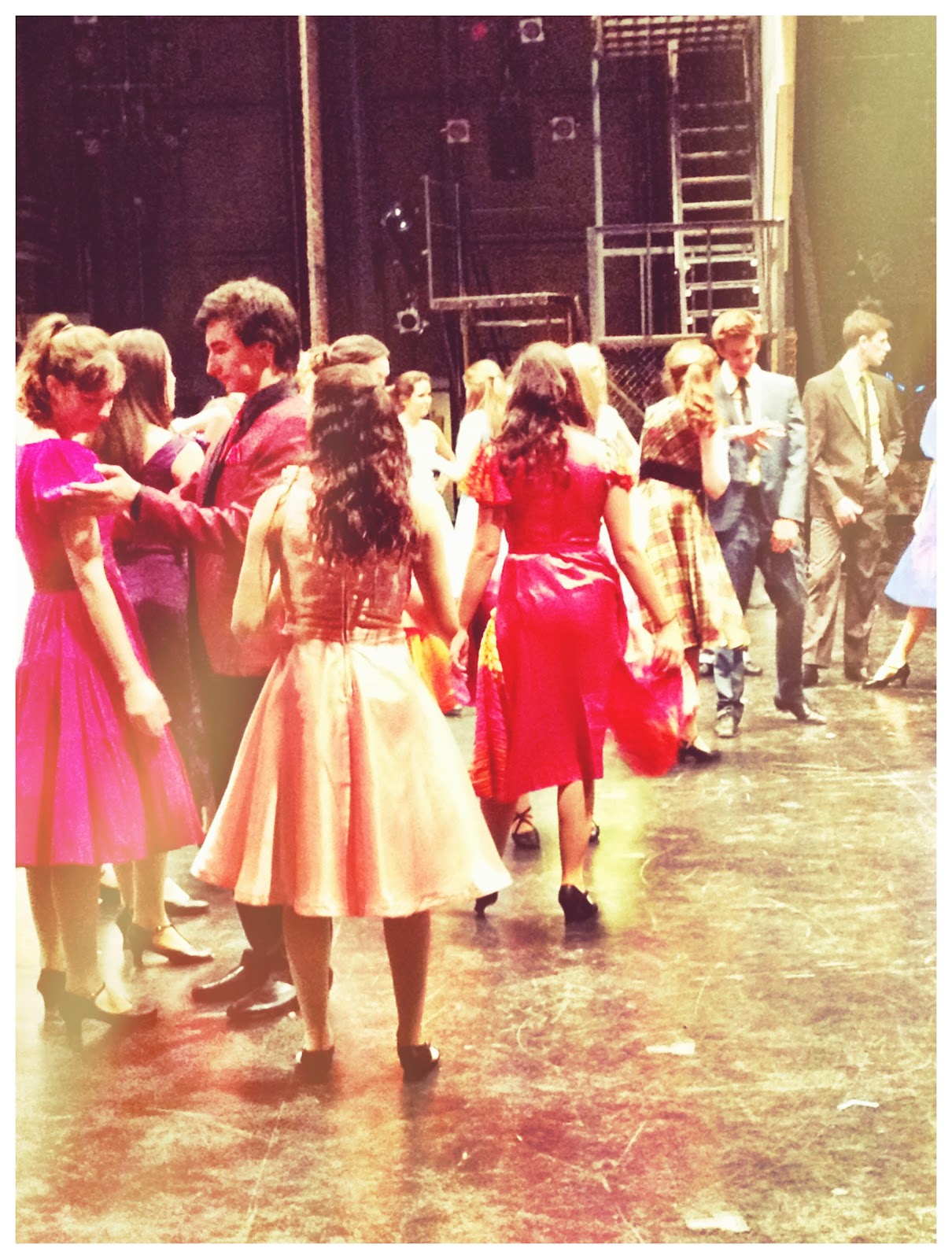
I recently returned from Interlochen Arts Academy, and talked with the students about, among many other things, their current production of West Side Story. Several of them followed up after I left, wanting to talk further, dig a little deeper about their characters and how to practically approach them. So we continued the conversation. I thought it might be interesting to share with all of you!

*

Dear All,

Write this next bit down, commit it to memory: 
We should never be afraid of knowledge.

Gather it with a healthy appetite like ephemera for a collage.

*

All of you:

The wonderful thing about working on WSS as a teenager is that the characters you are playing are exactly your age. This is a unique experience when you are in High School, for so often you are playing older adults in situations far exceeding your life experience. This is such an exciting opportunity to soul search: if you were in these (exciting, violent, confusing, frightening) situations right this moment, how would you feel and how would you react?

These are extreme circumstances. Struggling for survival (either "on the streets of New York" survival, or "making it in America without a penny to my name and I've come from San Juan with nothing but my wits" survival). Life and death circumstances--literally. People could die at any moment. People do die. Brothers, lovers, best friends--die. Take that in. Because of that, you must think in terms of extremities and levels of human desperation.

So. How can you push yourself as an actor to a similar place of that kind of desperation?
Head-work:
How can you make every single given circumstance of the highest possible stakes?

Example: When Lieutenant Schrank says "How's the action on your mother's mattress Action?"
--the actor playing Action could choose to just be "offended" or a "hot head," OR, he could conceive of a history with the actor playing Schrank-- perhaps Action's mother is in prison for solicitation. And perhaps it was Schrank who arrested Action's mother six months ago for the prostitution. OR, perhaps Schrank is his mother's customer. Perhaps all of the above. How can you load those moments and relationships so that they are swollen with meaning and high stakes?

Body work:
I suggest using exercise taken to an extreme. Running until every muscle and lung cell burns . I would try asking a friend to accompany you as you actually sprint in circles around the theatre--have the "spotter" push you physically until you actually feel you are going to burst. Then sing or recite (without music) your lines or songs. How does that change the experience?

By having a friend with you they can
a. Push you further. If they are there egging you on saying "you can run faster" or "You can dig deeper--say it again!" you will go to a new place. They keep you accountable.

b. They can make sure you don't actually get hurt.

Also, like I said before, remember that these characters are teenagers. Young people dancing on the line of childhood and adulthood in a quickly changing world who think they know it all, and fear they don't know a thing. They are young people just like you.You truly have to ask yourselves hard questions: if this were happening to me right now, what would I feel/think/do? 

When it comes to tangible research, use other young people (or older people when they were young) as a point of reference. Baz Lurman's Romeo & Juliet is a great guide because he was brave/practical enough to cast actual young (incredible) people in the major roles. Not to mention tremendous early teen/early 20s work from Johnny Depp, James Dean, Marlon Brando, Jodi Foster, Natalie Portman, Christian Bale, Patty Duke and Thora Birch.


*

Riff:

Check out Leonardo DiCaprio.

DiCaprio shares a lot of qualities with Riff-- but the most important is that wily, passionate charisma. At his best Riff is DiCaprio in Catch Me If you Can, at his worst (and in that darkest hours, when literally possessed by secret fears), he is screaming in a puddle of his own snot like DiCaprio in Romeo & Juliet or Basketball Diaries. YouTube this stuff. It'll help. It'll give you a point of reference. 

Crucially: Riff is a kid. You are also a kid. Wonderful: you have that unique quality in common-- you get to look inside yourself and ask "have I ever seen any of my friends on a slab at the morgue?"

Plus Riff has some serious family problems--to say the least. Flesh out and establish what those are.

The truth is every single one of these boys are afraid--left alone, they'd be paralyzed by fear. But they have one another. That is why Tony and Riff started the Jets: together, in their gangs, they can do anything. They believe-- they must believe-- that together they are untouchable.

As true impending violence gets closer and closer (and they can feel it) the tensions and fear build. And each Jet manifests that fear in a different way-- Action has his anger. Tony has his ideals and dreams. Riff has charisma and it exponentially mounts and mounts and mounts. It grows in its grandiosity and is deeply tactical. From wild highs (check out Baz Lurhmann's Romeo & Juliet, Mercutio's Queen Mab speech, brilliant performed by Harold Perrineau) to the "cool" lows (which are not low, they are merely subdued fear-- check out Marlon Brando being astonishing in "Wild One")

Practically:

1. How can you push yourself as an actor to a similar place of that kind of controlled and reigned in desperation? Use the sprinting exercise. Then singing/reciting/dancing "Cool" with as much mastery as if the audience were present. How does that change the experience? (Please make sure you don't get hurt!)

I also highly recommend doing this exercise with the actor playing Bernardo, and then doing your final knife fight.  If you are both "out of your minds on the edge" (controlled controlled), it will be electric. And true. (You do not want to have it look like ballet when really it is the end of their Universe.)

2. How can every dance move become a tangible sentence of articulate gesture? What does each and every movement "say?" Know the answers.

3. Lead that group of actors/Jets. You guys aren't a group yet and it's all on you baby doll. Get pizza. Walk around campus in a gang. Identify the weaker relationships in the group and and create little secrets that bond you. It won't take as long as you think. Give it a few hours. You are their leader: lead them.

4. Finally: stand up straight. You hunch your shoulders. But motivate standing up straight-- "If I stand tall and look at broad and tall as I possibly can, no one will touch me, or know that I am vulnerable." Standing up straight then becomes a motivated need.


*


Bernardo / Anita:

Bernardo and Anita are both unsafe in this new country and world without the other. Remember: What they share is that they both look after others. Not just often. But ALL THE TIME. No one looks after them. No one keeps them safe and secure and cherished. No one except the other.

Also crucially: they have a physical relationship exceeding merely sex. What I mean is their most articulate language is physical. The secret to the dialogue is in the dance at the gym. those aren't dance moves-- they are love making and war mongering. Practically do the running exercise, then recite (and I know this seems a little odd) the first few lines of the balcony scene (WSS or R&J) even though it isn't yours because Bernardo and Anita are THAT in love. Then do the Mambo. Ask one another/work out together how each step and move can have an actual "sentence" attached to it.

B:

1. Lead your boys (see #3 for Riff in reference to the Jets) Come up with a handshake and a Sharks gang "all for one" type slogan. And puh-lease: make sure it is in Spanish.

2. Unlike Anita, you can take a great deal of juice from referencing Tybalt from Shakespeare. Check out the perfect 'Latin-ized' modern reference once again in Baz Lurhmann's Romeo & Juliet played brilliantly by John Leguiziamo.


Also, there are (sadly) a great many modern manifestations of Latin gangs-- check out Gang Wars 2, a Discovery Channel documentary about Oakland, California Latino gangs (The Nortenos, The Surenos and The Border Brothers), as well as the HBO series Oz: the Latin gang (El Norte) is a great point of reference.

*

Action:

Check out at this clip of Leonardo DiCaprio in Basketball Diaries. It is Action-- inside, he is a frightened, angry kid. Action probably feels the same way about his mother (whom he defends in the soda shop so ferociously to Lieutenant Schrank) as DiCaprio feels about the mother in this clip.You clearly have a really great back story worked out about your mother, particularly with the actor playing Schrank, but flesh it out even further.

With tension and fear building Action has nothing but anger. The more fear he feels the shorter his fuse, the more violent his visions and solutions and dreams.

It is important to remember that Action is not a leader. He needs Riff and he knows it. So by the time Tony is off in LaLa Land consorting with the enemy, and Riff is actually dead, Action is left alone to lead a group when he is scared to death to lead. Because he is scared to death to DIE. Action spends every second dancing on the edge--"Officer Kruptke" is not so much a comedic song as a desperate attempt to quell the fear that at that point in the show is threatening to destroy him before a Shark does.

Action doesn't have Riff's charisma, he doesn't have Tony's ability to dream. He has his muscles, the ability to crush someone's throat with his bare hands just to keep himself safe. I don't think you would have to look hard to find a contemporary parallel anywhere in the world. Violence...fueled completely by soul-chilling fear.

Practically:

1. Work on your Levels of Tension. ("Levels of Tension" is a wonderful basic acting tool from the Le Coq tradition). Actually number them-- from 1-7, 1 being asleep, 7 being a nervous murdering psychopath (which is where Action goes-- he is like Romeo or Hotspur in Shakespeare).

Interlochen Arts Academy West Side Story costume parade

21 December, 2010

RSAMD: Drama at 60

So. My alma mater, The Royal Scottish Academy of Music and Drama (aka The RSAMD)'s School of Drama is 60 years old this year and I was hono(u)red and thrilled to participate in the Drama at 60 campaign.

Scotland is a beautiful country, Glasgow a beautiful city, with blinding creative artists in it-- and I was blessed to train there and will never forget the experience, and those that forever formed and touched my life, at the very beginning of my acting career...

Check out the RSAMD website, the Drama at 60 site, and follow the RSAMD on Twitter to learn more about the college that trained the likes of Alan Cumming, James McAvoy, John Hannah, Ruby Wax, Colin Morgan, Emun Eliot, Billy Boyd, Tony Curran, Richard Wilson, John Doyle, Robert Carlyle, David Tennant, and lil' ol' me (or, as they would say in Scotland-- wee auld me...)

03 May, 2009

Ask Al: A Second Opinion

Here are a few second opinions on the "Acting Vs. Musical Theatre," and other general training questions. I thought it would be interesting to glean some insight from those who experienced it from the other side. A few reliable resources are listed below.

Michael Jibson (Guilford School of Acting):
Interesting... There are some better colleges than others for Musical Theatre courses - Guildford - Mountview - Arts Ed. But I think ultimately, if you are in plays and films, you are an actor. If you are in Musicals you are still and actor. You would still approach a song in the same way as a piece of text - prose or verse.

There are some really good drama schools out there, and they will all give you the best opportunities - with the best agents going along to performances and showcases. If you want to be in musicals you audition for them. If you don't want to be in them, you don't audition for them.

I think what ever course you do, Acting or Musical Theatre, you are still an actor. If you wanted to be a singer, you would go and do an Opera course.

Conclusion: Whatever course you do, you make it work for you as an actor. Just make sure you take the course you will be happy on.


Rosanna Hyland (LaSalle College of the Arts):
I acquired a BA (Hons) Musical Theatre at LaSalle College of the Arts in Singapore. I went there because the choices in my home country of Australia were limited and I heard LaSalle had a reputable faculty.

So here's my two cents:

Find a course with a selective yearly intake. We had twelve people in my class, you can imagine the kind of personal attention and intensive training we got from that! Consequently, the course tailored to our own needs (ie. more dance classes because we were crap dancers, accent workshops because we sucked at accents, etc.)

If you're specifically interested in pursuing musical theatre, I would recommend a course that encourages students to actually study music! (I am shocked that most MT students in the UK graduate without being able to read music. They struggle to prepare for auditions and rehearsals as a result.) You don't need to be a maestro but it's comforting to know you can thump out your melody on a keyboard if you need to. Musical directors love you when you can sight read and learn your part independently. (That being said, music theory is naturally something one can always study on their own).

Go to some open days. Have a look at the students. And ask questions:

- Are they performing to a professional standard?
- Compare the MT students with the Acting students. Will the MT course give you intensive enough training to hold up in a straight or classical play?
- What is the student-teacher relationship like?
- Is the curriculum up-to-date?
- Are the students encouraged to 'find themselves', to experiment without fear of failure, to question their teachers, to be independent learners?
- Or are they expected to fall in line and nail that triple pirouette?

At an open day you can ask ANYTHING, you're not a student there yet so no one is going to penalize you for asking confronting questions!

What I'm trying to say is, find a course that is less worried about it's own reputation and standards, than more focused on giving it's students what they need. My class was such a motley crew of dancers, singers and actors, we were all so different from each other, and it was great to see twelve students emerge as individual, confident performers with different strengths.

Whatever the course, you don't want it to be about conformity and obedience. They are good if you want to be a lean mean dancing machine in the chorus, but if you're want to be a creative and unique performer (ie. "leading lady material") I'd say you need a course that encourages one to wipe off the makeup and explore yourself in a greater depth.

That said, I believe in a simple equation when it comes to education: INPUT = OUTPUT. That is to say, how much you learn and develop depends largely on how much you commit and devote yourself to the course. For that reason I tend to think a person can make the most of any course they take!


Damian Humbley (West Australian Academy of Performing Arts):
In my opinion, the training question is only relevant, insofar as, you should do it. If you want to work as anything in this world you have to train and learn the skills required. I've worked with people who've trained, and people who haven't, and I've always had better professional relationships with the former.

Training teaches you a language, which makes the creative process of any piece far more efficient and enjoyable.

In regards to what sort of training:

Al writes that acting drives everything, and while I agree, I'll be more specific and state that storytelling drives everything. Understanding what skills the story needs, to be told, is what takes training. While singing is a technical skill, there is nothing so moving as hearing a proficient tenor sing the final moments of Puccini's Nessun Dorma. Watching a dancer perform unimaginable feats with the human body to express a spellbound Odette in Tchaikovsky's Swan Lake is equally as affecting as an actor delivering an inspirational speech from Shakespeare's Henry V.

My point is - What do you need to learn, to do what you want to do creatively? Because, that's why we enter the arts - to be creative. AND to earn money doing it. But in that order. If your goal is to earn money, then I suggest IT, or Accountancy (something to do with numbers). People who are trying to find the 'right' form of study as a step in plotting out a successful career, are already off to a disappointing start. The piece of paper is worth very little, sometimes it gets you in the door, but it's for absolutely nothing if you don't have the skills.

Find a course that you connect with. One that offers classes you want to take. Lesson you want to learn. It sounds obvious, I know, but we can get lost with the planning. If I study this, people will see me as this, and therefor, I'll get this... It's all a lie. Learn, Understand, and be Good at what you do. That is where true greatness lies.

* * *

Interesting, huh? Thanks to Michael, Rosie and Damian, and hopefully this will spark some more discussion. All the best to you all, and I hope this proves stimulating if not helpful.