I recently returned from Interlochen Arts Academy, and talked with the students about, among many other things, their current production of
West Side Story. Several of them followed up after I left, wanting to talk further, dig a little deeper about their characters and how to practically approach them. So we continued the conversation. I thought it might be interesting to share with all of you!
*
Dear All,
Write this next bit down, commit it to memory:
We should never
be afraid of knowledge.
Gather it with a healthy appetite like ephemera for a collage.
*
All of you:
The wonderful thing about working on WSS as a teenager is that the characters you are playing are exactly your age. This is a unique experience when you are in High School, for so often you are playing older adults in situations far exceeding your life experience. This is such an exciting opportunity to soul search: if you were in these (exciting, violent, confusing, frightening) situations right this moment,
how would you feel and how would you react?
These are extreme circumstances. Struggling for survival (either "on the streets of New York" survival, or "making it in America without a penny to my name and I've come from San Juan with nothing but my wits" survival). Life and death circumstances--literally. People could die at any moment. People do die. Brothers, lovers, best friends--
die. Take that in. Because of that, you must think in terms of extremities and levels of human desperation.
So. How can you push yourself as an
actor
to a similar place of that kind of desperation?
Head-work:
How can you make
every single given circumstance of the highest possible stakes?
Example: When Lieutenant Schrank says "How's the action on your mother's mattress Action?"
--the actor playing Action could choose to just be "offended" or a "hot head," OR, he could conceive of a history with the actor playing Schrank-- perhaps Action's mother is in prison for solicitation. And perhaps it was Schrank who arrested Action's mother six months ago for the prostitution. OR, perhaps Schrank is his mother's
customer. Perhaps all of the above. How can you load those moments and relationships so that they are swollen with meaning and high stakes?
Body work:
I suggest using
exercise taken to an extreme. Running until every muscle and lung cell
burns . I would try asking a friend to accompany you as you actually sprint
in circles around the theatre--have the "spotter" push you physically until you actually feel you are going to burst. Then sing or recite (without music) your lines or songs. How does that change the experience?
By having a friend with you they can
a. Push you further. If they
are there egging you on saying "you can run
faster" or "You can dig
deeper--say it
again!" you will go to a new place. They keep you
accountable.
b. They can make sure you don't
actually get hurt.
Also, like I said before, remember that these characters are teenagers. Young people dancing on the line of childhood and adulthood in a quickly changing world who think they know it all, and fear they don't know a thing. They are young people just like you.You truly have to ask yourselves hard questions:
if this were happening to me right now, what would I feel/think/do?
When it comes to tangible research, use other young people (or older people when they were young) as a point of reference. Baz Lurman's
Romeo & Juliet is a great guide because he was brave/practical enough to cast actual young (incredible) people in the major roles. Not to mention tremendous early teen/early 20s work from Johnny Depp, James Dean, Marlon Brando, Jodi Foster, Natalie Portman, Christian Bale, Patty Duke and Thora Birch.
*
Riff:
Check out Leonardo DiCaprio.
DiCaprio
shares a lot of qualities with Riff-- but the most important is that wily, passionate
charisma. At his best Riff is DiCaprio in
Catch Me If
you Can, at his worst (and in that darkest hours, when literally
possessed by secret fears), he is screaming in a puddle of his own snot
like DiCaprio in
Romeo & Juliet or
Basketball Diaries. YouTube this
stuff. It'll help. It'll give you a point of reference.
Crucially: Riff is a kid. You are also a kid. Wonderful: you have that unique quality in common-- you get to look inside yourself and ask "
have I ever seen
any of my friends on a slab at the morgue?"
Plus Riff has some serious family problems--to
say the
least. Flesh out and establish what those are.
The truth is every single one of these boys are afraid--left alone, they'd be paralyzed by fear.
But they have one another. That is why Tony and Riff started the Jets:
together, in their gangs, they can do
anything. They believe-- they must believe-- that
together they are
untouchable.
As true impending violence
gets closer
and closer (and they can feel it) the tensions and fear build. And each
Jet manifests that fear in a different way-- Action has his anger. Tony
has his ideals and dreams. Riff has charisma and it exponentially mounts and mounts
and mounts. It grows in its grandiosity and is deeply tactical. From wild highs
(check out Baz Lurhmann's
Romeo & Juliet,
Mercutio's Queen Mab speech, brilliant performed by
Harold Perrineau) to the "cool" lows (which are
not low, they are merely subdued fear-- check out
Marlon Brando being astonishing in "Wild One")
Practically:
1. How can you push yourself as
an
actor
to a similar place of that kind of controlled and reigned in
desperation? Use the sprinting exercise. Then singing/reciting/dancing "Cool" with as much mastery
as if the audience were present. How does that change the experience? (
Please make sure you don't get hurt!)
I also highly recommend
doing this exercise with the actor playing Bernardo, and then doing your final
knife fight. If you are both "out of your minds on the edge" (controlled controlled), it will be
electric.
And true. (You do not want to have it look like ballet when really it is the end of their
Universe.)
2. How can
every dance move become a tangible
sentence of articulate
gesture? What does each and every movement "
say?" Know the answers.
3.
Lead that group of actors/Jets. You guys aren't a group yet and it's all on
you baby doll. Get pizza. Walk around campus in a gang. Identify the weaker
relationships in the group and and create little secrets that bond you. It won't take as long as you
think. Give it a few hours. You are their leader:
lead them.
4. Finally: stand up straight. You hunch your shoulders. But
motivate
standing up straight-- "If I stand tall and look at broad and tall as I
possibly can, no one will touch me, or know that I am vulnerable." Standing up straight then becomes a motivated need.
*
Bernardo / Anita:
Bernardo and Anita are both
unsafe in this new country and world without the other. Remember: What
they share is that they both look after others. Not just often. But ALL
THE TIME. No one looks after them. No one keeps them safe and secure and
cherished. No one except the other.
Also crucially: they have a physical relationship exceeding merely sex. What I mean is their most
articulate language
is physical. The secret to the dialogue is in the dance at the gym.
those aren't dance moves-- they are love making and war mongering.
Practically do the running exercise, then recite (and I know this seems a
little odd) the first few lines of the balcony scene (
WSS or
R&J)
even though it isn't yours because Bernardo and Anita are THAT in love.
Then do the Mambo. Ask one another/work out together how each step and
move can have an actual "
sentence" attached to it.
B:
1.
Lead your boys (see #3 for Riff in reference to the Jets) Come up with a
handshake and a Sharks gang "all for one" type slogan. And puh-
lease: make sure it is in Spanish.
2.
Unlike Anita, you can take a great deal of juice from referencing
Tybalt from Shakespeare. Check out the perfect 'Latin-ized' modern
reference once again in Baz Lurhmann's
Romeo & Juliet played brilliantly by
John Leguiziamo.
Also, there are (sadly) a great many modern manifestations of Latin gangs-- check out
Gang Wars 2,
a Discovery Channel documentary about Oakland, California Latino gangs
(The Nortenos, The Surenos and The Border Brothers), as well as the
HBO series Oz: the Latin gang (El Norte) is a great point of reference.
*
Action:
Check out at this clip of
Leonardo DiCaprio in Basketball Diaries.
It is Action-- inside, he is a frightened, angry kid. Action probably feels the same
way about his mother (whom he defends in the soda shop so ferociously to Lieutenant Schrank)
as DiCaprio feels about the mother in this clip.You clearly have a really great back story worked out about your mother, particularly with the actor playing Schrank, but flesh it out even further.
With tension and fear building Action has nothing but anger. The more fear
he feels the shorter his fuse, the more violent his visions and
solutions and dreams.
It is important to remember that Action is
not a leader. He
needs Riff and he knows
it. So by the time Tony is off in LaLa Land consorting with the enemy, and Riff is actually
dead, Action
is left alone to lead a group when he is scared to death to lead. Because he is
scared to death to DIE. Action spends every second dancing on the edge--"
Officer Kruptke" is not so much a comedic song as a desperate attempt to
quell the fear that at that point in the show is threatening to destroy
him before a Shark does.
Action
doesn't have Riff's charisma, he doesn't have Tony's ability to dream. He has his
muscles, the ability to crush someone's throat with his bare
hands just to keep himself safe. I don't think you would have to look hard to find a contemporary parallel anywhere in the world. Violence...fueled completely by
soul-chilling fear.
Practically:
1. Work on your Levels
of Tension. (
"Levels of Tension" is a wonderful basic acting tool from the Le Coq tradition). Actually number them-- from 1-7, 1 being asleep, 7 being a
nervous murdering psychopath (which is where Action goes-- he is like
Romeo or Hotspur in Shakespeare).
 |
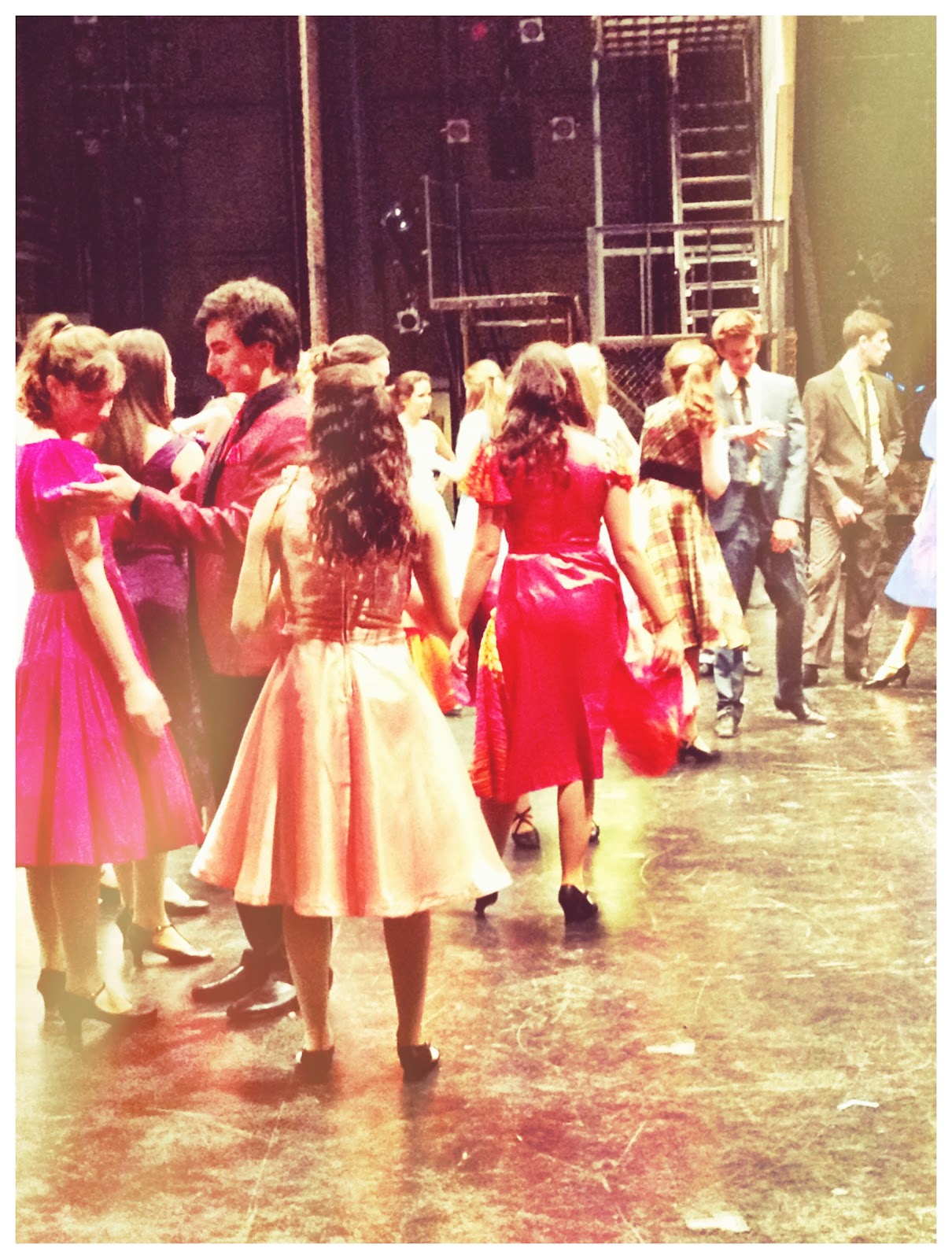
| Interlochen Arts Academy West Side Story costume parade |




 Posts


