Showing posts with label Fiddler on the Roof. Show all posts

13 March, 2023

I wanna talk about this hug with Samantha...


I want to talk about this hug with Samantha Masssell...

Playing Tzeitel in the 2015-16 production of Fiddler on the Roof on Broadway was one of the best and hardest 16 months of my life. While the public part of me soared in such a gorgeous production and beloved role on stage, off stage I was battling with truly debilitating severe ulcerative colitis daily.

I have a lot of people to thank for keeping me afloat and alive— my “Helens,” (the beloved wig room and creators of "the Cutest Pregnant Woman on Broadway!") my Hub Adam Kantor, The “Pineapples,” (a handful of the 30-somethings who were beyond there for me), but the majority of the agony happened in the dressing room I shared with Samantha—our beloved Dressing Room 51.

I am so unspeakably grateful that those health struggles are behind me now… it’s been quite the road to recovery.
 
But what forever remains is the memories of an incredible 26-year-old young woman who—with no training, and who never signed up to share space with a very sick person—bore witness to it ALL.
 
And even when I was very hard to love and be with, Sam stuck by me. We cried. We laughed (man how we laughed). We “kept it at a 10.” She listened. She saw. All of it.
 
Sam and I don’t have sisters in real life.
But the further away that experience gets, the more remarkable that incredibly young and remarkable Samantha seems to me, and the more truly sisterly her devotion.
 
In the business of show, there are a lot of glittering highs. A lot of unspeakable lows. But what remains at the end of the day is the friendships—more like family than could ever possibly be articulated.
 
So. Hug your friends. Tell them what they mean. We have such precious, fleeting, fragile days here on earth.

That’s it.
I just wanted to tell you all.
I love you, Doo Doo. X
 
📸: James T Murray (thank you SO much)

20 October, 2021

Henry

Are these screenshots from me and Henry Goodman doing an advertisement for the Jewish Film Festival of London? 

Why yes it is.

Did we ride the train back to London Bridge together and say goodbye on the train platform... because that is always how Henry and I say goodbye? 

Also yes. 

Henry, "God alone knows when we shall see each other again," but leaving it "in His hands" is always a sure bet. I love you, thank you for sharing the most heart-opening scene of my career thus far.   It was a joy to affirm with words, after all these years, that it meant as much to you as it did to me.


18 January, 2020

In dialogue with "Hey, Alma" regarding my Bat Mitzvah!

Hello, darling blog readers!  Below is an interview I did with Emily Burack for the glorious Jewish website Hey Alma.

Enjoy a little peek inside my journey to becoming a Bat Mitzvah at 36, and all the illuminating points along the way.

The article below was published on Hey Alma, January 17, 2020.

*

Alexandra Silber is a Broadway star, writer, Jewish educator — and now a newly bat mitzvah’ed woman.

Let’s back up a second. Silber is Jewish; she was raised outside Detroit, Michigan, the daughter of a Jewish dad and a Catholic mom. Her dad passed away when she was 18 years old.

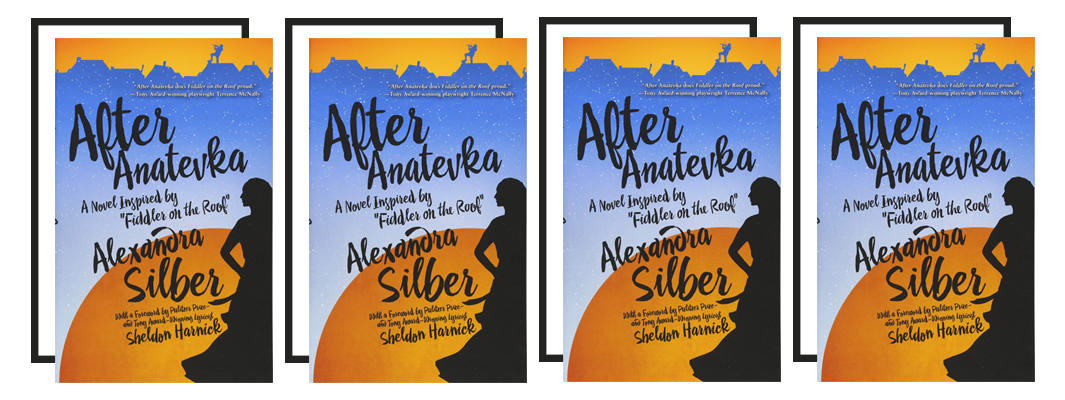
Silber has a long history with Fiddler on the Roof. In 2007 and 2008, she portrayed Hodel (the middle daughter) on London’s West End, and in 2015 and 2016, she was part of the Broadway revival of Fiddler as Tzeitel, the eldest sister. After the Broadway run of Fiddler ended, she went on to write After Anatevka, a novel that imagines what happened to Hodel after the story of Fiddler ends, and White Hot Grief Parade, a memoir about what happened when her father died of cancer.

“After two huge productions of Fiddler and the publication and book tours around each of my books, I met so many people in Jewish communities that sparked, fed, and fueled my interest in knowing more, and finding a peaceful, curious, voracious, and joyful certainty of God,” Silber explained over e-mail to Alma. Becoming a bat mitzvah “was the best decision I’ve made in my adult life.”


We talked with Silber about her bat mitzvah, why she wore her mom’s wedding dress and her deep relationship with Fiddler on the Roof.

Mazel tov on your bat mitzvah! What made you decide to become a bat mitzvah?
I come from a mixed family — my father’s family being Jewish and both sides of my mother’s family, Catholic. Life in my home was deeply spiritual, religiously informed, but entirely secular. I would say I am definitely a product of a few generations of highly motivated American assimilation — my mother’s cultural background is Irish and Latinx, and her maiden name is Noriega. When and where she grew up in California in the 1950s and ’60s, there was cultural incentives for assimilation that her parents and grandparents gave their lives for.


The same was true for the Silber family. My grandparents came into the prime of their adulthoods during the Holocaust, and though they were far from the European atrocities, their families and friends were not unaffected by the horrors. I will never fully understand their experience, but I can wrap my mind around the cultural pressures to assimilate.

I lost my father to cancer when I was just 18, and the experience charged me with many spiritual life-and-death questions at that tender age. As I’ve grown, those thoughts and concepts have swirled around me, informing so much of my life and work. And of course, professionally, Judaism has been a huge part of my life and immersing in the culture via the theatre (and subsequently through my books) has been a game-changer.

I saw on Instagram that you wore your mom’s wedding dress to your bat mitzvah — why did you decide to do this? What did it mean?
I’m so glad you asked this question. I wanted my mother to feel that she was literally embracing me, standing alongside me and offering a meaningful contribution to the ceremony that might otherwise feel slightly alienating to her culture and faith of origin. My mom Catherine could not be more supportive of all that I do, but I wanted her to feel significantly represented in the ceremony.
My parents were married in 1980 by a generous and beautifully spirited rabbi in Detroit, Rabbi Richard Hertz. The wedding photos of this outdoor Jewish ceremony are integral to my vision of my parents’ origins and peerless love story. It was a simple way for both of my parents to be “present” on the day, almost 40 years later.

What was the process like?
The month after the Broadway run of Fiddler on the Roof ended, Rabbi Larry Hoffman of Hebrew Union College invited me to teach at a retreat for his fourth year rabbinical and cantorial students. It was a three-day experience I will never forget. I used lessons commonly taught in theatrical environments and applied them to the scope of Judaism, and got some of the most memorable feedback and lessons were thrown back at me from the group of 16 or so students (that were largely my own age!).

A few students in particular really stood out to me as people I’d love to remain friends with — two being (now Rabbi) Samantha Frank and (soon to be Rabbi) Rena Singer. They had gone about starting what can only be described as a Reform, feminist, totally inclusive, profoundly informative, and an all-around glorious Instagram account called @modern_ritual. I devoured the content. I identified with it. And before long, I realized that if I was going to engage with this bat mitzvah experience, I wanted to do it with them — with peers I looked up to immensely leading me, in just the way I had led them just a few years earlier.

Rabbi Frank and I made an initial date to meet and discuss the details — my prior knowledge, my goals, and what I truly wanted from the experience, and together we crafted a plan that was personal to me, where I am in my life now as an adult woman. We met once a week (sometimes in person and sometimes over the internet), and not only learned Hebrew and trope (from scratch!) but we discussed all things spiritual, Israel, Torah, history, and culture.

What was the hardest part?
Aside from learning Hebrew (medium-hard — I’m quite adept at languages in general) and trope (almost unbearably hard as a musician and music-reader), the hardest part was the bittersweet moment of saying goodbye to Rabbi Frank after the process was over. She became the only person in my life (other than my partner and my mother) whom I spoke with every day. I miss her!

Totally on a different note from your bat mitzvah, why did you write After Anatevka?
I played Hodel in the ’07-’08 West End production at the Savoy Theatre. Hodel took on a deeper significance for me than any other character I’d ever portrayed, mostly because when I began rehearsing here in London I was coming to terms with the death of my father five years earlier at the age of 18. Hodel’s final scene is not only an assertion of her adult autonomy, but it’s her chance to say goodbye to her father, a chance I was personally lacking in my real life. When Hodel said, “Papa, God alone knows when we shall see each other again,” it was more than a piece of dialogue for me. It felt mythological, primal even.
after anatevka

I suppose I only now see the direct connection between the an 18-year-old girl who boards a train to Siberia, and an 18-year-old girl who boarded a plane to Scotland. By exploring and assuring Hodel’s future, and her capacity to endure, I was in some deeper way doing the same for myself.

Did playing Hodel in Fiddler impact your Jewish identity?
Of course. On several levels. The first being that I was playing Hodel in London and the UK has a much less prominent experience of Jewish culture woven into the mainstream than we do here in the US. That said, in a large cast of 30, I was only one of three (even remotely) Jewish actors, and throughout that experience I learned many things alongside the Judaism novices, as well as feeling charged to be the best ambassador of Jewish culture I could be. I did endless research not only to benefit myself but to be a more dependable guide for my castmates. That naturally trickled into my off-stage life.

Second, and perhaps deepening that experience, studying Jewish culture, history, and the faith itself gave me an aperture into my personal genetic legacy — a connection to my father, grandparents, and beyond — all of whom I could no longer connect with on earth in the present tense. It was a way for me to feel the ancient links that connected me straight back to Hodel herself. A way to feel close to my father.

fiddler al silber
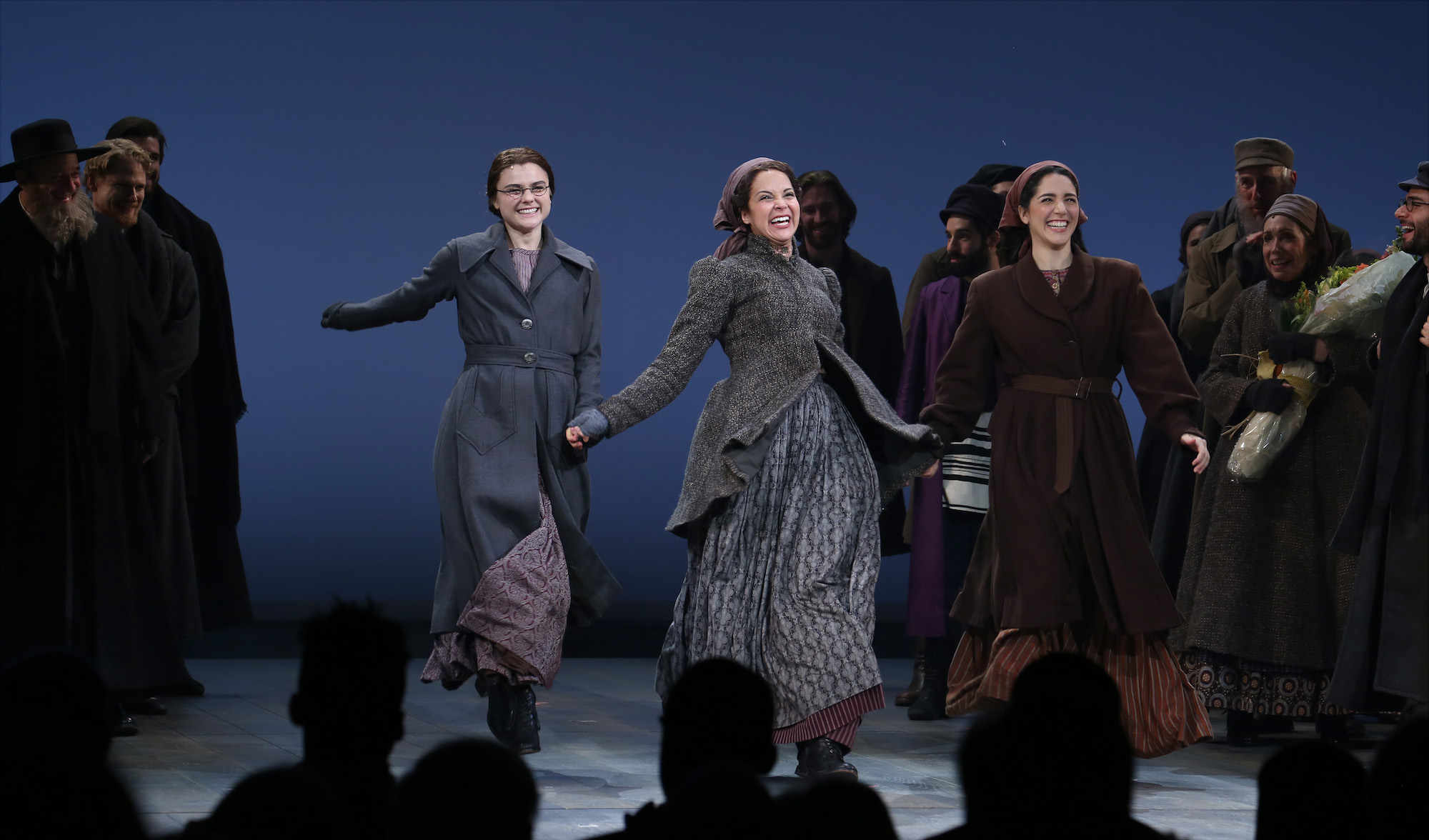
Melanie Moore, Alexandra Silber and Samantha Massell during the Broadway Opening Nigh,t Performance Curtain Call bows for ‘Fiddler On The Roof’ at the Broadway Theatre on December 20, 2015 in New York City.
By the time I arrived to live permanently in America in 2010, the process was well underway even if it wasn’t in the forefront of my consciousness. And by the time I was cast as Tzeitel in the 2016 Broadway revival, if the deal wasn’t sealed already, it was sealed doubly so by Rabbi Larry Hoffman of Hebrew Union College. He served as the Broadway production’s Jewish consultant, and we forged a very special connection that remains alive to this day.


What was the reaction like to your novel?
Largely positive. So many people shared my curiosity about what happens to this family! Of course, there will always be dissenters and people who wished I’d crafted the date of their beloved characters in a different way, but I had to remain true to history and to the woman I grew to know Hodel to become.

Jews have such a long history in the theater — why do you think that is?
All of the arts have powerful Jewish cultural parallels: ways of uniting a community, telling stories that make people think, feel, laugh, and change, and providing a way to bear the adversities of life.

What’s your favorite Jewish show?
Aside from Fiddler, I’m a huge fan of Paula Vogel’s gorgeous play Indecent — which chronicles the history of another pivotal Jewish/Yiddish play “The God of Vengeance” by Shalom Ashe.

26 June, 2018

Ask Al: FAQs! - Part 4

1. You got a flat-out rave review for your portrayal of Guinevere in Camelot from the Washington Post. Was there anything the critic noticed that was especially meaningful to you?

     I always love to know that the production we’ve worked so hard on building is received so warmly.

     I’m not alone in being an actor who does now read my own theatre reviews. I find they “mess with my head” and regardless of positive or negative feedback, they give me specific adjectives that stick in my mind and body that infuse my performance. I wrote about this in a former post a few years ago. The extraordinarily difficult thing about theatre reviews is that the actors have to RETURN to the work the reviewers love or hated the following day, week, month, etc., with the knowledge of those words and opinions.

     In contrast, I do not feel this way about my book reviews! And I suppose I would feel similarly about acting work captured on film. The work, in those instances, is “over.” One cannot change it, it is preserved forever in the form it is and is not a “living” work of art. The distinction of the living work is what makes reading reviews particularly difficult for me, and I suspect, for many others.


2. One of the songs you sing in this show is "I Loved You Once In Silence." Who is someone you loved, but never expressed it to them?
Believe me: they know who they are.

It was expressed. The sentiment of the song remains exactly the same. Sometimes loving is hard.


3. What drew you to the role of Hodel and then Tzeitel in Fiddler on the Roof— are the three of you alike in any ways?

     There are too many to mention. I honestly feel this question is best answered within the pages of After Anatevka— and not only the similarities, but the differences, and the growth every human being hopefully acquires as they age and experience life. I had the uncanny joy of being able to understand each woman more deeply as I embodied the other— much like members of the same family come to more deeply understand their siblings as they all become adults.

     One of my most treasured passages from After Anatevka is from the penultimate chapter, an epistolary exchange from Tzeitel to Hodel:

“Home, Hodelleh. That place beyond the place where we rest our heads every night. Where our centerpieces, our sewing, our carefully prepared meals, simply do not matter. Where our petty little differences and competitions with one another do not matter anymore.

And I thought of you.

It is odd, Hodelleh. Because I do not know if you shall ever read this, I feel compelled to tell you more than ever. Home—where love shall reign supreme. The kind of home you always held within your heart, my dear sister, the kind no meaningless skill of mine could ever fully capture. How I love you, Hodel. It aches within me that I failed to show you in so many ways. That I provided you with every comfort but the comfort of my heart.

Yet I know that we shall both, as we always did, return to each other. For the love beneath our struggle is so strong. Perhaps in time, the Lord shall reveal to us why it is so difficult.”

     My goodness, to embody two such women. What a privilege.


4. Since you started your career how have your future aspirations changed or stayed the same?

     One of the wonders of being a human being is that your dreams really do come true. Not all of them, and not always in exactly the way we envision them, but dreams DO come true, and what happens after they do? Well, we gotta get some new dreams!

     The way I would put it is like this: if the book of my life/career is 25 chapters long, I know that I want Chapter 25 to be someone pulling me off a stage and putting me in my coffin in my costume. That remains the same— the interim dreams alter. I can’t wait to work with people I’ve yet to meet. I can’t wait to play Cleopatra. I can’t wait to originate roles that haven’t been written yet. But ultimately, the final dream remains the same: a life in the theatre.


5. What are your strengths and as an actress?

     Hm. I believe I have a very quick access to the emotions many people consider to be “beyond the comfort zone”— particularly sorrow and anger. I also enjoy using my vivid imagination to create emotional backstories that fuel me. I also have a very active academic mind, curiosity about the world around me and a strong sense of empathy. Those help!


6. The arts in schools are often so low in the chain of importance that it’s mostly overlooked, how can students, teachers even parents shine more light on the importance of the arts?

Interlochen Center for the Arts
     The first and most important aspect of arts education is that is must begin at home. If parents and families value the arts, they will pass that import on to their children. But the arts belong in schools, for a myriad of reasons.

     Music, visual art, creative writing, and dance all belong in schools, but because my background is predominantly in the theatre I will use a theatrical example: theater’s earliest origins extend back to Ancient Greece, where participation in the Festival of Dionysus, a multi-day cultural event, was a requirement of citizenship! The theater was not about celebrities or spectacle; it was about telling stories for the purpose of the public having a cathartic experience together. Aristotle defined it as “the purification of the spirit…by witnessing the playing out of such emotions or ideas on stage.” The result is positive change. Especially in fractious times like ours, when there are great fears and even greater uncertainties, the theater can be a place of emotional and societal healing.

     Further, not every human being possess numeric or linguistic intelligence (the two “kinds of smart” that are predominantly measured in conventional schooling), and the arts offer students an additional way to excel, process and experience the world and to deeply contribute to society.

28 March, 2018

Q&A: Talking Camelot with Shakespeare Theater Company

Oh hello: this is my cape.
Shakespeare Theater Company in Washington, DC, welcomes Alexandra Silber as Guenevere in CAMELOT.

Alexandra Silber, who has been seen on Broadway stages in Fiddler on the Roof and Master Class, will be featured as Guenevere in STC’s upcoming production of Camelot. She recently spoke to STC about the comparison between Guenevere and Tzeitel, her experience adapting modern adaptations of Greek classics and her thoughts on Camelot.

What’s most exciting to you about bringing the character of Guenevere to the stage at STC?
     The story is about a young leader who is trying to change the way things are through reason, equality, and humanity. That feels beyond timely. Guenevere is the woman at Arthur’s side who shares his vision, and helps him fuel, build and create it. That also feels beyond timely.
Above all, I’m intrigued by the unapologetic examination of three endemically flawed protagonists—all doing the best they can, derailed by their humanity, their ideals, and ultimately, by one another. I adore living inside of and exploring human flaws, darkness, weakness, and shame—we don’t take those things out and look at them enough. Yet our less favorable natures are there, latent within us all, informing all of our moment-to-moment choices and overall lives. Aren’t most of us endeavoring to do what we consider to be “good,” and don’t we all, at some point, fail?

Is there a specific moment or song that you look forward to from the piece?
     I have always felt that “What Do the Simple Folk Do?” is one of the greatest sung scenes in musical theatre—on par with Carousel’s bench scene and West Side Story’s balcony scene (and I’ve played them both!). What makes this musical scene unique is what is unspoken, unuttered. In this remarkable display of a deeply loving, but crumbling couple’s marriage, we see the spark that continues to connect them: their capacity to seek beyond themselves and approach existence with ravenous curiosity. It is the quality that initially enchanted them about one another—the depth and breadth of their discussions create a new era, a new England, and this is their articulate, singular, irreplaceable love language.

     Throughout the course of this deceptively not-at-all-trivial song, we see two souls—a husband and wife—awaken to the reality that their marriage, and likely their vision for a better world, is over. They feel it. They know it. Yet they say almost anything else. This is the last of their “one brief shining moment.”And I don’t know about you, but I’ve been there. I have stared into the eyes of someone I loved desperately and known it was over, and not uttered it; hoping that one more conversation, metaphor, or chorus, would delay the inevitable if even for a moment.


Tzeitel. I love her I love her.
What would you imagine Guenevere and Tzeitel meeting would look like?
     Both Guenevere and Tzeitel discover themselves within the circumstance of an arranged marriage. Both are strong-minded, deeply feeling and passionate women, who take great issue with their given situations. Both roil against the lack of agency allowed to them as women, both instinctually fight for their autonomy despite extraordinary pressure to conform, and both, at heart, are deeply principled about the nature of true love.

     I’m certain Guenevere would mine Tzeitel’s experience of having loved one man fiercely the entirety of her life, and Tzeitel would be fascinated by the complexities of Guenevere’s simultaneous loves: her constancy for Arthur and passionate awakening discovered with Lancelot.
I also think their dialogue would be very different if they met as their Act One and Act Two selves! Both women grow tremendously, grow up, change, suffer, endure. I know Tzeitel like a very old friend, and barely know Guenevere at all yet, but I sense a possible bond and hope they’d find common ground and be able to connect and learn from one another.

     The Cosmopolitan magazine answer to this question is: I’m sure they’d talk about their mutually fabulous manes of hair because let’s face it: both gals won the hair lottery.


You have written modern language adaptations of Greek classics. Is there any another classic you’d be interested in adapting?
Seven against Thebes     My passion for re-examining and re-imagining the Greek classics is rooted in a fascination that our societies, regardless of time period or culture, seem to be reliving the same relationships, political struggles, griefs and arrogant mistakes that we have been making since the dawn of examined life. I am obsessed with picking apart the well-known (and sometimes simplistic) myths and zooming in on the psychological microscope on why these familiar icons of Greek lore would make the choices they do. What are the particular nitty-gritty complexities of their relationships, their inner workings? And not only insinuating it into the playing but putting new, sometimes fairly contemporary but always poetically visceral words in the characters’ mouths. I do try to honor the poetic tradition, while also making the language feel more a little more immediate. I’m no definitive playwright, but as an actor, I know that if a phrase in my mouth feels like a missile? I’m getting somewhere!
     My existing adaptation of Sophocles’ Antigone is probably the piece I feel closest too, and the one that feels the most currently ripped from the headlines; and, to loop back to answering the question, I have already begun adapting Seven Against Thebes. The play is Aeschylus’ take on the epic struggle between Antigone’s brothers (all of them children of the doomed Oedipus Rex), Eteocles and Polynices, for control of Thebes. I feel like there are some really potent American parallels to micro-factions myopically fighting narrow-minded battles for control their country.


For more information on Camelot, click here.

19 February, 2018

Ask Al: FAQs! - Part 3

1. What is the hardest part of being in the public eye?
This is a very tough one.
There are some muddy lines can sometimes create very real misunderstandings with fans, acquaintances, and certain professional relationships.

[*Cracks knuckles and types manifesto*]

The arts are all intimate businesses, and we don’t deal in numbers, quotas or measurable things, we deal on a daily basis with the innermost workings of humanity, and reveal to the everyday human being the glory of life’s routines, exploring humanity’s full capacity, and revealing some of life’s extremities. We deal daily (and joyfully) with the vulnerability most people spend their entire lives avoiding! And when artists deal with it out in the “real world” transactionally and blithely, it can get confusing. For everyone.

As both an introvert and fiercely private person, it is difficult to feel comfortable about said privacy— particularly in an age of social media where so many people feel (for lack of a better term) entitled to know certain details of your life. Some people feel absolutely comfortable sharing intimate details, and others less so. All variations of that comfort are okay and up to the individual. I believe strongly that the tone, content, and level of intimacy on social media is solely up to the owner of the account, and just because fans want intimacy does not mean it has to be given.

For example you are currently reading my blog. I have been writing this blog for 10 years, sometimes for the purpose of enjoying a creative crucible, sometimes for the purposes of sharing an already-processed experience. However, my inner-most vulnerabilities are mine, and preserved for my close friends and family. The fact that I share selective facts and reflections of and upon life’s ups and downs is one thing, but I do not use this blog (or any aspect of my social media) to actively work through my emotions in real time. I do not share unresolved experiences. Further, and all the sharing is for the purpose of universal connection, not exploitation.

My real-life vulnerability is reserved for my real-life friends. Not, say, my “Facebook Friends.” My personal definition of the word Friend is “a person who has borne witness to, and held, my innermost life.” Thus, never mistake the behavior commonly known as “friendLY” with the well-earned state of “friendSHIP.”

Ultimately, I am very honored to be in my position, and love to share my heart on my own terms. It is an honor to be known for what I love to do and I endeavor to deserve that honor.


2. If you could write a continuation of any other musical theatre character, who would you choose and why?
You might be surprised to hear this but Chava! I think we can all agree that I’m now intensely involved in this family’s “future story—” I do feel compelled to finish what I’ve started and Chava is the daughter I will always somewhat regret not getting a chance to embody as well. I also find her decision equally as harrowing and thus, compelling. How do you cope with he results of such a decision? How does hers and Fyedka’s marriage fare? So many specific adjustments in that scenario. Additionally, I don’t think I’ve heard the last of Hodel. We leave her at quite a cliffhanger in After Anatevka!


3. Have you always aspired to be a performer or did you have a different dream when you were younger?
I always knew I wanted to be a professional creative— I’m not certain that acting and singing professionally was the epitome of my dream. As a child and teenager, I loved the theatre, felt at home and accepted amongst its “creatures” and had an outlet to explore new worlds, research new ways of life, get inside different people’s minds and heart, and to express so many of my deepest emotions.

I’ve been thinking very deeply about “dreams coming true” recently— possibly because so many people are asking me about it. “Is publishing your novel a dream come true” they will ask, and I don’t entirely know how to answer that. Because of course, it is, I have dreamed of sharing my stories with the wider world, to hold a book-shaped book, with actual binding and  I have written in my hands

The voices on Broadway cast recordings were not only my inspirations but my companions, my teachers; I know many people for whom that is a familiar history. But I felt very much the same about characters in books. I was just as enamored with E.M Forster’s Margaret Schlegel as I was with the book and score of South Pacific.


4. After Anatevka tells the story of Hodel after Fiddler. When you research for a role do you think about what happens to the character after the show ends as well as their backstory or was Hodel an exception?

Hodel was absolutely an exception.

The Broadway community and wider world may know me as the most-recent Tzeitel,  from the 2016 Broadway revival of Fiddler on the Roof, but from October 2006 to February 2008, I played Tevye's second-eldest daughter, Hodel, in the last West End revival in London. That experience was, without exception, the most immersive and deeply felt of my artistic life thus far. It was like a “first love—” the kind one never forgets, and imprints itself upon you more deeply than any to follow it. Hodel’s strength and sense of purpose, your complex feminine spirit, her wit and determination, her devotion and loving heart. She offered me a chance to find all of these things within myself, and to grow with them.

While all characters tend to endear themselves to you, Hodel haunted me— remained in my cells like an un-rinseable, inextinguishable fuel. Actors often embody traits of the characters they take on, but few characters weave in and out of the soul until you can scarcely detect the line between the emotional truths of one and the other.


5. What is one piece of advice that you wish someone would have told you while you were in school/college/university?

The path to success is curved.


23 September, 2017

[The Real] Rabbi Syme

    As many of you out there are reading After Anatevka, you might be surprised to know that one of the leading questions I get is whether or not Rabbi Syme (Perchik's teacher and advocate) is based on a real person. The answer: of course he is. Rabbi Syme was indeed so influential, that I felt he had to be memorialized in After Anatevka for he was my first spiritual advocate.

    Fictional Rabbi Syme is based very loosely upon the real-life Rabbi Syme—loosely because my description in the novel is not so much a literal, but more of an evocative recollection and honoring of his influence. Real-life Rabbi Syme and I only spent a collection of minutes together in 2001, but they were crucial minutes. He gave me the gift of delivering the eulogy at my father's funeral service, as well as bearing witness to it when he lead the funeral service, and above all, he gave me an hour of his time months later, reminding me of what was eternal, and chartering a map toward the beauty, strength and individuality my faith. Irreplaceable gifts one can never forget.

    The influence of Rabbi Syme proves another true-to-life maxim: that we never know the depth of the influence we have upon one another. A fleeting moment to one, might bear a lifetime of profundity to another, for better and for worse. So it is in these tiny actions that we must recognize that our influence on earth is vast, has meaning, and should never be taken for granted.

    I include this story from my memory (also included in my upcoming memoir) in today's post because the prayer Rabbi Syme references, the Shema' Koleinu, is not only a prayer that is part of the Amidah (the core of every worship service), but especially significant on the High Holy Days, which are currently upon us.

    L'Shana Tova, one and all. May your new years be filled with positive influence that you both give and receive. Here's to a brighter and more peaceful world.


*


    Two months after the funeral I went to see Rabbi Syme.

    In the Jewish community, a rabbi is viewed as more than just a life cycle overseer, administrator, Bible reciter, or spiritual leader; but also as a counselor, a true community role model, and above all, an educator. The word Rabbi, in fact, translates as “teacher." At the time I’d be willing to admit that I required all of the above from good ol’ Rabbi Syme, a man I’d known for approximately 2 hours. I walked into Temple Bel El ready to order up the “super size me” platter of spiritual needs. Plus, I felt inexplicably close to him, compelled beyond logic to spend time in the company of the sweet, wise man who had, in such a brief collection of minutes, given me the ultimate gift—the eulogy. He had been the cartographer of the map that chartered the rest of my life.

    By the time I got to his office at Temple Beth El I realized, of course, that I barely knew him, and was suddenly embarrassed at my presence there. I knew so little of Judaism, had (unjustly) railed so harshly against it for, up until then, I had only ever associated it with my horrible grandparents.  Still, I entered and sat across from him. Two almost-strangers in two tiny chairs.

    “So. How are you doing?”

What was I supposed to say?

    “Fine, thank you Rabbi.”

I wanted to tell him about everything.

    “How is your family?”

Well well well, Rabbi Syme this is all getting a bit personal! I usually wait ’til the third date to list my favorite Mandy Patinkin roles in order of sexiness, craziness, intensity, beard length, let alone discuss my batshit-bonkers family, but I suppose I can make an exception. How. To. Respond. How can a person respond when “One time, grandma kidnapped me” is, say, the sixth most dysfunctional story?

    “I… don’t really know.”

Rabbi Syme sat up in his chair and nodded.

    “I sensed as much. They were… unusual.”

Rabbi Syme’s Spidey-skills: for the win.


    We talked for a long while that day, Rabbi Syme and I, or at least what felt like it.  It was an odd discovery, but Rabbi Syme was more than my first spiritual advisor, in many ways he was the first adult who, even in the mere three hours clocked together, was more interested in my cultivation of wisdom than of knowledge. I knew that the word Rabbi translated as “teacher” in Hebrew, but this exceeded reciting the periodic table. Knowledge is information—a collection of facts. Wisdom is the poetry inside those facts. Wisdom relies on evocation more than description. It is the difference between two photographs: one that looks exactly the way it looked in the moment, the other that looks exactly the way it felt. Memory through a lens.

    “Do you know the Shema' Koleinu” he asked, as if I actually might?
    “Rabbi, I wasn’t invited to the Bar Mitzvahs or the quinceañeras if you catch my drift.”
    “I ...do not.”
    “I’m kind of a Cashew.” He stared at me blankly. “A Catholic-Jew? An interfaith secularization situation?”
    “That’s very clever.”
    “Thank you.” I continued, nervously, “Well technically I was invited to both the Steinman kids parties and for what it’s worth I played Golde in Fiddler sophomore year of high school—”
    “I—” he stopped me, kind but swift, “I understand.”

    He went on.
    “The Shema' Koleinu is the sixteenth paragraph of a central prayer of Judaism, called the Amidah, which is the core of every Jewish worship service.

    It reads:

אָב הָרַחֲמָן, שְׁמַע קולֵנוּ, ה' אֱלהֵינוּ, חוּס וְרַחֵם עָלֵינו, וְקַבֵּל בְּרַחֲמִים וּבְרָצון אֶת ‘תְּפִלָּתֵנוּ, כִּי אֵל שׁומֵעַ תְּפִלּות וְתַחֲנוּנִים אָתָּה, וּמִלְּפָנֶיךָ מַלְכֵּנוּ. רֵיקָם אַל תְּשִׁיבֵנוּ.

    "Hear our voice, O Lord our God; spare us and have mercy upon us, and accept our prayer in mercy and favor.” Hear Our Voice is the essence of this prayer—and I sense that your voice has always been heard, both of the spoken and the sung variety. The eulogy proves that.”
    “Really?” I replied, not entirely understanding where he was leading me, all I knew was that I was willing to follow. 
    “Well I believe so. What do you think?”

     No one had ever asked me anything remotely like this, and I grew hot and uneasy fearing I would offend him, or say the wrong thing.

    “I really don’t know how to respond.”
    “There is no right or wrong here, Alexandra,” the Rabbi pacified, “it’s just a simple question. One of the beauties of Judaism is this ancient tradition of the dialogic process. Of discussion! Jews recognizing that understanding comes from meaningful exchanges, from challenges, not only with one another but with God Himself.”
    “Oh! Like in Fiddler how Tevye has a kind of dialogue with God!”
    “Exactly like that. God and Tevye have a very personal relationship.”
    “I really like that.”
    “So do I,” he smiled. “So? What do you think of ‘Hear Our Voice?’”
    “We all… want to be heard.”
    “Yes.”
    “And we all struggle to listen?”
    “I think so.” He leaned in. “Hear Our Voice is a very simple request, but it indicates that we want to engage beyond ourselves. It acknowledges the desire to be heard, and the validity of that desire.”
    “Wow,” I gasped. The thought took my breath away.
    “That’s why you are here today, isn’t it? To be heard?”

It certainly was. I nodded.    
He continued.

    “The prayer continues a few lines on: ‘Renew our days, as of old.’ Almost as if the speaker  is a little skeptical: Alexandra, do you think it is possible to recover the days of the past? And I’m not saying it isn’t.”
    “No but…” And then I saw.

    If prayers were only knowledge, prayers would fail. As wisdom, the prayer was true as anything. My father was dead. That was the fact. But the poetry of that fact could continue for the rest of my life if I turned these days of pain into lessons. Yes, the past indeed is truly “passed,” it is unrecoverable, and none of us can truly live there. But the wisdom gained by reflection upon that past is why we are alive. To make meaning. To understand better.  I looked at Rabbi Syme and said as much.
       
    “Do you believe, Alexandra?”
    “I believe you.”

I did—it wasn’t an evasion.

    “You know what I’m asking.”
    “I do. I can’t believe I’m saying it but I do. I believe in something.”
    “Well, good. ‘Something’ is possibility. ‘Something’ is something.”

    I thanked Rabbi Syme and left him that day, never to see him in person again. But his impact would be ever-with me, his name etched upon my heart, and, forever synonymous with integrity. 


02 July, 2017

NPR: All Things Considered


July 1, 2017, 5:34 PM ET
Heard on All Things Considered
Michel Martin

If you know any musicals at all, then you probably know the beloved Fiddler on the Roof. It tells the story of the dairy man Tevye and his family, and it's set in the town of Anatevka in czarist Russia. 

In the musical, and second eldest daughter, Hodel, makes the bold decision to leave her family and everything she knows to find her fiancé, who has been sent to a labor camp in Siberia. As she boards the train, Hodel says to her father, "God alone knows when we shall see each other again." 

That's how Hodel's story ended — until now. Actress and author Alexandra Silber has written a sequel to Fiddler on the Roof called After Anatevka. Silber played Hodel in a West End production of Fiddler on the Roof, and she also played Hodel's sister Tzeitel on Broadway. She says, "My journey with Fiddler began as a sophomore in high school when I gave the world my Golde, who was the mother of the family. So I've always, always loved this story." 

Silber is also Jewish and a descendant of people from the Pale of Settlement, the only part of czarist Russia where Jews were allowed to live. She says Fiddler on the Roof has "always been a very personal story, but also a very universal one." 
With unending thanks to Matthew Schwartz.

04 May, 2017

"The Waiting World" from After Anatevka in Concert

Enjoy this incredibly beautiful battle cry from the AFTER ANATEVKA concert at Symphony Space in March. I am so grateful to all of the friends that participated in this incredible evening. To have close friends write music based on my creation, then performed by dear friends Santino and Ryan to embody it with such vigor is a dream beyond imagining.

Enjoy.

*

"The Waiting World" by Eric Price and Will Reynolds

Based on Alexandra Silber's AFTER ANATEVKA from Pegasus Books

Performed by Santino Fontana (Perchik) and Ryan Silverman (Dmitri) at Symphony Space, NYC,
2017

13 April, 2017

#FakeDad

I met up with Fiddler Fake Dad Danny Burstein (and for a hot second, Fiddler Fake Mom Jessica Hecht!) today, and we forgot to take a selfie, so he drew this:


and i drew this:

We're a really special fake family.

01 January, 2017

I've Been: Nov-Dec 2016


- Taking Tatiana to WORK! (Shhhh don't tell....)

- Trying to get involved in Snapchat (@alsilbs) and finding my ouvre in the "Sad Series" (posted as Sad Reindeer and Tzad Tzeitel on Instagram.)

- Making history with my fellow Americans

- Voting for our first female president of the United States of America! (#ImWithHer)

- Gathering myself, my personal and communal missions, and my hope, post-election.This is going to be hard, but I feel galvanized and motivated to care about my world in new ways. As Pericles stated, "Just because you do not take an interest in politics doesn't mean politics won't take an interest in you."

- Truly starting to feel like myself again, health wise...

- Enjoying the fruits of our labor (union) when our union won a #FairWageOnStage!

- Basking in the sheer, unadulterated badassery of my mom, MamaSilbs

Fiddler LONDON cast!
- Singing at Joe's Pub with (the Noel Coward to my Gerturde Lawrence) Lance Horne

- Enjoying a Fiddler-London reunion at Joe's Pub!


- Bidding farewell to our original Mama extraordinaire, Jessica Hecht

- Welcoming the one and only (4-time Tony nominee, original Broadway Cosette,Betty, Svetlana and Mrs. Bechdel, VOICE OF POCHA-FREAKIN-HONTAS, and good friend) Judy Kuhn as our new Golde.

Don't be jealous.
- Reading reading reading:
     - The Art of Seduction by Robert Greene
     - The Magical Chorus by Solomon Volkov
     - The Art of Memoir by Mary Karr
     - Murder on the Orient Express by Agatha Christie
     - The Art of Possibility by Rosamund Stone Zander , Benjamin Zander 
(I highly recommend listening to the authors read this on Audible.comthere are dozens of musical examples that are present in the audio version that enhance the experience immensely!)

 - OMFG OMFG: Enjoying my 'Murder, She Wrote' makeup bag (purchased from Etsy)

- Having the honor of witnessing my soulmate friend Amy Jo Jackson get married in NYC. She was an authentic and glittering bride. 


- And also sharing some wonderful memories with dear friend Nikka Lanzarone (which included going over her maid-of-honor speech in the creepy AF train car of The McKittrick Hotel...)

- Decorating my "Christmakuh tree" with a dozen beautiful owl ornaments!

- Beholding the antics of MamaSilbs' Chloe the Cat


- Reveling in the final chapter of #TheCutestPregnantWomanOnBroadway!

- Closing Fiddler on the Roof on Broadway (GUYS: ...can you believe I was in Fiddler on the Roof ...on Broadway?)
. Saying goodbye to a very real and very dear new family that shall forever remain a part of the fabric of my psyche.


- The glow of Christmas

- The miracle of Hanukkah

- The joys of a New Year

- Mega New York City Snow!

- Starting a new chapter, with new values and lesson, in a new year of 2017

31 December, 2016

The Fiddler Plays…

The fiddler plays and grows ever thinner, thin and thinner,
already thinner than the fiddle-bow, thinner than a string.
In place of its master, by itself the fiddle plays thinner, ever thinner,
and its master burns for his faith on a white pyre.
The fiddle plays alone now ever thinner, thin and thinner,
the fiddler cannot pass it a sip of water; On their own
the sounds play and they play thinner, thinner.
until sounds glow on the pyre, sounds glow.
Sounds glow on the pyre, glow thin and thinner,
now the darkness plays without fiddle and without bow.
It plays without sounds and its playing: thinner, thinner, thinner,
until we sparkle all through its black eyes.
Oh, darkness, for whom do you play ever thinner, thin and thinner,
for us, the small tears? Are your favors destined for us?
Music from tears. Tiny tears. Thinner, thinner, thinner,
together with the white pyre and the dark earth.

18 November, 2016

things that got me through the last 10 days

1. my closest friends
2. leftover halloween stuff
3. my beloved student babies
4. joe biden memes
5. trees and leaves
6. the healing of communal grief with the company of Fiddler (the Wednesday matinee after the election is a performance I shall never forget as long as I live).
7. the cooking of things
8. tati
9. sleep
10. mama silbs
11. kittens
12. puppies
13. New York City
14. episodes of togetherness

Union Square Post-It Wall, NYC.

10 November, 2016

A Letter to my Beloved Students

Pandora.
Beloved babies, 
You have all been on my mind in the most profound way the last few difficult days. I can only imagine how shocking and frightening it has been for you, seeing your world churn in this way, feeling unsafe, and I am certain, afraid. 

I do not blame you. 

I want you to know that I keep my promises: you shall always have complete safety with, and and ally in, me.

So many of our shared memories have flooded through my mind in the last 72 hours: the now ever-more relevant themes of Electra and her struggles, the house of Oedipus, our ever-more prescient Trojan Women, the Hope remaining in Pandora's jar. Every single one of the plays we made together are ancient, and the ancients have been warning us of life's joys and horrors  for 4000 years.

But above all, I thought of Spoon River. 

People. Just people. Ordinary Americans with a myriad of pasts, needs, goals, myths, and pains--Americans who have just endured the First World War, with differing views, beliefs, politics and outlooks... yet there they all are, sharing the hill.

I am so proud to have been any part of your lives; you know how much you have always meant to and given me, and it is an honor to start to call you friends and not just students. Our paths are intrinsically intertwined and I felt compelled to share this moment with you. You are the future. 
Every night this week, the themes of Fiddler have been chilling in their relevance, but still we serve, and the catharsis of that collective, shared service has been a source of healing for the artists and the audience. That is what theatre has always been there for in society. You are the lucky servants, and we are the creators of the present and future. We have a job to do, we must serve to change the darkness that seems to swallow our world.

For freedom isn’t free, my loves. It blooms by the blood of those who seek it, and those who protect it against forces that would take it away. Artists have just been given the greatest role of all: to fight with our stories, our acceptance, our empathy. To lead with our understanding, our temperance and our tolerance for and of others, but intolerance of hatred and evil. That is NOT political. That is human. And as artists we are tasked by representing that humanity. 
Do not despair, create.
Do not destroy, serve.
Do not raise your fists in anger, reach your palms across the divide in an attempt to understand.
That takes courage, that takes dignity.
Be bigger than your opponents.
Love more than you could ever be hated.

And on the note of love:
I love you.
I love you truly.
I think love is the best super power we have, and I am sending all of mine to you for you each are beautiful beacons of hope; there will never be words for the gifts you have given me, and I hope I have given you a 1/100th in return.
Remember my babies;
The good we do.
How much we create.
The respect we bestow.

How hard we love—no one gets to vote on these.

With every last fiber of my heart,

Al

xx


Song of the Builders by Mary Oliver

On a summer morning
I sat down
On a hillside
To think about God

A worthy pastime.
Near me, I saw
A single cricket;
It was moving the grains of the hillside

This way and that way.
How great was it's energy,
How humble it's effort.
Let us hope

It will always be like this,
Each of us going on
In our own inexplicable ways
Building the universe. 


31 October, 2016

I've Been: Autumn 2016

Family Squad GOALS.
I’ve Been…

- Loving loving loving 'Autumn in New York'

- Singing  at the Mandarin Oriental with the "fam"

- Pranking Kantor
     (Kantor was out sick (?) for the first time, and thus I decided to start a prank: the entire cast wrote "Dear Adam" get-well notes, ranging from the sincere to the deeply inappropriate and his understudy Matt Moisey and I taped them ALL. OVER. HIS. ROOM.) 

Pranking genius.

- At the Mayo Clinic:
     - Getting answers
     - Meeting some of the best doctors on planet earth
     - Getting off the evil evil medications that were ruining my life!
     - Healing healing healing
     - Swimming in mega-steroid withdrawal! (SUUUPER FUN!)
     - Sleeping 9-14 hours a day.


- Introvert-dating to The Strand Bookstore with my beloved introvert gals Nikka and Ashley...

Introverts.
- ...and buying 8 squillion children's books (and a catnip owl for Tati, duh) for our mutual pal Laura Benanti's baby shower:
     - Lyle Lyle Crocodile
     - Eloise
     - The Phantom Tollbooth
     - The Secret Garden
     - A Little Princess 
     - The Chronicles of Narnia
     - Little Women
     - Anne of Green Gables
     - A Wrinkle in Time
     - East of the Sun West of the Moon
     - Frog and Toad

 - Enjoying Lilly playing in our Fiddler orchestra!
     (Can you believe Lilly and I have never, in our entire lives as performers and BFFs, performed together? This was one of the most incredibly special days of my life. Lilly and Al making their performance debut on Broadway. The feeling of having Lilly playing gorgeously, supporting me underneath my feet as I played Tzeitel was a dream beyond imagining.)


- Celebrating the Jewish High Holidays. 
 
- Adult-ing (I bought a shredder! And shredded things!)

- Exploring in NYC (Have you checked out The Oculus?)

- Experiencing major Fiddler understudy love!
(for instance, reveling in the magical day Adam Kantor was out, Jeffrey Schekter was on vacation, And Aaron Young was sick so JACOB GUZMAN HAD TO EMERGENCY GO ON FOR MENDEL!)

Happy Anniversary Hub!
- Celebrating our one-year anniversary at Fiddler on the Roof! Marking all the little "one year agos" as a company:
     - First day of rehearsal
     - T-shirt day
     - Staging Matchmaker
     - Our first Kamzoil date.
Happy Anniversary Fiddler!
- Finishing my book edits
     (Joyfully. It was a pleasure returning to these familiar characters I now see every day once again, and revisiting my new friends. I can't even express how extraordinary the priviledge is to share all these people with you on July 4).  
The cover!

- Dropping my jaw at the book cover! (It is REAL!)


- Coming apart at the seams that the book is available for pre-order on Amazon!

- Standing up for myself!
     (A very opinionated woman who is the hostess at Cosmic Diner on 52/8th avenue asked me "What did you do to your hair?" followed by her rolling her eyes, shaking her head and telling me it looked "terrible.")

- More and more Reading reading reading:
     - The Great Courses: Becoming a Great Essayist
     - Middlesex by Jeffrey Eugenides
     - The Five Keys of Mindful Communication
     - The Great Courses: World Mythology
  
- Auditions auditions auditions
     ...and then?
- Getting a new gig!

#TheCutestPregnantWomanOnBroadway
- Long autumnal walks in the park

- Making new friends!

- #TheCutestPregnantWomanOnBroadway SHENANIGANS

- 6 show weekend

- 5 show weekend

- WATCHING SOME TV
     - Binge-watching Hawaii Five-0 (...aaaaand WEEPING)
     - The Grinder
     - Bones
     - Family Guy
     - Chef's Table: France
     - Bloodline
     - The Roosevelts
   
- Reveling in Tati’s NOT *AT ALL* OVERBLOWN fame:


- Fighting for a #FairWageOnStage!

- Bonding with my lovely older neighbor Christian in apartment 12, as he attempts to give me his very last piece of precious baklava. I refused, but my my was he sweeter than the Aegean treat!


- Attending and singing at the Royal Conservatoire of Scotland's American soiree

- Attending my very first ever BOARD MEETING! For the RCS, a true honoUr.

Friends.

- Collecting for Broadway Cares/Equity Fights Aids

- Coaching incredibly talented students, friends and colleagues

- Watching Astoria (adorably!) trick or treat

- Having an impromptu Halloween Party with beloved pals ElStans, Max and Daniel with drinks, memories, laughter
     and
- the epics carving of pumpkins!

23 September, 2016

Back to School with Tevye's Daughters

As Tevye’s oldest daughter, Tzeitel, I wanted to offer some relevant and toootally up-to-date back-to-school advice, and provide some gifts to our beloved youngest sister, Bielke, played by Haley Feinstein.

On a personal note, I am so proud of Haley for choosing to commit herself fully to her sophomore year of high school. As a huge supporter of education, I recognize that nothing compares to the life experience of a being in a Broadway show, let alone in an original cast. But school, real learning, and having the experience of being a real teenager is more important than anything. She has made a difficult choice to leave an original company and focus on her academic goals, and her self-awareness, intelligence and tenacity are so inspiring for a 15-year-old. 

Happy back to school everyone!

05 September, 2016

Authenticity on "Show People" on Broadway.com

“It takes courage to grow up and become who you really are.” ~ E.E. Cummings
     In August I was honored to do a super fancy "Show People" interview with the lovely Paul Wontorek of Broadway.com.
     Initially, I was nervous. Often in purely Broadway industry interviews (and this is not a reflection on those interviews or interviewers, just on how I feel within those situations) I find it hard to be all of myself. Almost as if there is a "palatable" or "vivacious" or "Broadway" or "Alexandra Silber Person," that is a thin slice of the whole story, and "she" is the only person welcome to the party. It is not that I feel fake, for those components are all parts of my story and parts of who I am, they are just a narrow slice of the whole story. Sometimes, my heart longs to strip away the pure personality and share more my quieter, more thoughtful, most authentic self. The self, in fact, that I share here on this blog.
     And while I may choose to share a certain percentage of myself, say at stage door, or on a red carpet, I guarantee you that none of what I ever share is a lie. You might not get all of me, but you will get the truth, however little of it you receive that exact day. I believe it is not only healthy but essential about keeping one's dearest and most inner thoughts, feelings and intimacies for our closest friends and family. But utter exposure and revelation is not what authenticity is. Authenticity isn’t the presence of something, but the absence of everything that is not authentic. If you think about the moments in your life that are meaningful—I mean truly meaningful—you will always find a degree of realness, of truth and of this elusive quality of "authenticity." Those heartfelt compliments, tough conversations, honest job reviews, and actually enjoyable first dates: all of them involve at least some degree of authenticity. That is to say, all of those moments drop some form pretending and pretense, give up the need to make things "okay" and allow them to be exactly what they are.
     This interview was all of me. It was authentic Al in all my colors—bright and muted. Paul was a hoot, but he was also honest, curious, open, welcoming, smart as a whip, and willing to go there. It was such a victory for authenticity—in the business or anywhere.  
     As Oscar Wilde said:
“Be yourself; everyone else is already taken.”
FIDDLER ON THE ROOF star Alexandra Silber on being #TheCutestPregnantWomanOnBroadway, her enduring obsession with Rebecca Luker, her upcoming books and what she didn't want to tell Angela Lansbury when they met.Alexandra Silber on Her Broadway Prom Date, Writing Fiddler Fan Fiction & Why She’s Fancy AND Fun: